
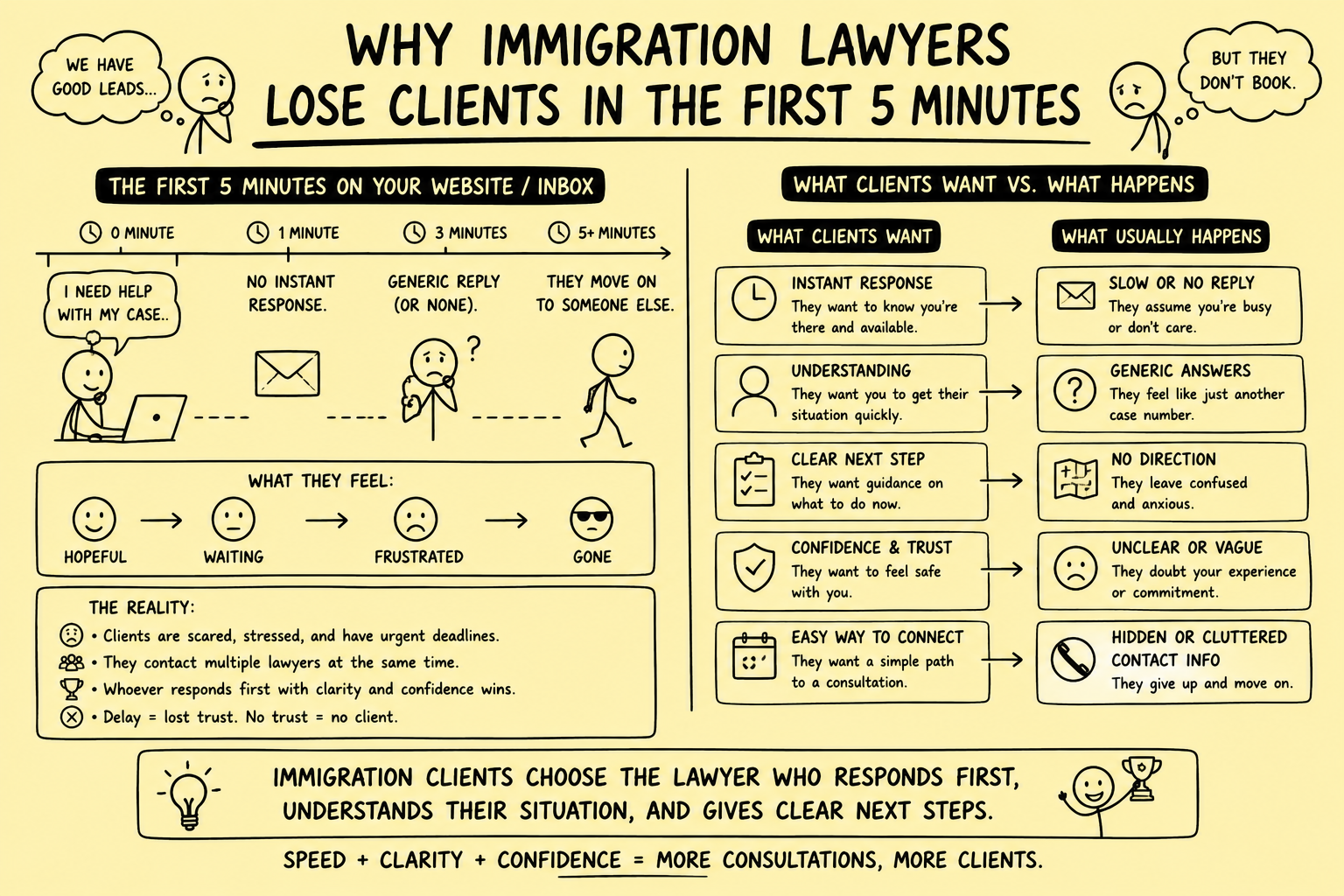
When someone submits an inquiry to an immigration law firm, they are rarely in a relaxed state of mind. They may have just received a notice from USCIS. Their work visa may be expiring in weeks. Their spouse may be facing removal. In almost every immigration case, there is an urgency underneath the inquiry that most law firms never see — because they take too long to respond.
The result: the lead contacts three or four firms in quick succession and signs with whoever calls back first.
This is not speculation. It is the documented behaviour of legal consumers across every practice area — and in immigration law, the stakes and urgency are higher than almost anywhere else.
This post explains why immigration law firms are especially vulnerable to slow lead response, what it costs them in revenue, and exactly how to fix it with a speed to lead system.
Who This Guide Is For
This guide is written for two types of immigration practice:
Type 1: You have more leads than you can handle. Your website generates enquiries, your referral network is active, and you're getting a steady flow of new enquiries every week — but your team is stretched thin, response times are creeping up, and you know cases are slipping through. The problem isn't lead volume. It's lead handling.
Type 2: You don't have a steady flow of leads. Your intake is inconsistent — some weeks are busy, others are quiet, and you can never predict where the next client is coming from. You're spending money on a website and maybe some ads, but nothing has produced a reliable pipeline. The problem isn't your legal work. It's the system feeding you new clients.
Both problems are solved by the same infrastructure: a fast, systematic, automated front end to your client acquisition process. The difference is that Type 1 firms use it to handle more volume without breaking down, and Type 2 firms use it to make the most of every single enquiry that comes in — because wasting a hard-won lead is especially painful when they're scarce.
What "Speed to Lead" Means in an Immigration Context
Speed to lead is a sales concept that describes how quickly a business responds to an inbound inquiry. In most industries, the research shows that responding within 5 minutes produces dramatically better conversion rates than responding in 30 minutes, an hour, or a day.
In immigration law, the dynamic is intensified by three factors:
1. Emotional urgency. An immigration inquiry is rarely casual research. The person submitting it is often frightened, confused, and actively shopping for help. That emotional state drives fast decision-making. They are not going to wait 48 hours for a callback while their deportation hearing approaches.
2. Simultaneous multi-firm contact. Legal research from multiple sources shows that most legal consumers contact more than one attorney before hiring. In immigration, where referrals are common and Google searches surface dozens of firms, submitting inquiries to three or four practices is standard behaviour. Whoever responds first has an enormous first-mover advantage.
3. High lifetime value. Immigration cases are rarely one-time matters. A family that comes to you for a spousal visa may need green card petitions, naturalization, work authorisation renewals, and children's cases over the following decade. The lifetime value of an immigration client can be £15,000–£60,000 or more. The cost of losing that client because you called back two days late is catastrophic.
The Average Response Time at Immigration Law Firms
The data on law firm response times is consistently alarming.
Studies of legal service response times have found:
- The average law firm takes 2–3 business days to respond to an online inquiry
- More than 40% of law firm inquiries never receive a response at all
- Only 26% of law firms respond within one hour
- Among firms that do respond, the first response is often a generic auto-reply that provides no value and generates no momentum
In immigration law specifically — a practice area where many firms rely heavily on word-of-mouth referrals and where the culture of "clients will wait" has been the norm for decades — these numbers are likely worse.
Meanwhile, the research on what happens when you wait is unambiguous: responding within 5 minutes makes a prospect 21 times more likely to qualify than responding in 30 minutes (InsideSales Research). By the time most immigration firms pick up the phone, the case has already been decided — by someone else.
What Happens During the Window You Are Not Responding
Here is a realistic timeline of what a person does after submitting an immigration inquiry at 9:47am on a Tuesday:
9:47am — Submits form to Firm A (your firm). Gets an automated "we'll be in touch" email.
9:48am — Searches Google for "immigration lawyer near me." Submits a form to Firm B.
9:52am — Calls Firm C directly from the search results. Gets voicemail.
9:55am — Calls Firm B. Reaches a receptionist who takes a message.
10:01am — Receives a call from Firm D, which she found on Avvo. Has a 12-minute conversation with an attorney who outlines exactly what she needs and offers to schedule a consultation.
10:18am — Firm D sends a follow-up email with a consultation link. She books the 3pm slot.
11:30am — Your firm's intake coordinator sees the form submission and calls. Gets voicemail.
2:00pm — Your firm calls again. She picks up, explains she has already spoken to another firm, and politely declines.
This scenario plays out thousands of times per day across immigration law in the UK, US, Canada, and Australia. Firms that have built a fast, systematic response infrastructure capture cases. Firms that rely on manual follow-up lose them.
Why Most Immigration Law Firms Are Slow
Immigration practices are not slow because attorneys don't care. They're slow because the infrastructure was never built to be fast. The most common reasons:
Reliance on shared inboxes. Inquiries come into a general contact form or email address. Someone has to notice the email, decide it's real, find the right person to assign it to, and then that person has to find time to call. Each handoff costs minutes or hours.
No after-hours coverage. Most immigration inquiries happen outside business hours — in the evenings and on weekends, when people are home from work and finally have time to deal with their visa situation. Firms with no after-hours system respond the following business day. By then, the window is closed.
No differentiated urgency protocol. A form submission from someone whose deportation hearing is in 10 days is treated the same as a general inquiry about a future work visa. Without an urgency triage system, everything gets the same slow response.
Intake is handled by the attorney. In smaller immigration practices, the attorney does intake themselves. When they are in court, in client meetings, or drafting documents — which is most of the day — inquiries go unanswered.
The Revenue Cost of Slow Response
Let's make this concrete for a mid-size immigration law firm.
Assumptions:
- 200 inbound inquiries per month (website forms, calls, referrals)
- Current conversion rate: 15% (30 retained clients per month)
- Average case value: £2,500
- Monthly revenue from new intake: £75,000
What happens if you improve conversion rate to 25% by implementing speed to lead?
- New retained clients per month: 50 (up from 30)
- Additional monthly revenue: £50,000
- Annual revenue increase: £600,000
That 10-percentage-point improvement in conversion rate — achievable entirely through faster response, before you change your pricing, your marketing, or your quality of service — represents a transformation in firm economics.
And the 25% conversion rate is conservative. Firms that implement structured speed to lead systems, with sub-5-minute response times and personalised follow-up, commonly report conversion rates of 30–40% from qualified inquiries.
The Five-Minute Response System for Immigration Firms
The goal is to respond — with substance, not just an auto-reply — within five minutes of any inquiry, 24 hours a day, seven days a week, including bank holidays and weekends.
This requires three components:
Component 1: Instant Acknowledgement With Triage
The moment a form is submitted or a call comes in, the prospect should receive:
- A personalised acknowledgement that names what they enquired about
- A brief explanation of what happens next and when
- An option to self-schedule a consultation immediately
This can be automated. Tools like n8n, Zapier, or HubSpot Workflows can trigger a personalised SMS and email the moment a form is submitted, regardless of what time it is.
The personalisation matters. "Thanks for reaching out about your spousal visa situation — a member of our team will call within 15 minutes" performs dramatically better than "Thank you for contacting us. We'll be in touch soon."
Component 2: Live or Near-Live Human Follow-Up
For high-value or urgent inquiries (which most immigration inquiries are), automation handles the first touch. A human needs to follow up within 15–30 minutes.
For firms that cannot staff this internally, options include:
- A trained virtual receptionist service (Ruby Receptionists, Clio's intake integrations, Smith.ai) that handles initial intake calls on behalf of the firm
- An offshore legal intake team operating across time zones to cover out-of-hours windows
- A structured rota among current staff for same-day response
Component 3: Consultation Booking Automation
Once a prospect has been contacted, the goal is to get them on the calendar as fast as possible. Delays between first contact and consultation booking are another conversion killer.
A direct booking link — using Calendly, Acuity, or your practice management software's scheduling module — should be embedded in the first response. Prospects who self-schedule are significantly more likely to show up and retain than those waiting for a callback to arrange a time.
The Immigration-Specific Context That Makes This Even More Important
Beyond the general speed to lead research, immigration law has specific dynamics that amplify the value of fast response:
Visa deadline urgency. Many inquiries involve an approaching deadline — a visa expiry, an appeal window, a work authorisation end date. For these prospects, a firm that responds in 5 minutes versus 48 hours is not just more convenient; it may be the difference between a viable case and a missed deadline.
Language barriers. Many immigration clients are not native English speakers. They may be more comfortable contacting multiple firms to find one that responds clearly and confidently. A fast, clear, personalised first response signals competence and builds immediate trust.
Referral behaviour. Immigration communities are tight-knit. Word travels fast when a firm is responsive and easy to work with. The reputation effects of systematically good intake extend well beyond the individual lead.
Fear as a decision accelerator. A person who is afraid — of deportation, of being separated from family, of losing their right to work — makes decisions quickly. Fear compresses the buying timeline. A firm that meets that urgency is aligned with the prospect's emotional state. A firm that sends a three-day reply is not.
Getting Started: The Minimum Viable Speed to Lead System
You do not need to rebuild your entire intake infrastructure to start capturing more cases from the leads you are already generating.
A minimum viable system for an immigration law firm looks like this:
- Set up an automated first-response sequence. Connect your contact form to an email/SMS automation (HubSpot, Mailchimp, or a native practice management tool like Clio Grow or Lawmatics). Send a personalised acknowledgement within 60 seconds of submission.
- Add a direct booking link to every first response. Embed a Calendly or Acuity link in the automatic email. Let prospects self-schedule a 20-minute consultation.
- Create an urgency routing rule. If someone mentions specific keywords (deportation, removal, visa expiry, court date, emergency), route their inquiry to a high-priority queue and send an SMS to the duty intake person.
- Track your response time. You cannot improve what you do not measure. Add a timestamp to every inquiry and measure how long it takes to reach first human contact. Set a target of under 15 minutes during business hours and under 60 minutes outside them.
- Review weekly. Look at how many inquiries came in, how many were contacted within your target window, and how many converted. Use this data to tighten the system.
The Firms That Win in Immigration Are the Ones That Show Up First
In a competitive immigration market — and most urban markets are extremely competitive — quality of legal work is only one dimension of competition. The firms that grow fastest are almost always the ones that have systematised the front end of the client acquisition process.
Speed to lead is not about rushing. It is about showing up for prospects at the moment they are most ready to make a decision. In immigration law, that moment is when they submit the form, not two days later when someone finally gets around to calling.
Building the system to be there in that moment is one of the highest-leverage investments an immigration practice can make.
If your firm has more leads than it can handle: the system above stops cases from falling through the cracks, lets your attorneys focus on legal work instead of playing phone tag, and turns your existing lead volume into significantly more retained clients — without adding headcount.
If your firm doesn't have a steady flow of leads: the system above ensures that every single enquiry you do generate — from your website, Google ads, referrals, or directories — is handled so well that your conversion rate doubles or triples. You can't afford to lose a single lead when volume is low. Speed to lead is your highest-leverage investment until the pipeline is fuller.
If you want to see exactly how to build this kind of intake automation for your immigration practice — including the specific tools, workflows, and scripts that work for both high-volume and growth-stage firms — get in touch with Systemify Automation. We build these systems for professional service firms and can have yours running within two weeks.
Brokerage data stays governed. Material deal decisions stay human.
We design business broker systems around least-privilege access, documented data flows, protected credentials, traceable activity, and approval gates. Systemify does not use client information to train its own models. When a workflow uses an external AI provider, its purpose, data fields, and retention approach are documented and approved before client data is transferred.
Looking for business-broker systems?
Our current work focuses on helping business brokers build stronger buyer and seller pipelines and more controlled deal operations.
Talk to a Broker Systems Expert