
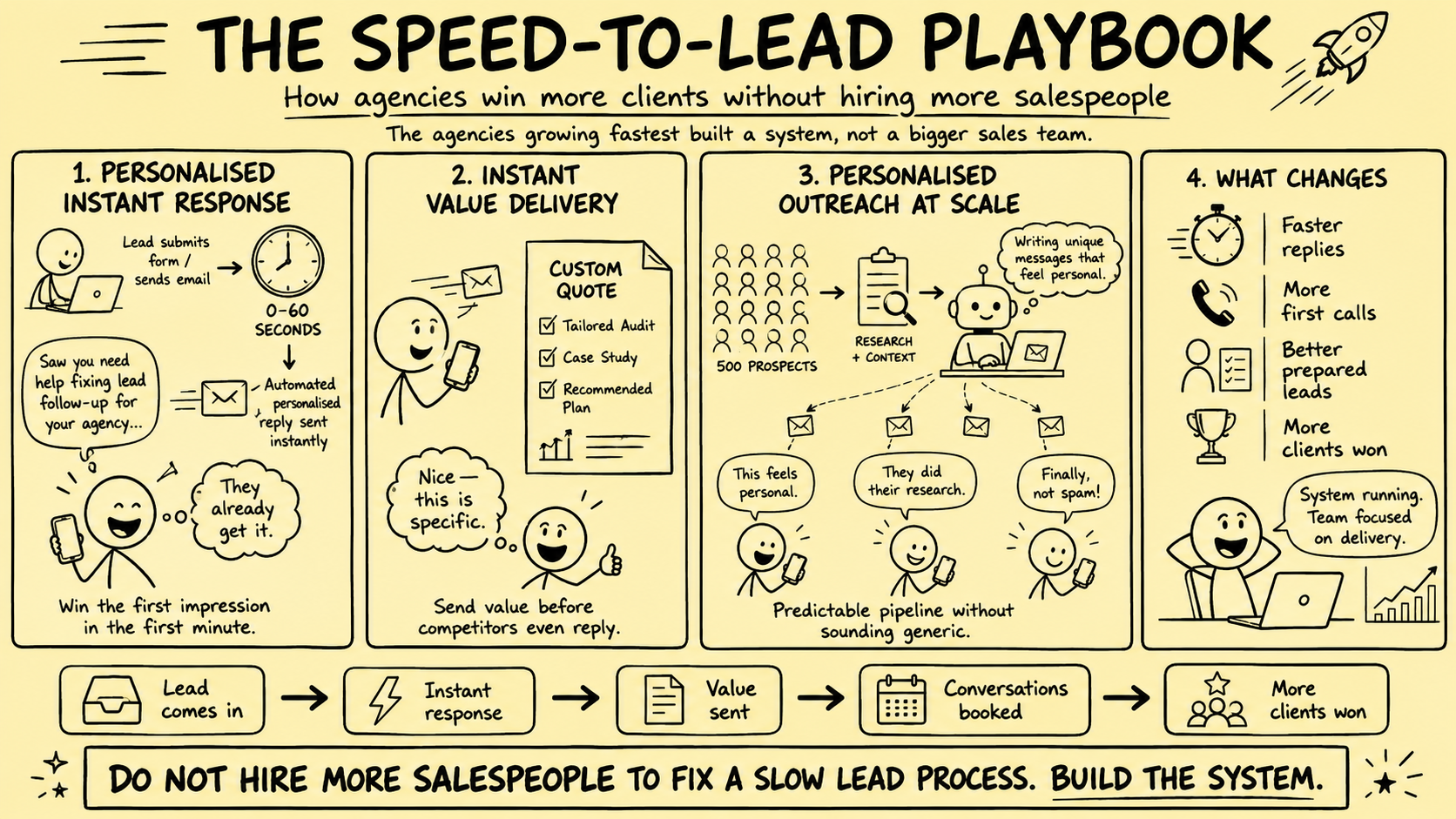
The agencies winning more clients right now are not better at their craft than you.
They have not cracked some new pitch technique. They are not cheaper. They have not hired a world-class sales team.
They have built a system that makes every lead feel like the most important one — before the first call, before the proposal, before any competitor has even replied.
This is that system. The full playbook.
The Problem With How Most Agencies Handle Leads
Most agencies have a lead handling problem they do not realise they have.
It looks like this: someone submits a form or sends an email. They get a generic acknowledgement, or nothing until a team member sees it. Eventually someone reaches out — hours or days later — with a personalised message. By then, two competitors have already had a conversation with this prospect.
The agency with the better work loses because another agency responded faster and better.
This is not a sales problem. It is a systems problem. And it has a systems solution.
The Three-Part Speed-to-Lead System
There are three components to a complete speed-to-lead system for agencies. They work independently, but they work best together.
Part 1: Personalised Instant Response
The moment a lead contacts you — through any channel — they receive a response that feels personally written for them.
Not a generic "thanks for reaching out." A message that references what they said, their business, their specific situation. Something that makes them think: these people already understand my problem.
This is the single highest-impact change most agencies can make. The response does not need to close the deal — it needs to make the lead feel like they contacted the right business. That impression, set in the first minute, shapes every subsequent interaction.
The key elements of a personalised instant response:
Specific reference to what they submitted Not "we received your enquiry" — but "saw you are scaling the retainer side of your agency and need help with lead follow-up for the sales team." One specific sentence shows you read what they wrote.
A relevant next step, not a generic one "A member of our team will be in touch" is a generic next step. "I have put together a brief breakdown of how we typically approach this for agencies your size — attached" is a relevant one.
Immediate availability, not a waiting period The response should invite the next step and make it easy — not suggest they wait for something to happen.
Building this requires personalised lead response automation — a system that generates the personalised message automatically, the moment the lead submits, at any hour.
Part 2: Instant Value Delivery
The agencies that win most often are the ones that deliver value before the first call.
This means the lead receives something tangible — a custom quote, a personalised proposal, a tailored assessment, a relevant case study — before they have spoken to anyone. Before competitors have even replied.
When a lead walks into a first call having already received something specific to their situation, two things happen:
First, the call starts at a more advanced stage. The price conversation, the scope discussion, the credibility questions — much of this is already handled. The call is a finalisation, not a discovery.
Second, every competitor they speak to after you is being compared to someone who already showed up prepared. That is a comparison you almost always win.
The most effective forms of instant value delivery for agencies:
- Custom scope estimate built from the lead's form inputs — their goals, team size, timeline, and budget range
- Relevant case study automatically matched to their industry or use case and sent in the first response
- Personalised audit or assessment showing what you would fix or improve in their current situation, generated from publicly available information about their business
- Tailored onboarding preview showing what the first 30 days of working together would look like for their specific type of project
The infrastructure that makes this possible is instant value delivery automation — connected to your intake form and CRM, generating the relevant document automatically.
Part 3: Personalised Outreach at Scale
The first two parts cover inbound — what happens when a lead comes to you. This third part is about going to them.
Most agencies rely on referrals for the majority of their new business. Referrals are excellent clients and excellent deals — but the pipeline is unpredictable. One month you have three strong referrals. The next month you have none.
Personalised outreach at scale creates a consistent, predictable pipeline alongside referrals. It reaches your ideal clients — identified by industry, company size, role, and buying signals — with outreach that reads like it was written specifically for each one.
The mechanics of doing this at scale without sounding generic are covered in depth here: Personalised cold outreach at scale: reach 500 prospects without sounding like mass email.
The short version: every message needs to reference something specific about the prospect — not their name and company, but something about their actual business situation that makes the message feel individually composed. At scale, this requires a system that collects personalisation signals automatically and generates the message from them.
The infrastructure is personalised outreach at scale automation — prospecting, personalisation, sequencing, and response routing running as a connected system.
How the Three Parts Work Together
Each part of the system creates a different kind of advantage:
- Personalised instant response wins the first impression — you are the most present, most prepared business in the first interaction
- Instant value delivery wins the consideration stage — your lead has something tangible from you that competitors do not have
- Personalised outreach wins the pipeline game — you are consistently in conversations with ideal clients regardless of referral volume
Together, they mean your agency is never waiting for leads. You are attracting them, converting them faster, and closing more of them.
What Implementing This Looks Like
Building a full speed-to-lead system for an agency typically involves:
Week 1–2: Audit and planning Map the current lead flow — where leads come from, what happens to them, where they drop off. Identify the highest-impact automation to build first.
Week 3–5: Build and integrate Connect the intake forms to the response system. Build the personalisation logic. Create the document templates. Integrate with the existing CRM and email tools.
Week 6: Test and launch Run test submissions. Check response quality. Verify delivery. Go live.
Ongoing: Optimise and expand Review what is converting. Improve the personalisation. Add the next layer of automation — follow-up sequences, outreach system, long-term nurture.
Most agencies see measurable results in the first month — faster response times, higher response rates from leads, more first calls booked.
The Agencies This Is Built For
This playbook works best for agencies and service businesses that:
- Are already generating leads (inbound, referral, or both) but not converting as many as they should
- Have a strong service but lose deals to businesses that respond faster or look more prepared
- Want consistent pipeline that is not entirely dependent on referrals
- Have a team that should be focused on delivery, not chasing cold leads
If that is you, the free personalised execution plan is the right starting point. A 30-minute call, and within 48 hours you have a full map of your lead flow, the specific automations relevant to your business, and a clear picture of what it costs and where to start.
Further Reading
- [Why 78% of deals go to whoever responds first and makes it personal](/blog/why-78-percent-of-deals-go-to-whoever-responds-first-and-makes-it-personal)
- [How to send a custom quote before the first call — automatically](/blog/how-to-send-a-custom-quote-before-the-first-call-automatically)
- [Personalised cold outreach at scale](/blog/personalised-cold-outreach-at-scale-reach-500-prospects-without-sounding-generic)
- [The 3 follow-up automations that stop deals from going cold](/blog/3-follow-up-automations-that-stop-deals-from-going-cold)
Brokerage data stays governed. Material deal decisions stay human.
We design business broker systems around least-privilege access, documented data flows, protected credentials, traceable activity, and approval gates. Systemify does not use client information to train its own models. When a workflow uses an external AI provider, its purpose, data fields, and retention approach are documented and approved before client data is transferred.
Looking for business-broker systems?
Our current work focuses on helping business brokers build stronger buyer and seller pipelines and more controlled deal operations.
Talk to a Broker Systems Expert