
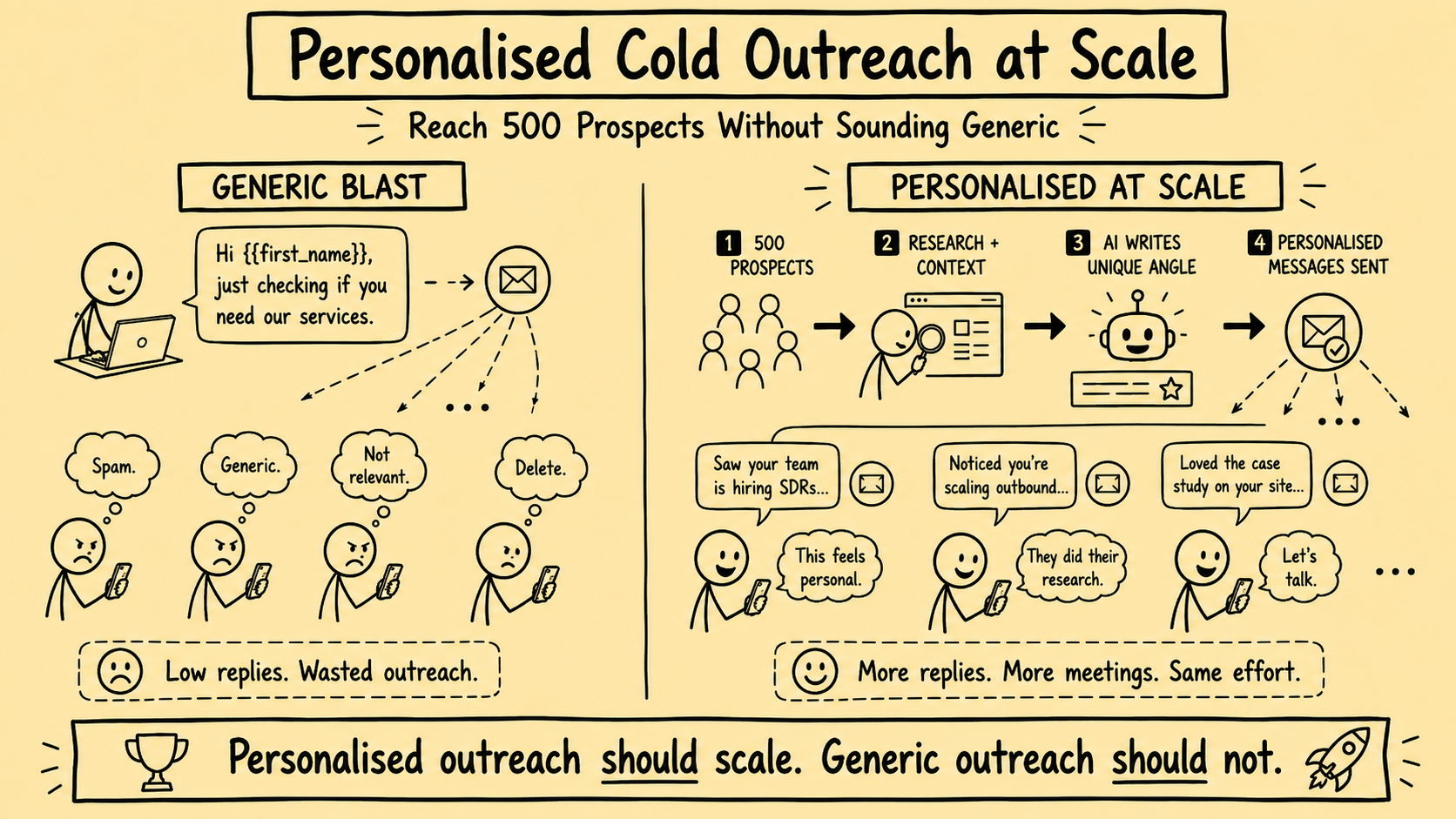
An arbitrary outreach target—500 prospects, 5,000 emails, or any other round number—is not a strategy. It says nothing about whether the businesses fit the brokerage, whether the contact data may be used, whether the message is accurate, whether the channel permits the activity, or whether the team can handle replies responsibly.
For a business broker, poor outreach creates more than a deliverability problem. It can damage trust with owners, expose confidential assumptions, contact excluded parties, duplicate relationship activity, or create demand the team cannot qualify and serve.
Direct answer: Build seller outreach around eligible audiences, traceable data, approved channels, accurate messages, human review, suppression, response ownership, and measured learning. Volume is an output of those controls—not the objective.
This article provides an operating framework, not legal advice. Commercial-email, privacy, telemarketing, data-broker, professional, and platform rules vary by jurisdiction, recipient, channel, and use. Have qualified counsel review the actual program before launch.
Why the “500 prospects” framing was removed
This article previously promised personalized outreach to hundreds of prospects and suggested predictable warm-conversation outcomes without a source, tested population, or operating context. It also described automated LinkedIn research and messaging without addressing platform restrictions.
Those claims were removed because a fixed send count does not establish quality or results. The same number can represent a carefully reviewed list in one market and an indiscriminate, high-risk campaign in another.
There is no responsible universal answer to “how many should we send?” until the brokerage knows:
- Which owner and business profiles it is qualified to serve
- Where the contact data came from and what use is permitted
- Which countries, states, and recipient types are involved
- Which channel and platform rules apply
- Which relationships, competitors, clients, and opt-outs must be excluded
- How much human review and reply-handling capacity exists
- What delivery, complaint, qualification, and engagement data shows
Start with an outreach policy
Before building a list or sequence, document the rules the system must enforce.
| Policy area | Decision to document | Evidence to retain |
|---|---|---|
| Audience | Business, geography, size, sector, ownership, and exclusion criteria | Approved target definition and version history |
| Data source | Permitted providers, first-party records, referrals, and public sources | Source, collection date, license or terms, and field provenance |
| Lawful channel | Email, phone, post, platform, or referral rules by market | Counsel-approved channel matrix |
| Suppression | Opt-outs, prior objections, clients, conflicts, competitors, and sensitive cases | Central suppression record and enforcement tests |
| Message | Permitted claims, prohibited assumptions, sender identity, and disclosures | Approved template, variables, and review record |
| Human approval | Who approves the audience, message, exceptions, and release | Named owners and approval log |
| Response handling | Ownership, qualification, escalation, and response targets | Routing matrix and exception queue |
| Retention | How long research, drafts, contact data, and events remain | Retention and deletion schedule |
The policy should distinguish prospect research from a decision to contact. Finding a public fact does not automatically establish that the brokerage may collect it, enrich it, store it, infer from it, or use it in marketing.
Apply the rules for each jurisdiction and channel
United States commercial email
The Federal Trade Commission’s CAN-SPAM guide says the Act covers commercial messages and makes no exception for business-to-business email. Its guidance addresses accurate routing information and subject lines, advertisement identification, postal address, opt-out mechanisms, timely honoring of opt-outs, and responsibility for vendors sending on a company’s behalf.
CAN-SPAM is not a complete outreach policy. State law, privacy rules, telemarketing requirements, professional obligations, contractual restrictions, and the characteristics of the data or recipient may add further requirements.
United Kingdom electronic marketing
The UK Information Commissioner’s Office guidance explains how PECR and data-protection rules apply to electronic-mail marketing. Requirements can differ based on whether the recipient is an individual subscriber or corporate subscriber, how data was obtained, and whether an exception applies.
Do not convert a rule for one recipient type into a global permission. Record the market, entity type, data source, and approved basis at the contact level when necessary.
Gmail delivery requirements
Google’s email sender guidelines cover authentication, DNS, transport security, message formatting, spam-rate management, and additional controls for higher-volume senders. These requirements can change, so the sending team should review the current first-party page rather than copy a static checklist indefinitely.
Authentication supports trust and delivery; it does not make an unwanted or unlawful message acceptable.
LinkedIn data and automation
LinkedIn’s prohibited-software guidance says it does not permit third-party tools that scrape its service or automate activity such as sending messages. A workflow should not quietly depend on prohibited scraping, fake accounts, or unauthorized messaging automation.
Use approved platform features or properly licensed data sources, and confirm that the intended collection and use comply with the applicable terms and law.
Define a seller profile that can be reviewed
“Business owners who may want to sell” is too broad. Create criteria that an authorized person can inspect, such as:
- Sector and business model
- Geography and transaction market
- Approximate size range, using reliable and permitted fields
- Ownership and operating signals relevant to the brokerage’s mandate
- Clear exclusions and conflict rules
- Minimum data confidence
- Evidence recency
Avoid inferring highly sensitive facts or presenting an estimate as confirmed. A model-generated guess about revenue, owner age, health, succession pressure, financial distress, or willingness to sell can be inaccurate and harmful.
Each record should show why it entered the audience, which facts support that decision, where those facts came from, and who approved contact.
Use personalization as a relevance check
Personalization should demonstrate legitimate relevance, not surveillance.
Useful context may include a permitted, verifiable fact about the business, sector, geography, ownership announcement, service fit, or prior interaction. The message should still make sense if the recipient asks where the information came from.
Reject drafts that:
- Invent facts or praise
- Reveal sensitive or confidential information
- Mention personal circumstances without a justified reason
- Imply knowledge the brokerage does not possess
- Claim a valuation, buyer match, or transaction outcome
- Hide the commercial purpose
- Create false urgency
- Use a person or company name misleadingly
AI can organize approved facts and prepare a draft. It cannot determine that a message is lawful, appropriate, accurate, or relationship-safe without the required human review.
Design the workflow with approval and suppression
A controlled seller-outreach workflow can follow this sequence:
- Import only approved sources and preserve field-level provenance.
- Deduplicate against CRM, active mandates, buyers, partners, prior campaigns, and suppression records.
- Apply documented eligibility and exclusion rules.
- Send uncertain records to a human research queue.
- Prepare a factual context summary and message draft.
- Run automated checks for missing source data, blocked claims, sensitive inferences, and required disclosures.
- Require an authorized person to approve the audience and release batch.
- Send within the permitted channel and infrastructure limits.
- Stop sequences immediately for replies, objections, opt-outs, bounces, complaints, or relationship conflicts.
- Route responses to a named owner with the source, message history, and next-step rules.
Suppression must be centralized. An opt-out recorded in one campaign should not be bypassed because another tool, mailbox, domain, contractor, or list is used later.
Launch by capacity, not by a vanity number
Start with a reviewable cohort. The right size is the number the team can verify, approve, monitor, and answer without losing control.
Before expanding, confirm:
- The source and eligibility data is sufficiently complete
- Exclusions and suppression work across every tool
- The messages remain accurate after variable insertion
- Authentication and delivery signals are healthy
- Replies reach accountable people
- Opt-outs and objections stop future contact
- Positive replies are qualified consistently
- The team can handle demand without delayed or generic follow-up
Expand only when the evidence supports it. A smaller qualified audience with disciplined follow-up may be more valuable than a much larger list that creates complaints, poor data, and false pipeline.
Measure the whole operating system
Send count and open rate are not enough. Track:
| Measure | What it reveals |
|---|---|
| Eligible records | Whether the audience actually fits the approved profile |
| Provenance completeness | Whether the team can explain where contact data and claims came from |
| Suppression removals | Whether exclusions are preventing inappropriate contact |
| Delivery and bounce | Data and infrastructure quality |
| Opt-outs and complaints | Relevance, permission, frequency, and brand risk |
| Positive and negative replies | Message fit and objections |
| Qualified seller conversations | Whether replies match the brokerage’s service criteria |
| Accepted engagements | Whether conversations progress after professional review |
| Owner response time | Whether the brokerage can serve the pipeline it creates |
| Incorrect-contact events | Whether routing, data, or identity controls failed |
Do not claim that outreach caused a signed engagement or transaction unless the attribution method can support that conclusion. Market timing, referrals, brand familiarity, prior relationships, service quality, and other channels may contribute.
The practical conclusion
The best seller-outreach system is not the one that sends to the largest list. It is the one the brokerage can explain, control, measure, and improve without sacrificing trust.
Define the eligible audience. Verify the source rights and channel rules. Keep suppression centralized. Let AI prepare—not decide. Require human approval. Measure qualified progression and negative signals together.
To apply this framework, review broker growth and pipeline operations or request a Business Broker Pipeline & Operations Assessment.
Frequently Asked Questions
How many seller prospects should a business broker contact?
There is no universal number. Volume should follow the size and quality of the eligible audience, the lawful channel basis, team review capacity, sender health, response handling, and measured results—not an arbitrary target such as 500 contacts.
Does CAN-SPAM apply to business-to-business email?
The U.S. Federal Trade Commission states that CAN-SPAM makes no exception for business-to-business commercial email. Other federal, state, national, sector, and platform rules may also apply, so the brokerage should obtain appropriate legal advice for its markets.
Can a brokerage scrape LinkedIn to personalize outreach?
LinkedIn states that unauthorized scraping and automated messaging tools are prohibited. Use approved access methods and verify the source rights, platform terms, and legal basis for any prospect data before collection or use.
Can AI write and send seller outreach automatically?
AI can prepare drafts from approved data, rules, and templates. An authorized person should review audiences, factual claims, sensitive context, exclusions, and messages before release, especially where confidentiality or a potential transaction is involved.
What should a brokerage measure besides reply rate?
Measure eligible records, source provenance, delivery, opt-outs, complaints, positive and negative replies, qualification, accepted seller conversations, signed engagements, owner workload, and suppression failures. Do not attribute transactions to outreach without defensible evidence.
Sources and evidence notes
Primary or first-party materials reviewed for this article. Scope and limitations are stated rather than silently generalized.
- CAN-SPAM Act: A Compliance Guide for BusinessU.S. Federal Trade Commission · Accessed
Official U.S. guidance explaining that commercial-email requirements also apply to business-to-business email and that senders retain responsibility for vendors acting for them.
- Guidance on direct marketing using electronic mailUK Information Commissioner’s Office · Published · Accessed
Current UK regulatory guidance on PECR electronic-mail marketing; legal requirements depend on recipient type, circumstances, data use, and jurisdiction.
- Email sender guidelinesGoogle Gmail Help · Accessed
Current first-party sender requirements and guidance covering authentication, infrastructure, message format, spam rates, and higher-volume sender controls.
- Prohibited software and extensionsLinkedIn Help · Accessed
LinkedIn’s first-party statement prohibiting unauthorized scraping and automated activity, including automated messages.
Brokerage data stays governed. Material deal decisions stay human.
We design business broker systems around least-privilege access, documented data flows, protected credentials, traceable activity, and approval gates. Systemify does not use client information to train its own models. When a workflow uses an external AI provider, its purpose, data fields, and retention approach are documented and approved before client data is transferred.
Apply this to your brokerage
We can assess your buyer and seller pipeline, valuation and vetting workflows, communications, documents, controls, and handoffs before recommending what to build.
Talk to a Broker Systems Expert