
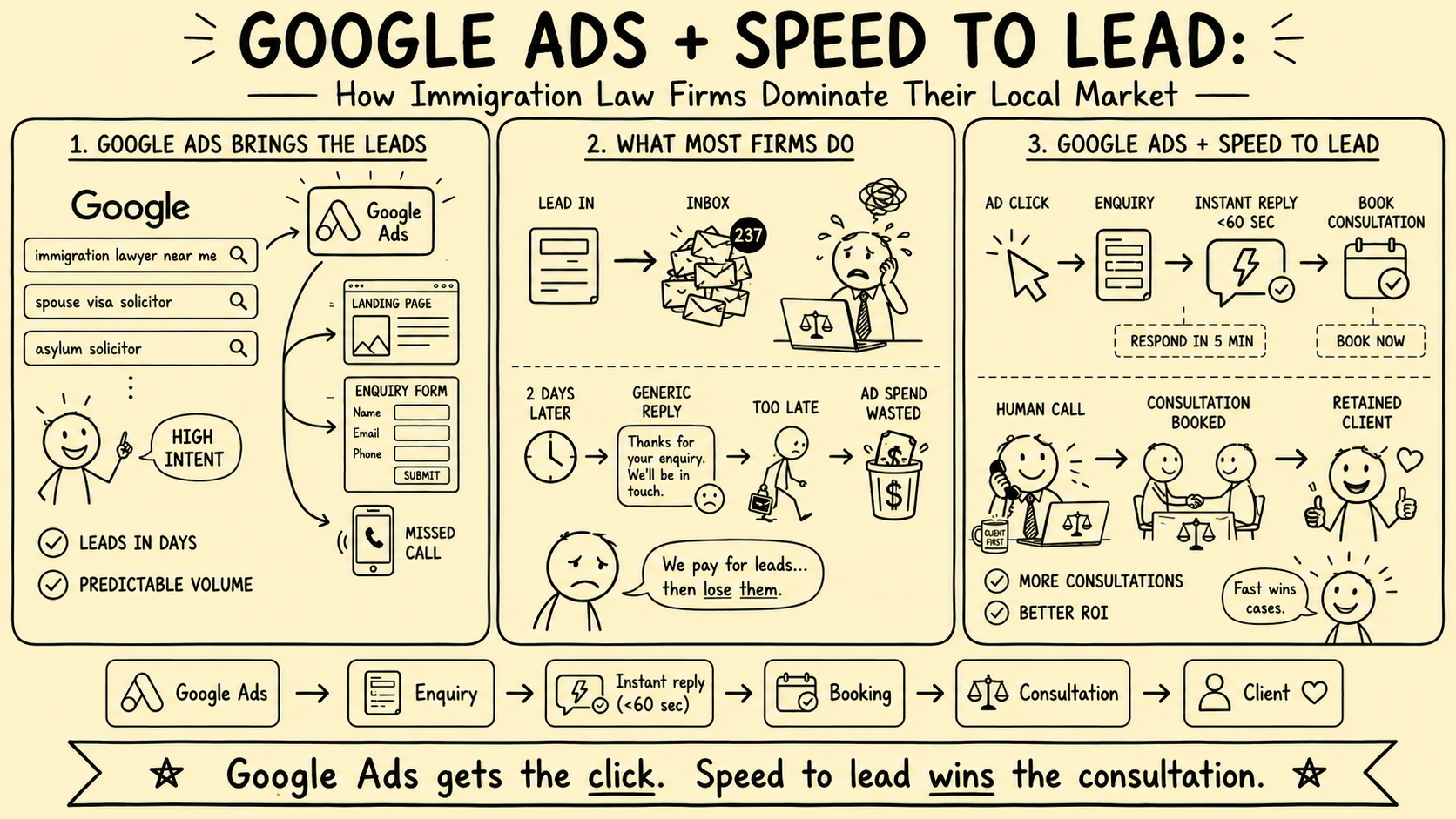
Google Ads is the fastest way to generate immigration law enquiries. Within days of launching a campaign, you can have high-intent prospects arriving on your website — people who have typed "immigration lawyer near me" or "spouse visa solicitor" into Google because they are ready to hire.
But there is a significant gap between generating those enquiries and converting them into retained clients. And most immigration firms fall into one of two traps:
Trap 1 (Pipeline-building firms): They try Google Ads, generate some leads, convert poorly, decide the ROI is bad, and switch it off. The problem was never the ads — it was that the intake system wasn't built to convert paid traffic.
Trap 2 (Busy firms): They get enquiries from all sources — Ads, referrals, organic — but the volume creates chaos. Paid leads sit in an inbox alongside everything else, get contacted two days late, and disappear. The Ads are generating leads, but the conversion system is leaking them.
Both problems are solved by the same solution: Google Ads built and targeted correctly, connected to a speed to lead intake system that converts enquiries within 5 minutes.
This guide covers both sides.
Why Google Ads Works Particularly Well for Immigration Law
High-Intent Audiences
Immigration law searches signal intent in a way that almost no other legal query does. Someone searching "asylum solicitor Manchester" is not wondering if they need legal help — they need it. The urgency is built into the search.
This is different from, say, searching "do I need a will." Immigration searches are rarely informational. They are operational: "I need someone, I need them now, help me find them."
High-intent traffic converts at significantly higher rates than display advertising or social traffic, which means your cost-per-client via Google Ads can be lower than most paid channels even if the cost-per-click is higher.
Predictable, Scalable Volume
Unlike referrals — which are wonderful but unpredictable — Google Ads delivers a volume of leads that is approximately proportional to budget. If your campaign is well-built, spending £1,000/month will deliver roughly twice the lead volume of £500/month. This predictability makes it the best channel for firms that want to control their growth trajectory.
For firms building their pipeline from scratch, this scalability is crucial: you can start small (£500–£800/month is a viable starting budget for most UK markets), prove the economics, and scale from there.
Speed Advantage
Most immigration firms are not running Google Ads or are running them poorly. In many cities, the paid search landscape for immigration law is surprisingly thin. The firms that invest in well-structured campaigns — the right keywords, dedicated landing pages, strong calls to action — often dominate because the competition simply isn't there.
Building a Google Ads Campaign That Actually Converts
Step 1: Campaign Structure
Run separate ad groups for each major service/visa type you offer:
- Spouse visa / partner visa
- Skilled Worker visa / work permit
- Asylum / refugee status
- Indefinite Leave to Remain
- Naturalisation / citizenship
- Student visa
Each ad group targets a distinct set of keywords and links to a dedicated landing page for that service. Do not send all traffic to your homepage — conversion rates drop dramatically when a prospect searching "spouse visa solicitor" lands on a generic "We Do All Immigration" homepage.
Step 2: Keyword Targeting
For each ad group, build your keyword list around three tiers:
Tier 1: High intent (exact and phrase match)
- "[visa type] solicitor [city]"
- "[visa type] lawyer near me"
- "help with [visa type]"
- "[visa type] refused — what to do"
Tier 2: Problem-aware (phrase match)
- "how to apply for [visa type]"
- "[visa type] application taking long"
- "visa refusal appeal"
Tier 3: Competitor brand (if appropriate)
- Competitor firm names (controversial but legal; can capture prospects who are still deciding)
Add negative keywords aggressively to avoid wasting budget on irrelevant searches: "DIY," "free," "how to apply myself," etc.
Step 3: Ad Copy
For immigration law, the ads that convert best are ones that:
- Acknowledge the specific situation (not generic "expert immigration lawyers" claims)
- Establish credibility (years of experience, success rate, accreditations)
- Reduce anxiety ("Free consultation," "We handle appeals and refusals," "Help available today")
- Create urgency where genuine ("Facing a deadline? Call today")
Example high-performing ad headline structure:
- Headline 1: Facing a [visa type] Issue?
- Headline 2: Speak to an Immigration Solicitor Today
- Headline 3: Free Initial Consultation — Call Now
Step 4: The Dedicated Landing Page
Each ad group's landing page must:
- Headline that mirrors the search query (if someone searched "spouse visa solicitor," the page headline should say "Spouse Visa Solicitors — [Firm Name]")
- One clear call to action (book a consultation or call now — not both, not three)
- A contact form visible above the fold
- Trust signals: accreditation badges, review scores, case outcome stats
- A response promise: "We respond within 1 hour" or "Speak to a solicitor today"
The response promise is critical. It differentiates your firm from every other firm running Google Ads — and it creates the expectation of speed that your intake automation delivers.
Connecting Google Ads to Your Speed to Lead System
This is where most firms break down. They build decent ads and a decent landing page — but the enquiry goes into a general inbox and gets followed up the next day. The prospect who searched with urgency, landed on your page, and filled out your form has already moved on.
The 5-Minute Promise Has to Be Real
If your landing page says "we respond within 1 hour" (or ideally "within 5 minutes"), you need an automated system to back it up — not a human checking an inbox.
Connect your landing page form to your CRM. Every form submission should create a new contact in your CRM immediately and trigger the automated first-response sequence (SMS + email with booking link within 60 seconds).
Enable call forwarding for paid traffic. Use a unique phone number on your Google Ads landing pages (call tracking numbers via CallRail or similar). This lets you track exactly which calls came from Ads and ensures paid leads are routed to an available person rather than a general voicemail.
Set up lead form extensions. Google Ads offers native lead form extensions — a form that opens directly on the Google results page without the prospect needing to visit your site. These leads should be automatically synced to your CRM via API or Zapier and trigger the same first-response automation.
The ROI Math
For firms unsure whether Google Ads is worth it given the cost-per-click, here is the math that changes the calculation:
Assumptions (typical UK market):
- Average cost-per-click: £12
- Clicks needed to generate one enquiry: 8 (conversion rate from click to form: ~12%)
- Cost per enquiry: ~£96
- Conversion rate from enquiry to retained client (without speed to lead system): 15%
- Cost per retained client (without automation): £640
- Average case value: £2,500
- ROI: 3.9x
The same numbers with a speed to lead system improving conversion rate to 35%:
- Cost per retained client (with automation): £274
- ROI: 9.1x
The speed to lead system more than doubles the ROI of your Google Ads investment — not by improving the ads, but by improving what happens after the click.
For Firms Already Generating Leads: Diagnosing Where They're Leaking
If your firm is already running Google Ads and the ROI feels disappointing, the problem is almost certainly at the intake stage, not the ad stage. Before adjusting bids or rewriting ad copy, check:
Response time: How long does your team take to respond to paid enquiries, on average? If it's more than 30 minutes, that's your primary problem.
No-response rate: What percentage of paid enquiries receive no call at all? Track this in your CRM for two weeks. The answer often surprises firms — and explains the conversion shortfall.
After-hours coverage: What percentage of your paid enquiries arrive outside business hours? Check your form submission timestamps. If 40% arrive in evenings and weekends and you have no after-hours automation, you're wasting 40% of your ad spend.
Landing page specificity: If all your ads go to your homepage, your landing page conversion rate is almost certainly under 5%. Dedicated landing pages for each service type typically convert at 10–20%.
The Combination That Wins
Immigration law firms that dominate their local market consistently do the same two things:
- Invest in Google Ads — consistently, at a budget that produces meaningful volume, with proper campaign structure and dedicated landing pages
- Pair it with speed to lead automation — so that every lead generated by those ads is contacted within 5 minutes, 24/7, with a personalised message and a direct booking link
Neither investment fully pays off without the other. Google Ads without automation is expensive and underperforming. Automation without enough leads to process is an idle system.
The firms that have both running simultaneously experience compounding returns: better conversion from the same ad spend, which improves the ROI, which justifies more ad spend, which generates more retained clients, who generate more reviews, which improves organic rankings, which reduces the cost per lead over time.
Systemify Automation builds the intake and automation side of this system for immigration law firms. Get in touch to discuss what the right setup looks like for your practice.
Brokerage data stays governed. Material deal decisions stay human.
We design business broker systems around least-privilege access, documented data flows, protected credentials, traceable activity, and approval gates. Systemify does not use client information to train its own models. When a workflow uses an external AI provider, its purpose, data fields, and retention approach are documented and approved before client data is transferred.
Looking for business-broker systems?
Our current work focuses on helping business brokers build stronger buyer and seller pipelines and more controlled deal operations.
Talk to a Broker Systems Expert