
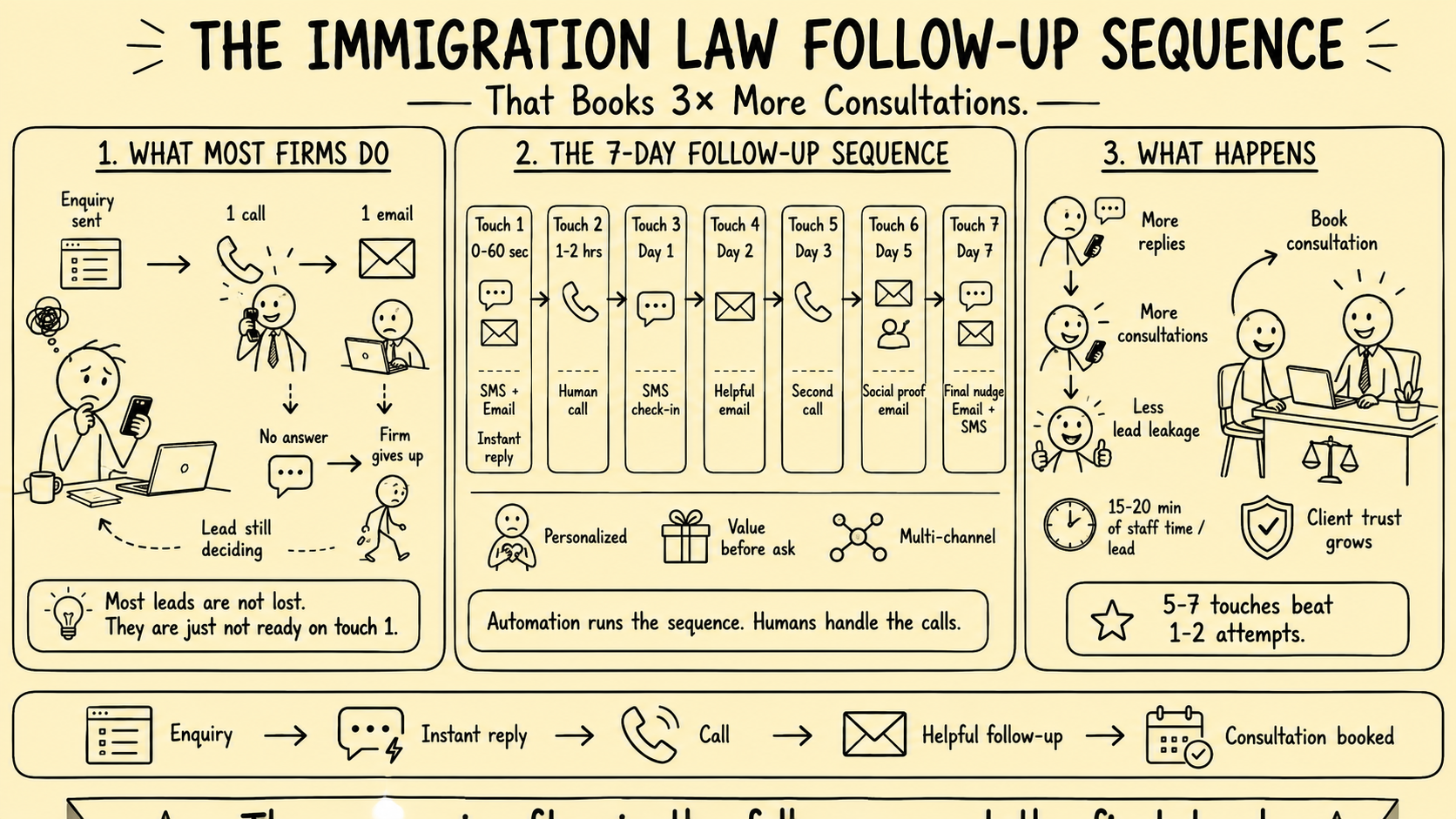
A common assumption in immigration law: if a prospect doesn't respond to your first message or callback, they've decided to go elsewhere.
This assumption costs firms a significant percentage of their potential clients every month.
The reality is that most enquiries do not convert on the first touch. The prospect may have been busy when your call came in. They may have been comparing firms before committing. They may have had a family discussion to have first. They may have been waiting for a document to arrive before moving forward.
In every one of these cases, a structured follow-up sequence — not an assumption of disqualification — is what converts the lead.
This post walks through the exact follow-up sequence that consistently books more consultations from the same number of enquiries.
Who This Guide Addresses
If your firm has more leads than it can handle: a follow-up sequence is the key to handling that volume without proportionally increasing manual effort. It runs automatically in the background while your team focuses on booked consultations — and it rescues leads that would otherwise silently drop off.
If your firm has a thin or inconsistent pipeline: a follow-up sequence is arguably your highest-leverage activity. When leads are scarce, abandoning one after a single unanswered callback is equivalent to leaving money on the floor. A structured sequence gives every lead 5–7 meaningful touches before it is treated as cold — and it does so automatically, without costing your team time.
Why Most Immigration Firms Don't Follow Up Properly
The reasons are predictable:
Time pressure. Immigration attorneys are busy people. When a lead doesn't respond immediately, they move on to clients who need help right now.
No system. Without a CRM or automation, follow-up depends entirely on individual memory and initiative. This creates wildly inconsistent results.
Discomfort with persistence. Some attorneys feel that following up more than once is pushy or unprofessional. In immigration law specifically, where clients are often in vulnerable situations, there is a cultural reluctance to "sell."
No visibility. Without lead tracking, firms don't know that they have 40 enquiries sitting in a follow-up limbo — so they don't notice the problem.
The result: the average immigration firm gives up on a lead after 1–2 attempts. Industry research shows it typically takes 5–7 touches to convert a high-consideration purchase — and immigration legal services are among the highest-consideration purchases a person can make.
The Principles Behind an Effective Follow-Up Sequence
Before presenting the sequence itself, three principles determine whether a follow-up sequence converts:
1. Personalisation at every touch. Generic follow-up ("Just checking in!") does not perform. Every message should reference what the prospect enquired about, making it clear you have their specific situation in mind — not that you're mass-messaging a list.
2. Value before ask. Alternating "please book a consultation" messages with genuinely useful information (a plain-English guide to their visa type, a FAQ about their situation) builds trust and gives the prospect a reason to engage even if they're not ready to hire.
3. Multi-channel. An email-only sequence misses prospects who respond to SMS but not email, and vice versa. The most effective sequences use both, plus a phone call, across the follow-up period.
The 7-Day Immigration Law Follow-Up Sequence
Touch 1 — Immediate (0–60 seconds): Personalised Acknowledgement
Channel: SMS + Email
SMS example:
"Hi [Name], thank you for reaching out to [Firm Name] about your [visa type] matter. We'll call you within the hour. In the meantime, you can book a free 20-minute consultation here: [Calendly link]. — [Firm Name]"
Email subject: Your Immigration Enquiry — [Firm Name]
Email body:
Hi [Name],
>
Thank you for contacting us about your [enquiry type].
>
A member of our immigration team will call you within the hour. If you'd like to book a time that works for you, you can schedule a free 20-minute consultation here: [Calendly link]
>
We know immigration situations can feel overwhelming. You're in the right hands.
>
The [Firm Name] Team
Purpose: Establish immediate presence. The prospect knows you received their enquiry and responded instantly — this alone differentiates you from competitors.
Touch 2 — 1–2 Hours After Submission: Human Phone Call
Channel: Phone (from intake coordinator or attorney)
Script notes:
- Reference their enquiry type: "I'm calling about your enquiry regarding [visa type]"
- Keep it brief and exploratory: "I wanted to make sure you received our message and see if you had any immediate questions"
- If they answer: invite them to book a proper consultation; have the calendar open and offer a specific slot
- If voicemail: leave a brief message with your direct number and the booking link from the SMS
Purpose: First human contact while the lead is still warm. The combination of an instant automated first touch followed by a genuine human call within 2 hours is extremely powerful and memorable.
Touch 3 — Day 1 (24 hours after submission): SMS Check-In
Channel: SMS
Example:
"Hi [Name], this is [Name] from [Firm Name]. I tried calling yesterday about your [visa type] enquiry. Is there a better time to speak? Or feel free to book a 20-minute consultation at your convenience: [link]"
Purpose: Catch prospects who missed the first call. Many people see an SMS from an unknown number and decide whether to respond based on the content — make it clear who you are and why you're reaching out.
Touch 4 — Day 2: Personalised Value Email
Channel: Email
Subject: A quick guide to [their visa type]
Body:
Hi [Name],
>
I wanted to share something that might be helpful while you're deciding on next steps.
>
[Insert 3–4 bullet points of plain-English information relevant to their specific visa type — e.g., typical timelines, common complications, what documentation is usually needed]
>
If you have questions or would like to speak with one of our solicitors, you can book a free 20-minute consultation here: [link]
>
We're here whenever you're ready.
>
[Attorney/Solicitor name], [Firm Name]
Purpose: Provide genuine value. This email has a strong open rate because it promises something useful, not a sales pitch. It positions the attorney as a helpful expert and keeps the firm present without pressure.
Touch 5 — Day 3: Second Phone Call Attempt
Channel: Phone
If the prospect hasn't engaged with touches 1–4, a second call attempt on day 3 — ideally at a different time of day than the first — catches people at different parts of their schedule.
Voicemail script:
"Hi [Name], this is [Name] from [Firm Name]. I've sent over a few messages about your [visa type] enquiry. I'd love to have a quick chat to see if we can help. You can call me back on [number], or grab a free consultation slot online: [link]. No pressure at all — just want to make sure you get the help you need."
Purpose: The third touch of the sequence; the second human call. Persistence without pressure.
Touch 6 — Day 5: Social Proof Email
Channel: Email
Subject: What others in similar situations have said
Body:
Hi [Name],
>
I know you're still deciding on next steps with your [visa type] matter.
>
Here are a few words from clients we've helped in similar situations:
>
*"I was terrified my visa would be refused. [Firm Name] walked me through everything and we got approval within 8 weeks. I couldn't recommend them enough."* — M.A., Spouse Visa
>
*"Very responsive from the first enquiry. They explained exactly what documents I needed and kept me updated throughout."* — T.O., Skilled Worker Visa
>
If you'd like to speak with us, you can book your free consultation here: [link]
>
[Firm Name] Team
Purpose: Social proof reduces anxiety and builds trust for prospects who are hesitating. Immigration clients often delay out of fear — of the process, of the cost, of a bad outcome. Reviews from people who felt the same way are the most effective trust signal.
Touch 7 — Day 7: The Final Offer
Channel: Email + SMS
Email subject: Is your [visa type] matter still something we can help with?
Email body:
Hi [Name],
>
It's been a week since you reached out about your [visa type] situation. I don't want to keep interrupting if you've already found the help you need — but if you haven't, I'd love to speak with you.
>
Your free 20-minute consultation is still available: [link]
>
Alternatively, if your situation has changed or you have a more urgent deadline, please call me directly on [number] and I'll make sure we prioritise you.
>
[Attorney name]
SMS (same day):
"Hi [Name], just one last message re: your [visa type] enquiry. If you'd still like to speak with us, book a free consultation here: [link]. If not, no worries at all. — [Firm Name]"
Purpose: Final, low-pressure close. The honest "I don't want to keep interrupting" framing actually increases response rates — it signals respect, not desperation, and gives hesitant prospects permission to re-engage without awkwardness.
After Day 7: Long-Term Nurture
Prospects who don't convert after the 7-day sequence should not be deleted — they should move to a monthly nurture list.
A monthly newsletter containing:
- One piece of genuinely useful immigration content (a change in the rules, a common mistake to avoid, a guide to a common process)
- A soft call to action: "If your situation has evolved and you'd like to speak with us, we're here"
This keeps your firm present for prospects who aren't ready yet. Immigration situations often develop over months — someone who enquired about a work permit in January may need a spouse visa by March. Being the firm that stayed in touch (helpfully) means you are the obvious choice when they are finally ready.
Implementing This Without Manual Effort
The entire 7-day sequence above can run automatically from the moment an enquiry is submitted, requiring no manual action except the phone calls.
The automation handles: Touch 1 (SMS + email), Touch 4 (value email), Touch 6 (social proof email), Touch 7 (final email + SMS).
Your team handles: Touch 2 (first phone call), Touch 5 (second phone call attempt).
Even with two manual calls, the sequence requires approximately 15–20 minutes of staff time per lead — and converts significantly more of them into consultations.
For overwhelmed firms: this structure keeps the process manageable because the automated touches run in the background while staff focus only on the call steps.
For pipeline-thin firms: every additional consultation booked through the sequence is a client that would otherwise have been written off. At £2,500 average case value, recovering even 3 additional clients per month from follow-up alone is worth £7,500/month in incremental revenue.
Systemify Automation builds and installs this exact sequence — with your firm's branding, your service types, and connected to your CRM — in under two weeks.
Brokerage data stays governed. Material deal decisions stay human.
We design business broker systems around least-privilege access, documented data flows, protected credentials, traceable activity, and approval gates. Systemify does not use client information to train its own models. When a workflow uses an external AI provider, its purpose, data fields, and retention approach are documented and approved before client data is transferred.
Looking for business-broker systems?
Our current work focuses on helping business brokers build stronger buyer and seller pipelines and more controlled deal operations.
Talk to a Broker Systems Expert