
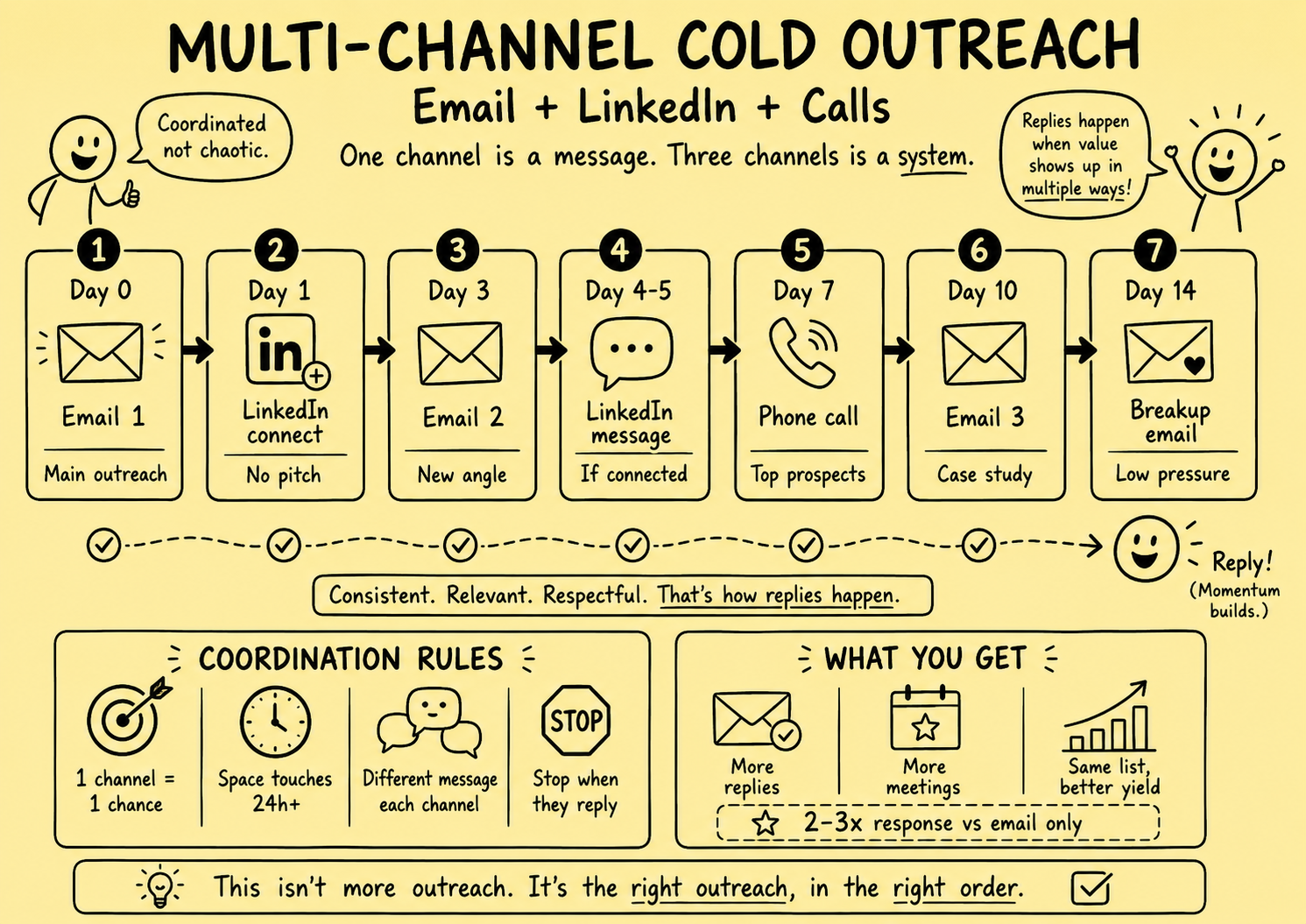
Using email, LinkedIn, and phone does not automatically create more qualified conversations. It can also repeat the same message, contact an owner after an objection, expose inconsistent records, violate platform rules, or make several people appear to pursue the same relationship independently.
This article previously claimed multi-channel outreach produced multiples of the replies from the same list. It also presented invented response and client projections, described a fixed 14-day cadence as proven, recommended unauthorized LinkedIn automation tools, and treated channel performance as universal. Those claims and prescriptions were removed.
Direct answer: Decide eligibility separately for each person, purpose, jurisdiction, and channel. Coordinate every touch through one relationship record, apply central suppression and stop signals, keep messages accurate and human-owned, and evaluate the program with the brokerage’s own controlled evidence.
This is an operating framework, not legal advice. Marketing, privacy, telemarketing, recording, data-broker, professional, and platform requirements vary by jurisdiction, recipient, number or address type, purpose, relationship, and technology. Have qualified counsel review the actual program.
Start with the brokerage use case
Do not begin with a generic “email, LinkedIn, then call” template. Define the relationship the brokerage is trying to create or progress.
| Use case | Relevant context | Main risk to control |
|---|---|---|
| Seller sourcing | Business fit, owner identity, source, prior relationship, exclusions | Unsupported intent or sensitive owner inference |
| Buyer acquisition | Acquisition criteria, authority, source, prior activity | Treating an unverified contact as a qualified buyer |
| Buyer reactivation | Prior consent, inactivity reason, current criteria, deal access | Reopening communication after an objection or material change |
| Seller follow-up | Agreed next step, mandate status, stakeholders, confidentiality | Mixing marketing automation with an active relationship |
| Referral development | Partner role, relationship owner, conflicts, history | Duplicate or inconsistent contact from several team members |
Prospecting sequences should remain separate from active deal communications. A seller, buyer, or adviser involved in a live transaction should not stay in a broad marketing cadence merely because the CRM still contains an email address and phone number.
Create an eligibility record for every channel
A contact record should not have one global “marketable” flag. Email, a social-platform interaction, a live call, an automated call, and a text message can have different requirements and relationship implications.
For each proposed channel, record:
- Contact and organization identity
- Source of the address, number, or profile
- Jurisdiction, recipient type, and channel classification
- Approved purpose and legal or operational basis
- Consent evidence where required, including scope and date
- Platform and provider terms that apply
- Prior messages, calls, replies, objections, and opt-outs
- Conflicts, clients, mandates, sensitive matters, and other exclusions
- Approved sender or caller and relationship owner
- Decision date, evidence, reviewer, and next review date
If the source, identity, jurisdiction, or permission is uncertain, route the record for review. Do not let a missing value default to eligible.
Apply channel-specific requirements
Commercial email
The FTC CAN-SPAM business guide states that the U.S. law covers commercial messages and makes no exception for business-to-business email. Its guidance addresses accurate routing information and subject lines, advertising identification, postal address, opt-out mechanisms, honoring opt-outs, and responsibility for companies sending on a business’s behalf.
The Gmail email sender guidelines cover current provider requirements and guidance for authentication, DNS, TLS, message formatting, spam rates, DMARC alignment, and unsubscribe controls for relevant senders. Provider compliance supports delivery; it does not establish that a message is lawful, wanted, or appropriate.
Keep suppression centralized across domains, mailboxes, campaigns, users, contractors, and replacement vendors. A recipient should not re-enter a sequence because a different sender or tool is used.
LinkedIn’s automated-activity guidance states that it does not allow third-party software or browser extensions that scrape, modify, or automate activity on its website. The previous article’s recommendations of connection-automation tools and daily automation limits were therefore removed.
Use approved platform features and current terms. A public profile does not automatically authorize scraping, enrichment, storage, inference, or marketing. Human activity should still follow the brokerage’s eligibility, identity, message, suppression, and relationship rules.
A connection acceptance is not universal consent for email, calls, data enrichment, or repeated pitches. Record each channel decision separately.
Live and automated calls
The FTC Telemarketing Sales Rule guide explains that federal and state requirements may overlap and that technology does not remove responsibility. It covers truthful identity and purpose, caller ID, records, calling restrictions, do-not-call controls, prerecorded messages, and call abandonment. Business-to-business treatment is not a universal exemption from all requirements or deceptive-practice prohibitions.
Separate a person making a live call from power, predictive, parallel, prerecorded, artificial-voice, or automated calling. Document the precise method rather than relying on the vendor’s marketing label. Recording and transcription require their own jurisdiction and consent review.
For UK programs, the ICO’s business-to-business marketing guidance addresses PECR and data-protection requirements across B2B email, live calls, and automated calls, including TPS and CTPS screening, prior objections, identity, consent, and personal data.
Replace the rigid sequence with a state machine
A fixed day-by-day cadence assumes every recipient and relationship progresses identically. A state machine responds to evidence instead.
| State | Meaning | Permitted next action |
|---|---|---|
| Research pending | Identity, source, fit, or channel eligibility is incomplete | Review and verify; do not contact |
| Eligible for approved channel | Evidence supports one defined touch | Authorized owner reviews and releases |
| Active outreach | A permitted contact was made | Wait, monitor, or use another separately eligible channel |
| Replied | Any substantive response was received | Stop automation and route to a person |
| Objection or opt-out | Recipient objects or asks to stop | Apply the required suppression immediately |
| Wrong party or invalid data | Identity or address is incorrect | Stop, correct provenance, and investigate downstream copies |
| Relationship active | A real buyer, seller, partner, or deal conversation exists | Move to the relationship workflow; remove marketing automation |
| Paused for review | Conflict, sensitivity, ambiguity, or exception exists | No further action until an authorized decision |
| Closed | No permitted or appropriate next action remains | Retain only the records required by policy |
Events should move the record across every connected tool. An email reply must be able to stop a scheduled call. A verbal objection must suppress future email where required by the approved policy. A relationship owner should not discover that a second system continued messaging independently.
Design central suppression and event synchronization
Choose one durable system to own contact state, relationship ownership, eligibility evidence, and suppression. Channel tools can execute approved actions, but they should not create independent versions of the truth.
Test:
- Email reply, unsubscribe, bounce, and complaint
- LinkedIn reply, connection rejection, block, and manual objection
- Call connection, voicemail, wrong party, objection, and opt-out
- Duplicate contacts and multiple addresses or numbers
- Contact reassignment and concurrent user activity
- Delayed webhooks, unavailable APIs, retries, and partial failures
- Imports from old campaigns and replacement vendors
- Conflict, active-client, active-mandate, and live-deal exclusions
Every transition needs an event timestamp, source, prior state, new state, reason, actor, and retry or exception status. High-risk failures should create an alert and pause contact rather than fail open.
Coordinate context without manufacturing familiarity
Each touch should add legitimate context, not simulate a relationship that does not exist.
Messages and calls should:
- Identify the brokerage and sender accurately
- State the commercial purpose truthfully where required
- Use verified facts from permitted sources
- Avoid implying that the owner wants to sell or the buyer is qualified
- Avoid invented referrals, prior conversations, urgency, buyer matches, or valuation claims
- Provide required disclosures and an effective way to object or opt out
- Match the channel’s format without copying the same pitch mechanically
- Give the human owner the full history before a live conversation
Referencing a prior touch is appropriate only if the record confirms it occurred and the reference is not misleading. “I sent a note” should not be inserted because the template assumes an email was delivered.
Use automation for coordination, not unchecked persuasion
Suitable automation may include:
- Checking approved eligibility and suppression rules
- Deduplicating records and resolving ownership
- Creating review tasks and assembling source evidence
- Scheduling an approved action within configured limits
- Stopping pending actions after a reply or objection
- Logging channel events and routing exceptions
- Preparing a factual draft for human review
- Monitoring delivery, synchronization, and control failures
Do not let automation decide that an inferred personal circumstance justifies contact, bypass a platform restriction, fabricate personalization, send a consequential reply, qualify a buyer, estimate value, disclose deal information, or continue after an uncertain stop signal.
Set cadence from evidence and capacity
There is no universal number of days, touches, or channels. Set an initial policy using:
- Recipient and relationship type
- Jurisdiction and approved channel basis
- Source quality and evidence recency
- Value and sensitivity of the proposed conversation
- Prior activity and response
- Team capacity to review and answer
- Complaint, objection, delivery, and wrong-party signals
- Provider and platform requirements
Start with a small cohort the team can inspect. Increase activity only when the brokerage can verify eligibility, preserve message quality, respond responsibly, and keep exceptions visible.
Measure the system without inventing an advantage
Replies alone can make a poor campaign look successful. Measure the whole operating system:
| Measure | What it reveals |
|---|---|
| Records reviewed and eligible by channel | Whether the audience matches policy |
| Provenance completeness | Whether contact data and message claims are traceable |
| Suppression and exclusion events | Whether controls prevent inappropriate contact |
| Delivered touches and successful live connections | Operational reach by channel |
| Wrong-party, bounce, and invalid-profile events | Data quality |
| Objections, opt-outs, blocks, and complaints | Recipient and brand impact |
| Positive and negative replies | Relevance and objections without hiding either |
| Qualified conversations | Fit against documented broker criteria |
| Accepted next steps | Whether a recipient agreed to a defined action |
| Cross-channel stop failures | Whether orchestration actually works |
| Human review and response time | Work created for the team |
To compare multi-channel outreach with a narrower approach, use eligible cohorts with comparable characteristics and predefine the outcome and observation period. Track total contact burden and negative signals. Document other changes in audience, copy, timing, personnel, and market conditions.
Do not claim that a channel or sequence caused an engagement or completed deal without a defensible attribution method. Relationships, referrals, brand familiarity, timing, service quality, and other activity may contribute.
A controlled launch process
- Define the seller, buyer, reactivation, or referral use case.
- Approve the channel matrix, sources, exclusions, messages, cadence limits, and owners.
- Configure central eligibility, suppression, and state transitions.
- Test with controlled addresses, profiles, and phone numbers.
- Simulate replies, objections, opt-outs, wrong parties, API failures, and duplicate records.
- Require human review for the audience and initial actions.
- Launch to a small eligible cohort with named response ownership.
- Review qualified progression, negative signals, workload, and control failures.
- Expand, revise, pause, or stop based on documented evidence.
Keep an emergency stop that pauses every connected channel. Preserve an export of consent or basis evidence, suppression, relationships, activity, and decisions so the brokerage can change vendors without losing control.
The practical conclusion
Multi-channel outreach is an orchestration problem, not a touch-count formula. The useful system is the one that knows whether a channel is appropriate, what happened previously, who owns the relationship, and when all contact must stop.
Treat each channel separately for eligibility and together for state, suppression, context, and ownership. Use automation to coordinate evidence and handoffs. Let qualified humans control messages, exceptions, and real buyer and seller relationships.
To apply this framework, review broker growth and pipeline operations or request a Business Broker Pipeline & Operations Assessment.
Frequently Asked Questions
Is multi-channel outreach better than email alone for business brokers?
It cannot be assumed. A brokerage should compare eligible, controlled cohorts using its own audience and outcome definitions while measuring objections, complaints, wrong-party contacts, workload, and accepted next steps—not only replies.
What is the best email, LinkedIn, and call sequence?
There is no universal cadence. Timing and channel choice depend on the recipient, relationship, jurisdiction, source, channel permission, message, team capacity, prior activity, and stop signals. Start with a reviewable policy and a small test.
Can a brokerage automate LinkedIn connection requests and messages?
LinkedIn states that it does not allow third-party software or browser extensions that scrape or automate activity on its website. Use approved platform features and review the current User Agreement and Help guidance.
Should every prospect receive an email, LinkedIn message, and call?
No. Eligibility should be decided separately for every channel. A record may be eligible for one channel and prohibited, inappropriate, or unsupported for another. Prior objections and relationship context should override the sequence.
How should replies and opt-outs stop a multi-channel sequence?
Use a central suppression and state service that updates every connected tool. Define which events stop all marketing, pause for human review, end one channel only, or transfer the record to a relationship owner, then test those transitions.
Sources and evidence notes
Primary or first-party materials reviewed for this article. Scope and limitations are stated rather than silently generalized.
- CAN-SPAM Act: A Compliance Guide for BusinessU.S. Federal Trade Commission · Accessed
Official U.S. commercial-email guidance covering business-to-business email, accurate identity and subject lines, required information, opt-outs, and responsibility for vendors.
- Complying with the Telemarketing Sales RuleU.S. Federal Trade Commission · Accessed
Official U.S. telemarketing guidance covering scope, truthful disclosures, caller identity, records, calling restrictions, do-not-call controls, and overlapping federal and state rules.
- Business-to-business marketingUK Information Commissioner’s Office · Accessed
Official UK guidance on applying PECR and data-protection requirements to B2B email, live calls, automated calls, suppression, identity, consent, and personal data.
- Automated activity on LinkedInLinkedIn Help · Accessed
LinkedIn’s first-party statement that it does not allow third-party software or browser extensions that scrape or automate activity on its website.
- Email sender guidelinesGoogle Gmail Help · Accessed
Current first-party Gmail sender requirements and guidance covering authentication, DNS, TLS, message format, spam rates, alignment, and unsubscribe controls for relevant senders.
Brokerage data stays governed. Material deal decisions stay human.
We design business broker systems around least-privilege access, documented data flows, protected credentials, traceable activity, and approval gates. Systemify does not use client information to train its own models. When a workflow uses an external AI provider, its purpose, data fields, and retention approach are documented and approved before client data is transferred.
Apply this to your brokerage
We can assess your buyer and seller pipeline, valuation and vetting workflows, communications, documents, controls, and handoffs before recommending what to build.
Talk to a Broker Systems Expert