
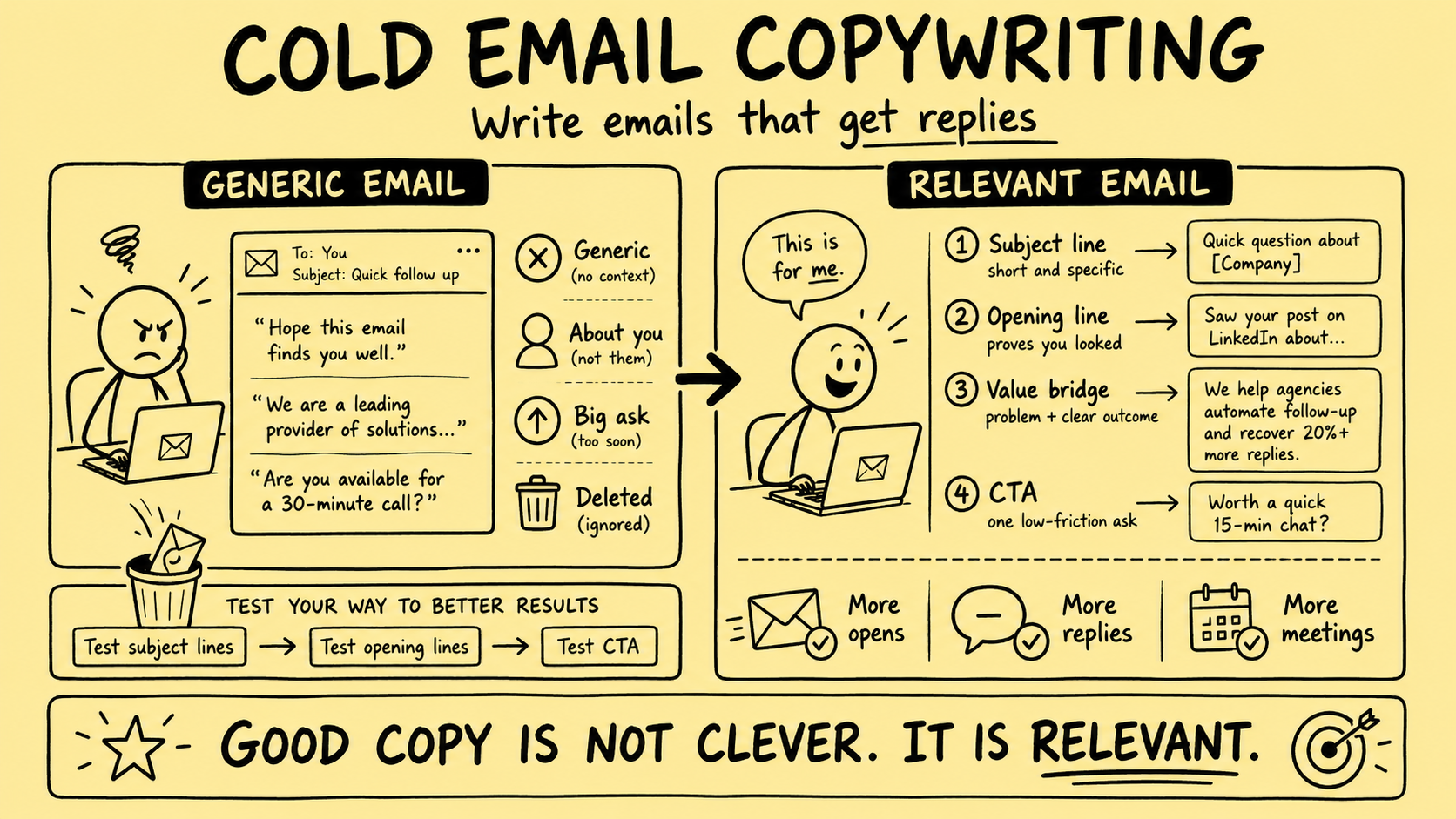
No email structure guarantees a reply. A clear message can still reach the wrong person, arrive at the wrong time, fail a channel rule, describe an irrelevant service, or receive a deliberate no. The copy’s job is narrower: communicate a truthful, appropriately sourced reason for contact and make the next decision understandable.
This article previously claimed recipients evaluate cold email in three to five seconds, said only personalized opening lines work, labeled particular subjects and calls to action “high-converting,” treated estimates as acceptable claim anchors, included invented client results, prescribed fixed day-three and day-fourteen follow-ups, published arbitrary sample sizes and benchmark ranges, and converted hypothetical replies into promised meetings and pipeline. Those claims, templates, schedules, benchmarks, and obsolete service links were removed.
Direct answer: Write from an approved message brief. Identify the broker and firm accurately, use only verified context the recipient would reasonably understand, separate facts from hypotheses, substantiate every objective claim, avoid seller-intent and buyer-capacity assumptions, protect confidential matters, state one proportionate next step, make preferences easy to express, and test variants within comparable eligible cohorts.
This is operating guidance, not legal, privacy, marketing, valuation, tax, accounting, licensing, or transaction advice. Requirements vary by jurisdiction, channel, recipient, subscriber type, relationship, purpose, and data. Qualified owners should approve the brokerage’s actual policy and messages.
Classify the message before writing it
Different broker relationships require different copy and controls.
| Message context | Legitimate purpose may include | Copy boundary |
|---|---|---|
| New seller outreach | Introduce a relevant, approved brokerage service | Do not imply the owner intends to sell or that buyers are waiting |
| New buyer outreach | Invite the person to state or update acquisition criteria | Do not imply qualification, funding, authority, or access |
| Referral introduction | Continue an introduction within its documented scope | Do not assume permission from an introduced person |
| Dormant relationship | Revisit a documented prior context when currently eligible | Do not treat old interest as current intent or permission |
| Existing service relationship | Fulfill or clarify an agreed next step | Do not disguise unrelated promotion as a service message |
| Live transaction | Communicate an authorized matter-specific action | Keep it out of generic marketing automation |
Record the purpose, relationship, source, channel, jurisdiction decision, owner, confidentiality state, permission or approved basis where required, preference status, and applicable policy before selecting a template.
Build a message brief
The writer or system should receive a bounded brief, not unrestricted CRM access.
Include:
- Verified recipient and entity identity
- Current role and source date
- Relationship type and owner
- Approved reason for selection
- Permitted personalization facts with source links
- Service description and approved claims
- Prohibited claims and sensitive fields
- Message purpose and channel
- Allowed next steps
- Required identity, address, disclosure, and preference elements
- Confidentiality and opportunity-disclosure limits
- Reviewer and approval rule
- Template, policy, and evidence versions
If identity, role, eligibility, or the reason for contact is uncertain, route the record to research or review. Do not compensate with vaguer copy.
Use a claim register
The FTC advertising guide for small businesses explains that advertising should be truthful and non-deceptive, objective claims need an adequate basis before publication, and implied claims matter as well as express ones.
Maintain a register for every reusable statement:
| Claim | Evidence | Scope | Approved wording | Expires or rechecks | Owner |
|---|---|---|---|---|---|
| Service capability | Current service specification | Exact workflow and territory | Reviewed description | On service change | Service owner |
| Client outcome | Underlying client record and permission | Named period, population, and method | Approved case wording | On correction or withdrawal | Evidence owner |
| Time or cost estimate | Documented method and assumptions | Defined client context | Qualified estimate | On process or price change | Commercial owner |
| Market or buyer statement | Current, authorized evidence | Named market and date | Reviewed statement | Short, defined interval | Broker owner |
“Typically,” “approximately,” “up to,” and “in our experience” do not make an unsupported number safe. A concrete number remains a claim. Preserve the population, period, calculation, exclusions, uncertainty, and permission to use it.
Do not imply:
- A likely sale price or valuation from public data
- Active buyer demand without current authorized evidence
- A guaranteed introduction, mandate, closing, ranking, or timeline
- That an automated workflow replaces broker judgment
- That an unrelated client result will transfer to a brokerage
- That the recipient has a problem, motive, or intent not established by evidence
Write an accurate subject line
The subject should help the recipient understand the message. It should not manufacture curiosity through deception.
The FTC CAN-SPAM business guide requires non-deceptive subject lines for U.S. commercial email and addresses accurate header information, message identification, postal information, opt-outs, and vendor responsibility. Google’s email sender guidelines also prohibit deceptive sender identity and describe provider requirements for mail sent to personal Gmail accounts.
Avoid:
- “Re:” or “Fwd:” when there is no prior thread
- A mutual-contact claim that the person did not make
- “Confidential offer” when no authorized offer exists
- “Buyer for your business” without a verified, disclosable buyer context
- False urgency, deadlines, scarcity, or document notices
- A company or person name inserted into an unrelated subject
Possible structures, subject to message review, include:
- Business brokerage in [verified region]
- Question about [accurately described business category]
- Updating acquisition criteria with [brokerage name]
- Following up on our [month/year] conversation
- Introduction from [verified referrer], with permission
These are formats, not performance claims. Test them only after accuracy and eligibility review.
Open with sourced relevance
A personalized statement should be true, necessary, and appropriate—not merely available.
Good opening logic is:
- Identify the relevant observed fact.
- Preserve its source and date.
- Explain why it relates to the approved service scope.
- Avoid turning it into a claim about intent, pain, readiness, or private circumstances.
For example:
Your company website listed [verified service or category] in [location] when we reviewed it on [date]. I’m [name] from [brokerage], and I’m contacting business owners in that defined market to introduce our [accurate service description].
This states what was observed and why contact occurred. It does not say the owner is struggling, approaching retirement, financially distressed, expanding, or ready to sell.
Do not mention personal social activity, family facts, health, age, inferred wealth, or other sensitive context to prove that research occurred. Even accurate facts can be intrusive or irrelevant.
Describe the service without diagnosing the recipient
Separate these three things:
- Observed fact: supported by a source
- General service context: what the brokerage is qualified and approved to do
- Recipient-specific need: unknown until the recipient states it or sufficient evidence supports it
A controlled bridge might say:
We help business owners prepare for and navigate a potential sale, including [approved service scope]. I don’t know whether that is relevant to you now; if it is, I can send our process overview or arrange a conversation with the appropriate broker.
For buyers:
We maintain a reviewed buyer process for people and organizations seeking businesses in [approved scope]. If you want us to assess whether the process is relevant, you can provide current criteria through [approved channel]. Access to opportunities remains subject to identity, qualification, confidentiality, seller authorization, and fit review.
Avoid using “businesses like yours usually…” to smuggle in an unsupported diagnosis. Avoid implying that a reply creates an engagement or grants access to confidential opportunities.
Offer a proportionate next step
The next step should match the relationship and risk.
Possible options include:
- Send a public process overview
- Confirm whether the topic is relevant
- Route the person to the appropriate broker
- Invite current buyer criteria through a controlled form
- Arrange a preliminary conversation
- Honor a stated revisit date
- Record that no further contact is wanted
Do not label a 15-minute call “low friction” as a universal truth. Do not force a calendar link when identity, qualification, or confidentiality review should come first. Do not create false binary choices or urgency to provoke a response.
State what happens after the person accepts. If the next step involves data collection, qualification, confidentiality, or a professional review, say so accurately.
Make identity and preferences clear
The ICO’s April 2026 electronic-mail marketing guidance covers recipient and subscriber types, consent, soft opt-in conditions, public and bought-in data, objections, and related duties in the UK context. Its B2B marketing guidance distinguishes channels, corporate subscribers, sole traders, certain partnerships, personal data, preference services, and suppression.
The message system should provide or preserve the identity, firm, purpose, required address and disclosures, and an easy preference path appropriate to the channel and jurisdiction. Do not hide an opt-out in faint text or require a sales conversation to stop marketing.
Classify replies for:
- Objection, opt-out, withdrawal, or channel preference
- Wrong person, role, or business
- Complaint, privacy request, dispute, or security concern
- Seller interest requiring broker review
- Buyer interest requiring criteria and qualification review
- Referral requiring permission review
- Request for information
- Revisit date or event
- Unclear response requiring human handling
Stop or reroute pending messages before drafting another response.
Protect confidential broker information
Cold outreach should not disclose:
- A confidential business identity or opportunity
- Buyer or seller identity without authorization
- Financial statements, valuation work, price expectations, or bids
- Deal-room, diligence, financing, or negotiation status
- Another party’s criteria, communications, or interest
- Matter-specific documents or links
If a message refers to an opportunity, require current seller authorization, recipient identity, buyer process status, confidentiality evidence, minimum-necessary disclosure, an approved artifact, and an accountable broker owner.
Generic copy tools should not have unrestricted access to CRM notes, valuations, mandates, data rooms, or active deal communications.
Broker-specific template: seller introduction
This is a controlled structure, not a send-ready legal template.
Subject: Business brokerage in [verified region]
Hello [verified name],
>
I’m [broker name] with [brokerage]. [Approved source] identified you as [verified public role] at [business] when reviewed on [date].
>
We advise owners of [accurate service scope] businesses in [territory] who choose to explore succession or a potential sale. I don’t know whether that is relevant to you now.
>
If useful, I can send [approved public resource] or explain our initial process. If you do not want marketing contact from us, use [approved preference method], and we will update our records.
>
[Required identity, address, and disclosure elements]
Review the source, current role, service scope, jurisdiction, channel, preference state, and all required disclosures before use. Do not add an estimated valuation or claim of buyer demand merely to increase interest.
Broker-specific template: buyer process invitation
Subject: Acquisition criteria with [brokerage]
Hello [verified name],
>
I’m [broker name] with [brokerage]. We are reviewing whether our buyer process is relevant to organizations seeking [approved general scope].
>
If you want us to assess fit, you can submit current criteria through [controlled channel]. Submission does not establish qualification or guarantee access to an opportunity; identity, evidence, confidentiality, seller authorization, and fit review may apply.
>
If this is not relevant or you do not want marketing contact from us, use [approved preference method].
>
[Required identity, address, and disclosure elements]
Do not name a confidential opportunity in an acquisition-development message. Do not imply the recipient has funds, authority, experience, or readiness until reviewed evidence supports the relevant statement.
Broker-specific template: documented referral
Subject: Introduction from [verified referrer]
Hello [verified name],
>
[Referrer] authorized us on [date] to contact you about [documented scope]. I’m [broker name] with [brokerage].
>
My understanding is limited to [facts the referrer was authorized to share]. I have not assumed whether the topic is relevant or whether you want to proceed.
>
If you would like, the next step is [proportionate action]. If you prefer no further marketing contact, use [approved preference method].
>
[Required identity, address, and disclosure elements]
Confirm the introduced person’s channel eligibility and the scope of the referrer’s permission. A referral is not automatic consent, endorsement, qualification, or authority to disclose confidential information.
Broker-specific template: eligible reactivation
Subject: Following up on our [month/year] conversation
Hello [verified name],
>
We last discussed [approved, non-confidential context] in [month/year]. I’m [broker name], the current relationship owner at [brokerage].
>
[Verified event or requested revisit date] prompted this review. If the topic remains relevant, the available next step is [approved action]. If not, no response is required, and you can update your preferences through [approved method].
>
[Required identity, address, and disclosure elements]
Before using prior context, confirm retention, ownership, identity, current relevance, permission or approved basis where required, objections, suppression, and confidentiality. Silence since the earlier conversation is not evidence of continued interest.
Follow up from state, not a fixed calendar
There is no universal day-three or day-fourteen sequence.
A follow-up decision should consider:
- Relationship and message purpose
- Recipient request or agreed date
- Last verified event and useful new context
- Channel eligibility and suppression
- Whether the brokerage owes an action
- Current owner and capacity
- Confidentiality and live-deal status
- Prior frequency, complaints, and delivery failures
- The reason another message would benefit the recipient
An automated timer may create an internal review task. It should not by itself prove that another outbound message is appropriate.
Stop when the purpose is resolved, the person objects or opts out, identity becomes uncertain, a complaint or privacy request appears, the matter becomes live or restricted, the brokerage owner takes direct control, or another message would merely repeat the same ask.
Test copy without inventing statistical certainty
Do not wait for an arbitrary number of sends or opens and declare a winner.
Before a test, define:
- Eligible seller or buyer population
- Assignment method
- One principal copy change
- Primary measure and denominator
- Reply-classification policy
- Observation window
- Minimum detectable effect or practical decision threshold
- Sample-size or stopping method
- Guardrails for objections, complaints, confidentiality, and workload
- Reviewer and rollback condition
Open tracking is an unreliable outcome because privacy features, image blocking, caching, and scanners can change the signal. Prefer verified replies by class, accepted qualified next steps, completed brokerage commitments, corrections, objections, complaints, and downstream reviewed transitions.
Compare like cohorts. Preserve non-delivery, missing data, and exclusions. A changed rate after a copy change is an observation; audience, timing, source quality, sender, offer, provider filtering, and other variables may also explain it.
Use AI as a constrained drafting assistant
The NIST Generative AI Profile provides voluntary guidance for governing, mapping, measuring, and managing generative-AI risk.
For broker outreach, constrain the drafting system with:
- Approved input fields and source references
- Retrieval limited by relationship and matter
- A current claim register
- Prohibited inference and disclosure rules
- Deterministic identity and preference elements
- Required uncertainty language
- Human-review thresholds
- Model, prompt, retrieval, and template versions
- Safe failure when evidence is missing
Test invented seller intent, fabricated buyer demand, false familiarity, wrong role, misleading thread prefixes, unsupported valuations, exaggerated outcomes, cross-matter leakage, hidden opt-outs, and prompt injection from source text.
The reviewer should see each material sentence beside its source. If the system cannot support it, omit or escalate it rather than improvising.
Review the complete message, not isolated sentences
An accurate sentence can create a misleading overall impression when combined with the subject, preview text, sender name, omitted limitations, images, links, and call to action.
Review:
- From name, address, reply-to, and firm identity
- Subject and preview text
- Personalization sources and dates
- Express and implied claims
- Missing limitations or material context
- Link destinations and access controls
- Required disclosures and postal information
- Preference mechanism and suppression behavior
- Confidentiality and recipient authorization
- Mobile and plain-text rendering
- Reply routing, owner assignment, and stop handling
Approve the exact rendered artifact and recipient class, not merely a reusable paragraph in isolation.
Measure quality beyond replies
Track:
- Messages proposed, eligible, approved, corrected, rejected, and canceled
- Unsupported or expired claims blocked
- Personalization fields missing, stale, contradicted, or removed
- Identity and wrong-recipient exceptions
- Replies by reviewed seller, buyer, objection, complaint, and correction class
- Preference capture and suppression propagation
- Confidentiality and unauthorized-disclosure incidents
- Accepted and completed next steps by relationship type
- Qualification decisions with evidence state
- Owner workload and reply aging
- Template performance within comparable mature cohorts
A high reply rate can reflect confusion, objections, or complaints. A low rate does not prove the subject line, opening, value statement, or call to action caused the result.
The practical conclusion
Good broker outreach copy is not a trick for getting opened or a template that guarantees replies. It is a controlled communication that accurately identifies the sender, explains a defensible reason for contact, makes only supported claims, respects the recipient’s context and preferences, protects confidential information, and offers a proportionate next step.
Write from verified evidence. Keep seller intent, buyer capacity, valuation, and deal access under professional review. Make stopping easy. Test one approved variable at a time and measure qualified progression and harms—not merely opens or total replies.
To design the surrounding workflow, review broker growth operations and operations streamlining, or request a Business Broker Pipeline & Operations Assessment.
Frequently Asked Questions
What should a business broker say in a cold email to a seller?
Identify the broker and firm accurately, state why the recipient was selected using a verified and appropriate fact, describe the service without implying the owner wants to sell, offer one proportionate next step, and provide the required preference and sender information for the applicable context.
What subject line gets the best reply rate?
No subject line universally produces the best reply rate. It should accurately describe the message without fake familiarity, false urgency, misleading reply prefixes, or unsupported personalization. Test approved variants within comparable eligible cohorts and measure complaints and qualified progression as well as replies.
Can a broker mention a valuation in outreach?
A broker may accurately describe an approved valuation service or process, but should not state or imply a business value, likely sale price, buyer demand, or outcome without appropriate evidence and professional review. Keep indicative education separate from a valuation conclusion.
How many follow-up emails should a broker send?
There is no universal sequence length or day schedule. Follow-up should depend on the relationship, purpose, recipient request, channel eligibility, prior interactions, useful new context, brokerage policy, and stop conditions. An objection, opt-out, complaint, or restriction must stop or reroute the workflow.
Can AI write and send broker outreach automatically?
AI may draft from approved, evidence-linked fields, but the system should block unsupported claims and sensitive inferences. Human review should cover seller intent, buyer qualification, valuation, confidential opportunities, commitments, complaints, and other consequential content before sending.
Sources and evidence notes
Primary or first-party materials reviewed for this article. Scope and limitations are stated rather than silently generalized.
- Advertising FAQ’s: A Guide for Small BusinessU.S. Federal Trade Commission · Accessed
Official U.S. guidance explaining that advertising must be truthful and non-deceptive, objective claims need a reasonable evidentiary basis before publication, and both express and implied claims matter.
- CAN-SPAM Act: A Compliance Guide for BusinessU.S. Federal Trade Commission · Accessed
Official U.S. guidance on commercial-email identity, subject lines, advertising identification, postal information, opt-out mechanisms and timing, message purpose, and responsibility for vendors.
- Guidance on direct marketing using electronic mailUK Information Commissioner’s Office · Accessed
Current UK guidance on electronic-mail marketing, recipient and subscriber types, consent, soft opt-in conditions, public and bought-in data, objections, and related data-protection duties.
- Business-to-business marketingUK Information Commissioner’s Office · Accessed
Current UK guidance on B2B marketing across electronic mail, live calls, automated calls, personal data, subscriber types, preference services, transparency, objections, and suppression.
- Email sender guidelinesGoogle · Accessed
Current requirements and recommendations for email sent to personal Gmail accounts, including authentication, DNS, TLS, message formatting, spam-rate monitoring, and additional obligations for high-volume senders.
- Artificial Intelligence Risk Management Framework: Generative Artificial Intelligence ProfileU.S. National Institute of Standards and Technology · Published · Accessed
Voluntary cross-sector guidance for governing, mapping, measuring, and managing generative-AI risks across the AI lifecycle.
Brokerage data stays governed. Material deal decisions stay human.
We design business broker systems around least-privilege access, documented data flows, protected credentials, traceable activity, and approval gates. Systemify does not use client information to train its own models. When a workflow uses an external AI provider, its purpose, data fields, and retention approach are documented and approved before client data is transferred.
Apply this to your brokerage
We can assess your buyer and seller pipeline, valuation and vetting workflows, communications, documents, controls, and handoffs before recommending what to build.
Talk to a Broker Systems Expert