
Two very different immigration law firms share the same underlying problem.
Firm A is busy. They have a strong referral network, decent Google rankings, and a social following. Enquiries come in every day. But the intake process is chaotic — forms pile up in a shared inbox, the attorney does their own follow-up when they have time, and cases that came in on Friday often don't get a callback until Monday afternoon. Nobody knows exactly how many leads they are losing.
Firm B is growing. They do good work, but their client pipeline is inconsistent. Some weeks they onboard three new clients; other weeks it's one, or none. They've tried Google ads and got some leads, but the conversion rate was low and they couldn't tell why. The business feels fragile because growth depends on word-of-mouth and luck.
Both firms would be transformed by the same intervention: a structured, automated intake process that responds to every enquiry instantly, qualifies leads intelligently, and converts consultations to retained clients at a predictably high rate.
This post walks through how to build that system.
The Two Intake Problems Side by Side
Problem 1: You Have Leads — But You're Losing Them to Chaos
Signs your firm has a lead-handling problem:
- Enquiries arrive in a shared inbox and get missed or delayed
- Response time during busy weeks stretches to 48–72 hours
- Attorneys spend significant time on intake admin instead of legal work
- You occasionally discover an enquiry from days ago that was never followed up
- Your intake coordinator is a bottleneck — when they're sick, enquiries pile up
The cost of this is invisible in your P&L but enormous in aggregate. If your firm receives 150 enquiries per month and loses 25% of them to slow or missed response, at an average case value of £2,500, you are leaving £375,000 per year on the table — from leads that have already found you.
Problem 2: You Don't Have Enough Leads — And the Ones You Get Often Disappear
Signs your firm has a lead generation and early conversion problem:
- Client intake is unpredictable month to month
- You've tried paid ads but conversion was poor and you stopped
- You can't point to one reliable channel that consistently brings new clients
- You have a nice website but it doesn't generate many enquiries
- Growth feels dependent on whoever happens to refer someone this week
When your pipeline is thin, every enquiry is precious. A lead that finds your firm, fills out a form, and gets a generic auto-reply followed by silence is not just a missed client — it's wasted marketing spend, wasted word-of-mouth, and a missed opportunity to build a relationship that could generate referrals.
The Automated Intake Pipeline
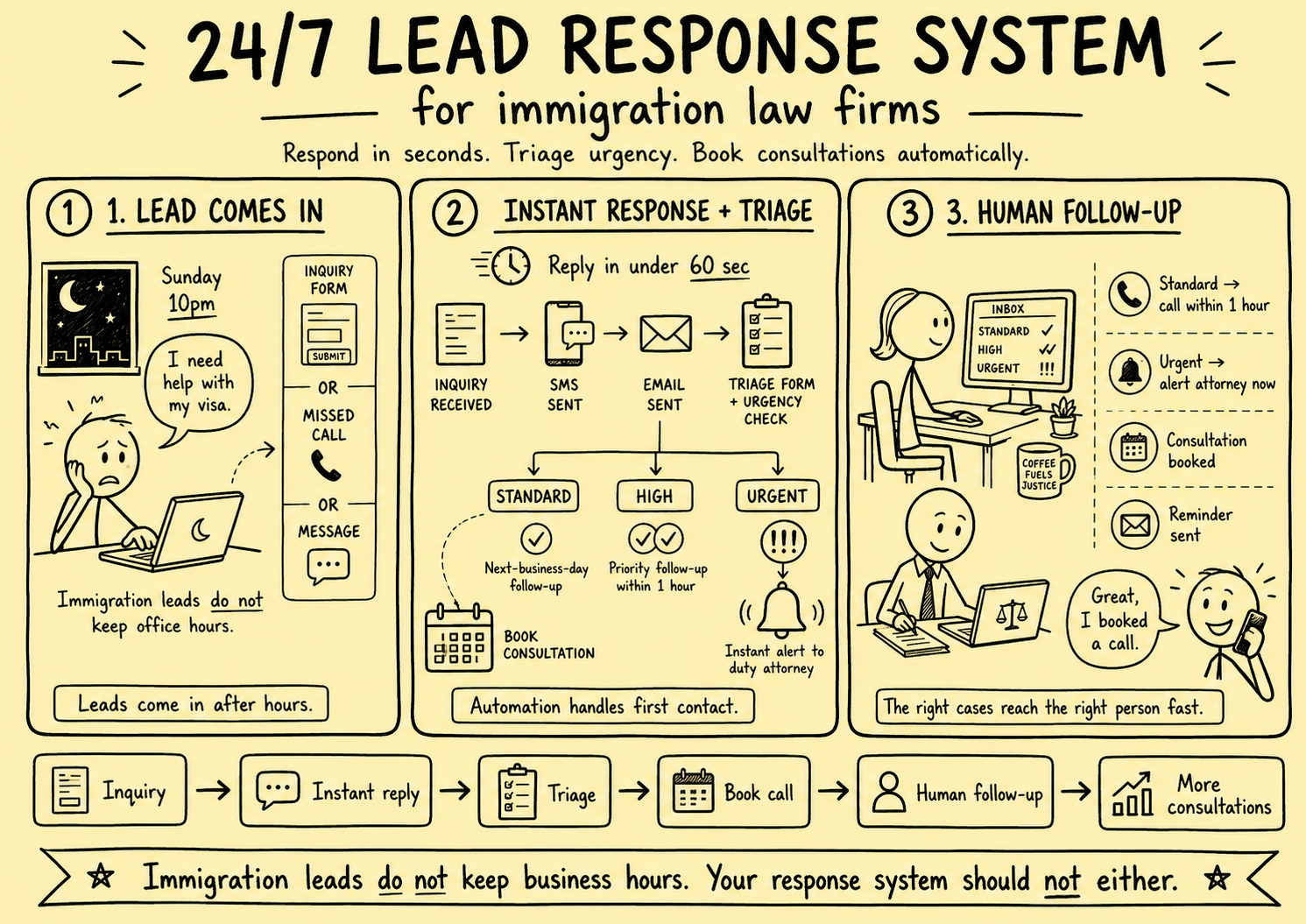
The solution for both types of firm is the same. A well-built automated intake pipeline has five stages:
Stage 1: Capture (Across All Channels)
Most immigration firms lose leads before they even enter the intake process because enquiry channels are fragmented. Phone calls aren't logged. WhatsApp messages sit unread. Website forms go into an inbox nobody monitors closely.
Fix:
- Centralise all enquiries into one system (HubSpot CRM, Clio Grow, or Lawmatics)
- Set up form integrations for your website, Google Business Profile, and any legal directory listings
- Configure a dedicated phone number with call tracking so missed calls are automatically logged as leads
- Add a WhatsApp Business integration if a significant portion of your client base communicates via WhatsApp (very common in immigration)
Every lead that contacts you, through any channel, should appear in one unified lead inbox within 60 seconds.
Stage 2: Instant Acknowledgement (Within 60 Seconds)
The moment a lead enters your system, they should receive a personalised response.
For overwhelmed firms: this automation removes the dependency on a human checking the inbox. The response fires automatically regardless of what your team is doing.
For pipeline-thin firms: this immediate, personal response puts you ahead of the 80% of firms that take hours or days. You are already winning before you've made a single manual call.
The acknowledgement should:
- Use their first name
- Reference what they enquired about (pulled from the form field)
- Confirm when they will hear from a human
- Include a direct booking link for a free consultation
Stage 3: Intelligent Triage
Not all immigration enquiries are equal in urgency or value. Your automation should classify every lead automatically based on the information they submitted.
Classification logic:
| Signal | Classification | Action |
|---|---|---|
| Deportation / removal mentioned | Emergency | Immediate SMS to duty attorney |
| Court date within 7 days | Urgent | Call within 15 minutes |
| Visa expiry within 30 days | High | Call within 1 hour |
| General enquiry | Standard | Call within same business day |
| Vague / incomplete form | Qualify first | Automated follow-up with questions |
This triage ensures that your highest-value and most urgent cases get the fastest response — and that your intake coordinator's time is allocated to the leads most likely to convert.
Stage 4: Personalised Follow-Up Sequence
For leads that don't immediately book a consultation after the first automated response, a follow-up sequence runs automatically.
Day 0 (immediate): Personalised SMS + email with booking link Day 1 (if no response): Follow-up SMS — "Hi [Name], just checking in on your [visa type] enquiry. Is now a good time for a quick call?" Day 3 (if no response): Email with a relevant resource (a plain-English guide to their visa type, or answers to common questions in their situation) Day 7 (if no response): Final follow-up — "We want to make sure you get the help you need. Your consultation slot is still available: [link]"
This sequence runs without any manual effort. For overwhelmed firms, it handles follow-up that would otherwise fall through the cracks. For pipeline-thin firms, it squeezes every possible conversion out of each enquiry.
Stage 5: Consultation to Retained Client
The consultation booking is not the finish line — it is the beginning of the conversion process.
Automated steps between booking and consultation:
- Pre-consultation questionnaire (sent immediately after booking)
- Document checklist (sent 24 hours before, tailored to their case type)
- Confirmation SMS on the day of the consultation
- Attorney briefing note generated from their questionnaire responses
Post-consultation automation (for those who don't immediately retain):
- Follow-up email within 2 hours of consultation: "Thank you for speaking with us today — here is a summary of what we discussed and the next steps"
- Second follow-up 48 hours later if no decision
- Final follow-up at 1 week with a limited-time consultation offer or simply a check-in
The Technology Stack
You do not need a complex or expensive setup to build this. Here is a pragmatic stack that works for most immigration practices:
Option A: All-in-one legal CRM (recommended for most firms)
- [Clio Grow](https://www.clio.com/grow/) — intake forms, email sequences, consultation scheduling, pipeline tracking
- Integrates with Clio Manage for case management
- Monthly cost: ~£70–£120/month
Option B: Generic CRM + automation
- HubSpot CRM (free) + HubSpot Sequences
- Calendly for consultation scheduling
- Twilio for SMS
- Cost: £0–£50/month depending on usage
Option C: Custom automation (most powerful)
- n8n (self-hosted or cloud) for workflow automation
- Any CRM of your choice
- Twilio (SMS), Mailchimp or Postmark (email), Calendly (scheduling)
- Cost: £30–£80/month; more setup time but fully customisable
What This Does for Each Type of Firm
If You're Overwhelmed
- Your inbox clears. Automation handles first contact, follow-up, and scheduling without anyone on your team doing it manually.
- Your attorneys stop doing intake. The system qualifies and books; attorneys show up prepared for a consultation that is already warmed up.
- You stop losing cases to the cracks. The follow-up sequence catches leads that would otherwise disappear after an unanswered first call.
- You can handle 2–3x more enquiry volume without adding intake headcount.
If You're Building Your Pipeline
- Every lead is worth more. A 50% conversion rate from enquiry to consultation (up from a typical 20–25%) doubles the return on every pound spent on ads or referral building.
- You understand where leads are coming from. A centralised CRM shows you which channel generates the most qualified leads so you can invest there.
- You look like a premium firm from first contact. The personalised, immediate, professional response positions you above the market before they've even spoken to an attorney.
- Retained clients refer. Clients who experience a seamless intake process become advocates. The referral flywheel starts turning faster.
The One Change That Makes Everything Else Work
If you implement nothing else from this guide, implement this: connect your website contact form to an automated SMS and email acknowledgement that fires within 60 seconds, 24 hours a day, including weekends.
This single change — which can be set up in an afternoon using HubSpot or Zapier — will noticeably improve your conversion rate from enquiry to consultation within the first week.
Everything else in this guide makes the system more sophisticated and more powerful. But the first 60 seconds is where the most significant difference is made.
Systemify Automation builds full intake automation systems for immigration and professional service firms. If you want the full system — including custom triage logic, personalised sequences, and calendar integration — built and running in two weeks, get in touch.
Brokerage data stays governed. Material deal decisions stay human.
We design business broker systems around least-privilege access, documented data flows, protected credentials, traceable activity, and approval gates. Systemify does not use client information to train its own models. When a workflow uses an external AI provider, its purpose, data fields, and retention approach are documented and approved before client data is transferred.
Looking for business-broker systems?
Our current work focuses on helping business brokers build stronger buyer and seller pipelines and more controlled deal operations.
Talk to a Broker Systems Expert