
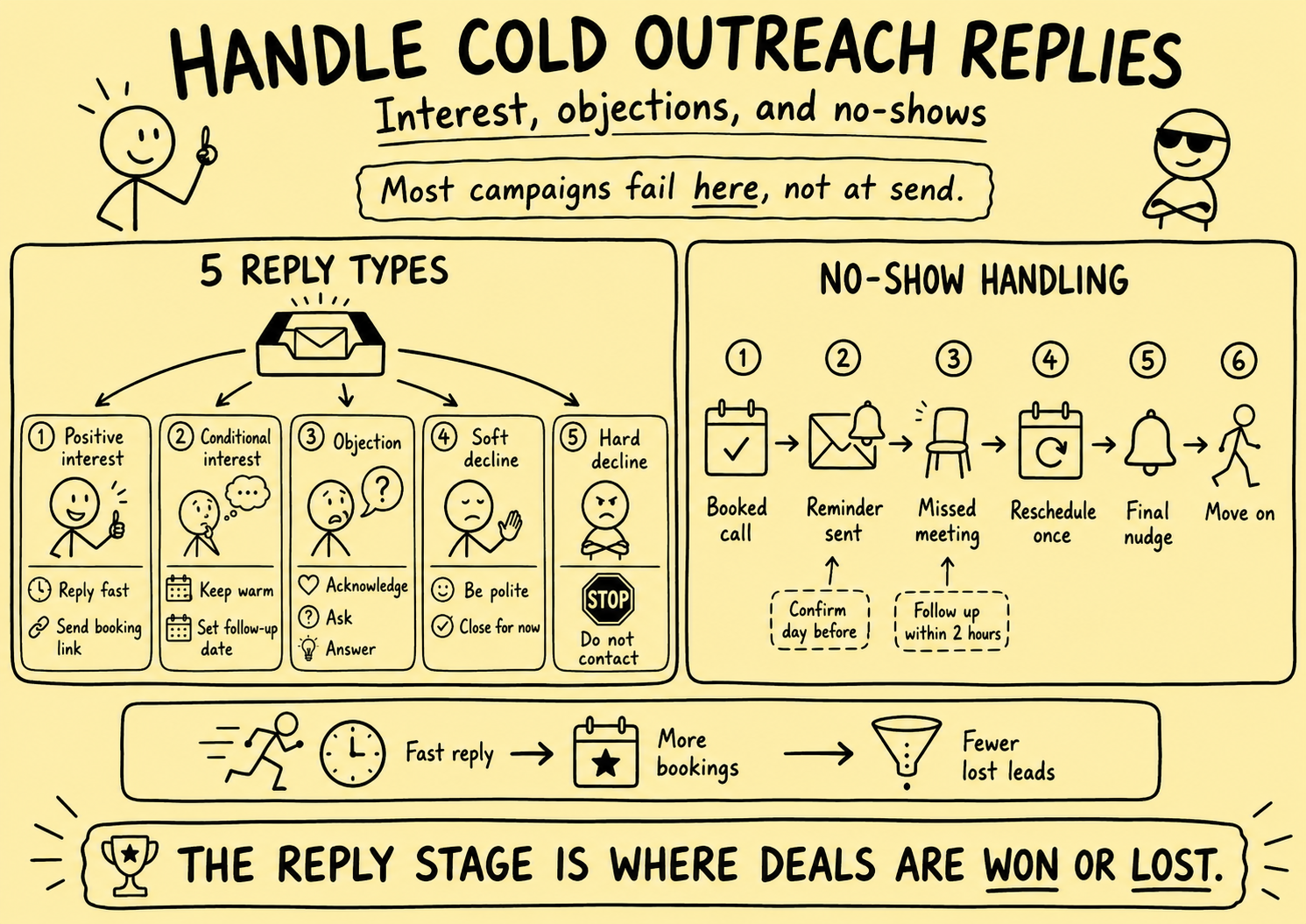
A reply is not automatically a lead, an objection to overcome, or permission to keep selling. It may be a seller inquiry, buyer question, referral, correction, preference, complaint, privacy request, confidential deal message, automated response, or evidence that the brokerage contacted the wrong person.
This article previously treated reply handling as a conversion system. It prescribed a universal four-hour response target, tactics for pushing through budget and priority objections, withholding price to force a call, a fixed reminder sequence, an unsupported 30-40% no-show reduction, two recovery nudges, vendor features, and promises of more meetings or revenue. Those claims, tactics, arbitrary cadences, and obsolete links were removed.
Direct answer: Preserve the original reply, classify its meaning and risk, apply any stop or channel preference before marketing continues, route the event to an accountable owner, protect confidential deal information, answer only from approved facts, and record the decision. Use automation to support this process, not to overrule the person or make consequential brokerage decisions.
This is operating guidance, not legal, privacy, marketing, licensing, valuation, tax, accounting, cybersecurity, or transaction advice. Requirements vary by jurisdiction, channel, recipient, relationship, purpose, and message. Qualified owners should approve the policy.
Start with the relationship, not the sentiment
A positive-versus-negative label is too coarse for brokerage work. Before deciding what a reply means, establish the context:
| Context | Questions the workflow must answer |
|---|---|
| Seller prospect | Was this an approved sourcing communication? Is the person the owner or an authorized representative? |
| Seller inquiry | What did the person request, and which disclosures or professional review does the answer require? |
| Buyer prospect | Is this general buyer development or a request involving a specific opportunity? |
| Qualified buyer | What identity, criteria, funds, authority, NDA, and opportunity-access controls already exist? |
| Referral | Did the person authorize an introduction and the information being shared? |
| Existing relationship | Which prior purpose, owner, preference, and last meaningful event apply? |
| Live deal | Which matter owner, confidentiality class, participants, deadlines, and approval rules govern the thread? |
Do not let a marketing classifier update a live transaction, expose a listing, qualify a buyer, infer that an owner wants to sell, or commit the firm.
Preserve the event before acting
Store enough evidence to reconstruct the decision:
- Stable reply and thread IDs
- Original content and attachments in their authorized system
- Sender identity, recipient address, channel, and received time
- Campaign, message, purpose, and sender identity that prompted the reply
- Relationship, matter, and current owner if known
- Existing permissions, objections, suppression, and channel preferences
- Proposed label, confidence, classifier and policy versions
- Final label, reviewer, action, reason, and timestamps
- Downstream delivery, suppression, routing, and reconciliation status
Treat attachments, links, quoted text, and signatures as untrusted input. Restrict access, scan content where appropriate, and do not paste a whole confidential thread into a general-purpose AI tool.
Use a broker-specific reply taxonomy
The first label should determine safety and ownership, not the best sales script.
| Reply class | Default operational action |
|---|---|
| Stop, objection, withdrawal, or channel preference | Suppress the applicable purpose and channel promptly; acknowledge only when policy permits or requires it |
| Complaint, privacy, security, threat, or dispute | Freeze marketing action and route to the designated specialist and accountable owner |
| Wrong person, role, entity, or factual correction | Stop the affected path, preserve the correction, and review linked records before reuse |
| Out-of-office or automated reply | Parse cautiously; do not treat a return date or alternate contact as permission |
| Explicit request or interest | Route by seller, buyer, referral, service, or matter context for owner review |
| Conditional timing | Record only the timing the person actually supplied; seek or record permission before future contact |
| Question about service, process, fee, or identity | Answer from approved, current information or route to someone authorized to do so |
| Referral or introduction | Verify authority, purpose, permitted details, and the introduced person's status before contact |
| Confidential or live-deal message | Isolate from marketing systems and route to the matter owner |
| Unclear | Hold external action and send to human review |
Allow multiple labels. A reply can express interest and a channel preference, or contain a correction and a privacy request. Risk and preference rules must take priority over commercial sentiment.
Apply objections and preferences first
The ICO guidance on respecting preferences explains the role of objections, opt-outs, preference records, and suppression. It also cautions against later contacting an objector merely to ask whether they changed their mind. In the United States, the FTC CAN-SPAM guide describes commercial-email opt-out duties and makes clear that using another company to send does not remove the promoted business's responsibility.
Build deterministic detection for clear stop phrases and provider unsubscribe events, with human review for ambiguity. Apply suppression before another queued message can send. Propagate it across campaign tools, CRM records, dialers, enrichment exports, audiences, task queues, and vendor copies that could recreate contact.
Scope the record carefully:
- Person, address, number, entity, or household as policy requires
- Marketing purpose and relevant brand or controller
- Email, call, text, social, mail, or all applicable channels
- Explicit wording and source event
- Effective time, system status, and propagation evidence
- Any legally approved exception and its owner
Switching from email to a call or social message is not a workaround. The ICO B2B marketing guidance emphasizes that the applicable analysis depends on channel, subscriber type, personal data, preferences, and circumstances. The FTC telemarketing guide describes U.S. rule scope, do-not-call controls, disclosures, calling practices, and recordkeeping. Determine which requirements apply before contact.
Respect an objection instead of manufacturing a rebuttal
An objection is evidence about the recipient's position, not a challenge the system must defeat.
Not interested or not a priority: close or pause the marketing path according to the words used. Do not ask for a hidden priority so the pitch can be reframed.
Already has a provider: acknowledge the answer. Do not probe for dissatisfaction unless the person explicitly asks to compare or continue.
Tried it before: do not assume the prior failure was poor implementation. If the person requests analysis, ask only the questions needed to understand their experience.
Timing: record a future date only when the person requested or agreed to future contact. A date is not permission to place the person into unrelated campaigns.
Budget or price: answer truthfully under an approved fee and scope policy. If a published fee or approved range applies, provide it. If the answer depends on scope, explain the specific missing facts. Do not hide available pricing solely to force a meeting.
Avoid language that creates urgency, implies known seller intent, claims a waiting buyer without evidence, suggests a valuation before authorized work, or promises an outcome.
Route interest without making deal decisions
An interested seller or buyer deserves a relevant response, but interest alone does not establish identity, authority, qualification, representation, or access.
For a seller-related reply, the owner may need to verify:
- Identity and relationship to the business
- Requested service and permitted purpose
- Whether the person wants information, a conversation, an opinion, or formal work
- Which claims, conflicts, engagement terms, and professional boundaries apply
- What may be stored or disclosed and to whom
For a buyer-related reply, separate general process information from opportunity access. Buyer criteria, proof of funds, authority, conflicts, NDA status, and seller-approved disclosure should remain controlled steps. Never send a confidential memorandum or identify a seller because a classifier marked a reply positive.
A referral needs its own permission check. An introduction by one person does not automatically authorize every fact about the other person or continued marketing.
Separate service replies from marketing replies
A calendar confirmation, rescheduling note, requested document, or live-matter update may serve a different purpose from a promotional message. Record the purpose explicitly and keep the content proportionate to it.
Do not wrap a service communication in a new pitch, add the recipient to a nurture sequence, or treat operational correspondence as proof of broad marketing permission. When a thread mixes purposes, route it for review.
Build no-show handling around evidence
There is no universal reminder sequence or defensible promise that two reminders will reduce missed meetings by a fixed percentage. Design the workflow from the brokerage's own meeting types, risk, preferences, and data.
Before labeling a no-show, confirm:
- The event existed and the right people received the invitation.
- The date, time zone, duration, location, and joining details were correct.
- The meeting had not been cancelled, moved, or answered on another channel.
- Attendance evidence distinguishes a true absence from a platform failure or staff error.
- The meeting type, relationship, owner, accessibility needs, and confidentiality class are known.
If the firm missed the meeting, route it as a service failure and let the owner apologize and repair it. If the other party missed it, an approved owner may send one context-aware note when appropriate. State what happened without blame, make rescheduling optional, and provide a controlled next step. Do not manufacture urgency or automatically send repeated nudges.
A missed seller consultation, general buyer call, diligence session, lender meeting, closing task, and confidential live-deal meeting are not interchangeable. Live-matter events should escalate immediately to the matter owner under the transaction's communication plan.
Capture structured reason evidence such as scheduling error, time-zone error, technical failure, firm absence, participant absence, cancellation mismatch, accessibility issue, or unknown. Do not invent a reason from silence.
Set risk-based service levels
A universal four-hour rule confuses speed with correctness. Define service levels by consequence:
| Priority | Examples | Required control |
|---|---|---|
| Critical | Security event, threat, accidental disclosure, live-deal deadline | Immediate specialist and owner escalation |
| High | Stop request, complaint, privacy request, wrong recipient | Prevent further contact and route under policy |
| Controlled | Seller or buyer request, referral, matter question | Assign the qualified relationship owner and preserve context |
| Routine | Out-of-office, duplicate, benign automated reply | Classify, schedule review if needed, and avoid unnecessary response |
Measure how long each stage takes, but do not publish a response promise until staffing, coverage, exceptions, and ownership can support it.
Constrain automation and AI
AI can propose labels and drafts, but confidence is not authority. The NIST Generative AI Profile provides a voluntary framework for managing risks including confabulation, privacy, security, human-AI configuration, and ongoing evaluation.
Keep these actions outside autonomous model control:
- Reversing or narrowing suppression
- Deciding that a decline is only an objection
- Inferring seller motivation, distress, urgency, or valuation expectations
- Qualifying a buyer or granting opportunity access
- Resolving complaints, privacy requests, threats, or disputes
- Sending confidential matter content
- Changing representation, deal, or task status
- Agreeing to fees, terms, timelines, valuations, or transaction positions
Use structured outputs, allowlisted labels, source-linked drafts, deterministic validators, least-privilege access, approval tiers, and complete audit records. Test indirect prompt injection in reply text, signatures, links, and attachments. A model should never execute instructions embedded in a recipient's message.
Make the workflow stateful and idempotent
A practical state machine might use:
- Received
- Preserved
- Safety and preference checked
- Classified
- Held for review
- Assigned
- Response approved
- Sent or intentionally closed
- Downstream systems reconciled
Each event should be processed once. Retries must not send duplicate acknowledgments, reopen suppressed records, create multiple owner tasks, or move a live matter twice. Use stable idempotency keys and compare source and destination states during reconciliation.
Maintain exception queues for unidentified senders, conflicting preferences, failed suppression propagation, uncertain classifications, absent owners, stale records, duplicate contacts, inaccessible attachments, and delivery failures. Define who owns each queue and when it escalates.
Measure operating quality, not persuasion
Use metrics with explicit numerators, denominators, windows, exclusions, sources, and owners:
- Classification precision and recall by reply class
- False-negative rate for stops, complaints, and sensitive messages
- Time from preference event to effective suppression across every sender
- Correct-owner assignment rate and reassignment rate
- Age of unresolved replies by risk tier
- Human correction, rejection, and escalation rates
- Duplicate actions and reconciliation failures
- Complaint, privacy, and security incident counts
- Missed-meeting rate by verified reason and meeting type
- Reschedule offered, accepted, scheduled, and completed as separate events
- Seller, buyer, referral, and live-deal progression under approved definitions
Delivery, reply, meeting, qualification, engagement, listing, and completed transaction are different outcomes. Do not claim that faster handling caused revenue without a suitable design and complete evidence.
Test before expanding
Build a representative test set containing seller and buyer interest, ambiguous declines, explicit stops, alternate-channel requests, complaints, privacy requests, wrong recipients, referrals, out-of-office messages, forwarded threads, multilingual replies, sarcasm, signatures with instructions, attachments, confidential live-deal content, cancellations, and calendar failures.
Have qualified reviewers establish reference labels. Test routing, suppression, access control, drafting, retries, outages, vendor failure, and audit reconstruction. Release in stages, sample production decisions, investigate errors, and stop automation when a high-risk threshold is exceeded.
A practical implementation sequence
- Inventory every inbox, campaign, calendar, dialer, CRM, AI tool, and downstream sender.
- Define relationship contexts, reply classes, owners, risk tiers, and prohibited actions.
- Centralize preference and suppression checks before delivery and reply processing.
- Preserve source events and establish deterministic high-risk detection.
- Build owner routing, review queues, service levels, and escalation paths.
- Approve answer libraries for identity, services, process, fees, and scheduling.
- Separate marketing, service, referral, and live-deal workflows.
- Add idempotency, reconciliation, retention, access, and incident controls.
- Validate with representative examples and staged production monitoring.
- Review policy, providers, templates, models, permissions, and metrics on a schedule.
The operating principle
The best reply workflow is not the one that wins the most objections. It is the one that reliably understands what happened, respects what the person said, protects confidential relationships, puts the right evidence in front of the right owner, and records the authorized next step.
Systemify helps business brokers design controlled buyer and seller pipeline systems, reply routing, communication workflows, and deal operations. Start with the Business Broker Pipeline & Operations Assessment, review operations streamlining for brokerage workflows, or talk to a Broker Systems Expert.
Sources and evidence notes
Primary or first-party materials reviewed for this article. Scope and limitations are stated rather than silently generalized.
- Respect people's preferencesUK Information Commissioner's Office · Accessed
Current UK guidance on objections, opt-outs, suppression lists, preference records, and the need to avoid contacting an objector merely to ask whether they have changed their mind.
- Business-to-business marketingUK Information Commissioner's Office · Accessed
Current UK guidance explaining that B2B marketing rules depend on the channel, subscriber type, use of personal data, preferences, objections, and other circumstances.
- CAN-SPAM Act: A Compliance Guide for BusinessU.S. Federal Trade Commission · Accessed
Official U.S. guidance on commercial email identity, subjects, disclosures, postal information, opt-out mechanisms and timing, message purpose, and responsibility when another provider sends on a business's behalf.
- Complying with the Telemarketing Sales RuleU.S. Federal Trade Commission · Accessed
Official U.S. business guidance on the rule's scope, disclosures, prohibited misrepresentations, do-not-call requirements, calling practices, monitoring, and recordkeeping.
- Artificial Intelligence Risk Management Framework: Generative Artificial Intelligence ProfileU.S. National Institute of Standards and Technology · Published · Accessed
Voluntary cross-sector guidance for governing, mapping, measuring, and managing generative-AI risks, including confabulation, data privacy, information security, human-AI configuration, and ongoing evaluation.
Brokerage data stays governed. Material deal decisions stay human.
We design business broker systems around least-privilege access, documented data flows, protected credentials, traceable activity, and approval gates. Systemify does not use client information to train its own models. When a workflow uses an external AI provider, its purpose, data fields, and retention approach are documented and approved before client data is transferred.
Apply this to your brokerage
We can assess your buyer and seller pipeline, valuation and vetting workflows, communications, documents, controls, and handoffs before recommending what to build.
Talk to a Broker Systems Expert