
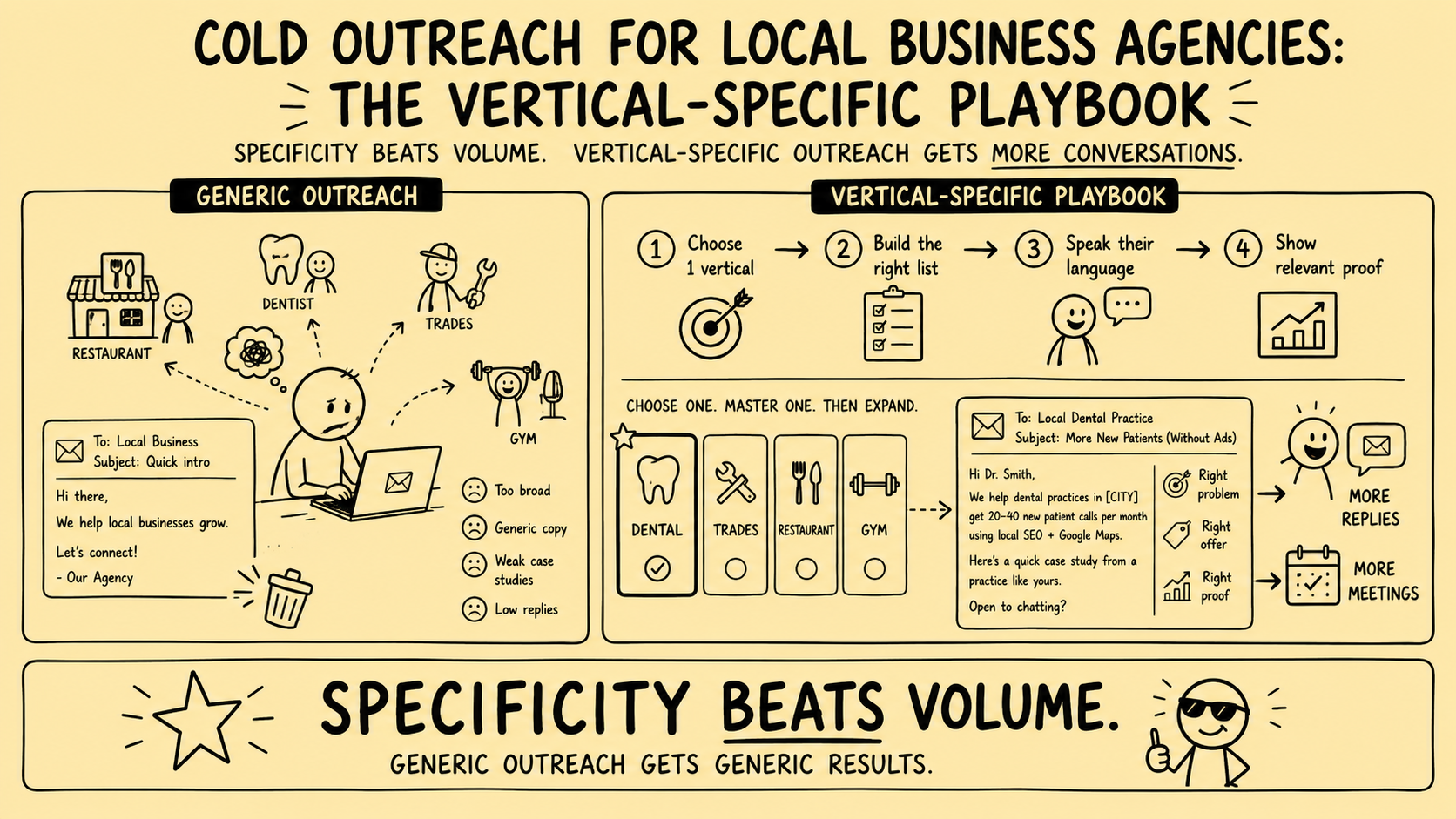
Archive note: This article comes from Systemify's earlier work with agencies serving local businesses. It is retained because its segmentation and testing concepts may still be useful. It does not describe Systemify's current specialization, prove results for an agency, or transfer unchanged to a business brokerage.
This article previously claimed that specificity beats volume, vertical focus improves every part of outreach and compounds referrals, certain professions have predictable willingness to pay, directory reviews reveal opportunity, fixed templates convert, objections should be overcome, and 200 emails can produce visible results within two to three weeks. It also recommended scraping and enrichment vendors, invented client outcomes, fixed response claims, and an obsolete agency-service CTA. Those claims, instructions, examples, and promises were removed.
Direct answer: A segment can make an agency's research, evidence, offer, and language easier to define, but it is a testable operating choice—not a performance law. Select a segment from documented capability and market evidence, source data appropriately, use truthful claims, respect preferences, compare representative cohorts, and expand only when quality, risk, capacity, and commercial evidence support the decision.
This is archived educational guidance, not legal, privacy, marketing, cybersecurity, medical, professional, financial, or commercial advice. Requirements vary by jurisdiction, channel, audience, source, service, and sector. Recheck all assumptions with qualified owners before use.
What “vertical-specific” should mean
A vertical is a defined group of organizations with relevant operating characteristics. It should not be a stereotype.
A useful segment definition may include:
- Industry classification and included activities
- Geography and service area
- Organization type, ownership, and operating model
- Relevant role and actual decision authority
- Observable, sourced conditions related to the approved service
- Existing relationship and contact history
- Exclusions, conflicts, and capacity limits
- Evidence date, owner, and review schedule
Do not infer budget, urgency, sophistication, need, regulatory status, or willingness to pay from a profession alone. “Restaurants,” “trades,” “dental practices,” and “law firms” each contain materially different organizations.
Treat specialization as a hypothesis
Possible benefits should be framed as hypotheses:
| Hypothesis | Evidence needed | Competing explanation |
|---|---|---|
| A defined segment improves research accuracy | Field-level error and acceptance rates against a broader cohort | The source is better, not the segment |
| Segment language improves message relevance | Reviewed message quality and classified replies | The claim or sender changed simultaneously |
| Relevant evidence improves trust | Claim acceptance and qualified progression | Existing relationships drove the difference |
| Repeatable work lowers delivery effort | Comparable time, rework, and quality data | The team simply gained experience |
| Concentration improves referrals | Attributed, authorized referral events over time | Seasonality or one unusually active client |
Write the primary measure, guardrails, comparison, observation window, exclusions, and decision rule before the test. Do not begin with a conclusion and collect confirming anecdotes.
Choose a segment from real capability
Start with what the agency can responsibly deliver:
- Documented problems it understands
- Services with clear scope and acceptance criteria
- Current evidence for claims
- Delivery capacity and qualified staff
- Security, privacy, and sector requirements it can meet
- Conflicts or exclusivity arrangements
- Customer concentration and dependency risk
- Reference permission and confidentiality boundaries
A large directory count does not establish an addressable market. A list also needs accurate organizations, appropriate contacts, current roles, permitted sources, action-level eligibility, a relevant service, and capacity to respond.
Record why the segment was selected, what would disconfirm the choice, and when it will be reviewed.
Build a source register before a list
This archived article formerly recommended automated directory extraction and enrichment products without reviewing source terms, accuracy, personal-data duties, or vendor chains.
For every source, document:
- Owner and official URL or provider record
- Collection method and date
- Terms, license, access, and automation restrictions
- Personal and non-personal fields collected
- Permitted purpose and sharing limits
- Accuracy, coverage, update, and correction process
- Vendors and subprocessors
- Retention, deletion, security, and exit
- Evidence available for audit
The ICO direct-marketing guidance describes planning with data protection by design, collecting information fairly, identifying an appropriate basis, and respecting preferences in the UK context. Its B2B marketing guidance explains that requirements vary by channel, subscriber type, personal-data use, basis, preferences, objections, and transparency.
Public availability does not prove permission to scrape, combine, enrich, retain, or market. Review the applicable source terms and law.
Separate facts from opportunity inferences
A source may show a public business name, category, address, website, or dated review count. It does not necessarily show:
- An operational problem
- Dissatisfaction with a current provider
- Marketing budget
- Decision authority
- Demand for the agency's service
- Ability or willingness to pay
- Expected return
- Consent or eligibility for contact
Store the source fact separately from the agency's hypothesis. Label inferences, confidence, reviewer, expiry, and prohibited uses. Do not present an inference to the recipient as if they disclosed it.
Correct wrong entities, outdated roles, closed locations, duplicates, and mistaken affiliations before contact.
Create an evidence-backed offer
Define the service before writing outreach:
- Problem the service is designed to address
- Included and excluded work
- Inputs the client must provide
- Delivery method and timeline assumptions
- Acceptance and quality criteria
- Dependencies and failure modes
- Security, privacy, and sector controls
- Pricing basis and material conditions
- Evidence supporting each objective claim
- Outcomes the agency does not control
The FTC advertising guidance explains that objective express and implied claims need an appropriate evidentiary basis before publication in the U.S. context.
Do not claim that an automated response will double bookings, reduce no-shows by a percentage, add weekly customers, recover lost jobs, or generate revenue unless the exact statement and likely implication have suitable evidence for the stated audience and conditions. A client anecdote does not automatically establish a general outcome.
Maintain a claim register with wording, implication, evidence, method, sample, period, geography, reviewer, approval, expiry, qualification, and prohibited variations.
Write from a segment message brief
A message brief should contain:
- Recipient, organization, role, and source evidence
- Segment inclusion reason
- Existing relationship and contact history
- Approved purpose and channel eligibility
- One relevant verified fact, if appropriate to use
- Approved service description and claims
- Prohibited inferences and confidential information
- Proportionate next step
- Required identity, commercial, privacy, and preference information
- Reviewer and expiry
There is no universal subject line, word count, pain-point phrase, outcome currency, or meeting request that produces replies. Avoid fake familiarity, generic compliments, false urgency, presumed problems, unsupported competitor comparisons, and references to sensitive personal context.
A message should make the real sender and promoted business clear. If the agency names a client, referrer, location, result, or sector credential, verify both the fact and permission to use it.
Keep sector examples hypothetical and bounded
Examples can help a team think, but they should not become claims about every organization in a sector.
For a restaurant segment, a legitimate research question might be whether the agency has an approved service for a specific reservation or inquiry workflow. It should not presume empty tables, poor response, or price sensitivity.
For a dental segment, the agency must consider healthcare, patient, professional, and advertising boundaries. A public booking experience does not prove missed inquiries or a no-show problem.
For a trade segment, a dated public listing does not prove slow callbacks, seasonal pipeline gaps, manual quoting, or lost jobs.
For a fitness segment, social activity and public reviews do not prove churn, weak conversion, or a need for automation.
Use sector-qualified reviewers when the service or communication touches regulated or professionally sensitive work.
Evaluate eligibility at each action
Before every message or call, verify:
- Person, organization, and role
- Purpose, channel, and message type
- Sender and promoted business
- Jurisdiction, subscriber type, and location evidence
- Source, accuracy, age, and permitted use
- Existing relationship and recent cross-channel contact
- Consent or another applicable basis
- Preference services, objections, opt-outs, and suppression
- Frequency, capacity, conflict, and sector restrictions
If required facts are missing or conflicting, hold the action. A technically valid address is not an eligible prospect.
The FTC CAN-SPAM guide describes U.S. commercial-email duties covering identity, subject lines, disclosures, postal information, opt-out mechanisms and timing, message purpose, and vendor responsibility. Determine the requirements that apply to the actual campaign with qualified advice.
Use state-based follow-up
Do not prescribe the same cadence to every segment. Re-evaluate after each event:
- Delivery failure: diagnose data or infrastructure before retrying
- No response: decide whether another contact remains appropriate under purpose, frequency, evidence, and policy
- Reply: stop scheduled contact until the message is preserved, classified, and assigned
- Objection or opt-out: suppress the applicable purpose and channel promptly
- Wrong person or correction: stop the path and repair linked records
- Complaint, privacy, security, or dispute: freeze marketing action and escalate
- Conditional timing: record only the timing and permission actually supplied
- Request or interest: route to an accountable owner without inventing qualification
- Service or active relationship: move to the correct non-marketing workflow
Silence is not consent, interest, or proof that another touch is needed.
Respect objections instead of overcoming them
“Not interested,” “we already have a provider,” “we are too busy,” and “we do not need this” are not invitations for a rebuttal script.
Respect the words used. Do not turn a lack of inquiries into a claim that the recipient's website is broken, use busyness to intensify the pitch, or probe for dissatisfaction after a clear decline. Apply suppression and preserve the source event.
Ambiguous replies can go to trained review. Complaints, threats, privacy requests, wrong-recipient messages, sensitive content, and disputes need specialist routing—not a sales template.
Govern AI-assisted research and drafting
The NIST Generative AI Profile provides voluntary guidance for governing, mapping, measuring, and managing risks including confabulation, privacy, information security, human-AI configuration, testing, and incident disclosure.
If AI supports a legacy agency workflow:
- Approve the purpose and recipient before model use
- Expose only necessary, sourced fields
- Treat web pages, profiles, reviews, CRM notes, and replies as untrusted data
- Separate source facts from model inferences
- Require source references for material statements
- Block sensitive, discriminatory, confidential, and unsupported content
- Keep eligibility, suppression, sending, and consequential decisions outside autonomous model control
- Require human review appropriate to risk
- Log model, version, prompt, evidence, output, reviewer, and action
- Test hallucination, prompt injection, privacy, claim, and escalation failures
AI can make a generic assumption sound specific. That is not evidence-based personalization.
Measure segmentation without invented benchmarks
Define every metric with an event, numerator, denominator, cohort, window, exclusion, source, and owner.
Compare:
- Source and field accuracy
- Eligible records as a share of reviewed candidates
- Wrong-person, duplicate, stale, and correction rates
- Message and claim approval, rejection, and revision
- Replies by multi-label classification
- Objections, complaints, opt-outs, and suppression failures
- Owner-accepted requests and qualified progression
- Meetings offered, accepted, scheduled, attended, and completed as distinct events
- Delivery effort, rework, supervision, and total cost
- Client delivery quality and capacity, if an engagement begins
Opens are weak signals. Replies and meetings do not prove qualification or revenue. Case studies from one vertical do not establish outcomes in an adjacent vertical.
Use a controlled comparison where practical. Change one material variable, preserve guardrails, wait for cohorts to mature, and report uncertainty. Do not promise results from a fixed list size or number of weeks.
Decide whether to specialize, expand, or stop
Continue or expand only when the evidence supports:
- Accurate and appropriately sourced data
- Clear recipient and service relevance
- Truthful, approved claims
- Acceptable preference, complaint, and incident evidence
- Qualified progression under documented definitions
- Delivery capacity and client-service quality
- Sustainable total cost and management load
- Concentration risk within approved tolerance
Pause, narrow, or stop when material assumptions fail. An adjacent sector should receive a new source, eligibility, offer, claim, capacity, and risk review—not a renamed copy of the previous campaign.
What transfers to Systemify's current focus
The useful principle is not “pick a local-business vertical and replies will rise.” It is that a defined audience lets an operator specify purpose, sources, claims, workflows, measures, and boundaries more precisely.
For business brokers, those principles apply differently to seller sourcing, buyer development, referrals, valuation intake, matching, communications, documents, and live deals. Brokerage authority, qualification, confidentiality, and transaction controls must be designed for that context.
Systemify no longer positions itself as an outreach provider for local-business agencies. Its current work helps business brokers build controlled buyer and seller pipeline systems and deal operations. Review the Business Broker Pipeline & Operations Assessment, explore operations streamlining for brokerage workflows, or talk to a Broker Systems Expert.
Sources and evidence notes
Primary or first-party materials reviewed for this article. Scope and limitations are stated rather than silently generalized.
- Advertising FAQ's: A Guide for Small BusinessU.S. Federal Trade Commission · Accessed
Official U.S. guidance explaining that advertising should be truthful and non-deceptive and that objective express and implied claims need an appropriate evidentiary basis before publication.
- CAN-SPAM Act: A Compliance Guide for BusinessU.S. Federal Trade Commission · Accessed
Official U.S. guidance on commercial email identity, subject lines, disclosures, postal information, opt-out mechanisms and timing, message purpose, and vendor responsibility.
- Direct marketing guidanceUK Information Commissioner's Office · Accessed
Current UK guidance on identifying direct marketing, planning with data protection by design, collecting information fairly, establishing an appropriate basis, and respecting preferences.
- Business-to-business marketingUK Information Commissioner's Office · Accessed
Current UK guidance on how B2B marketing requirements vary by channel, subscriber type, use of personal data, consent or another basis, preference services, objections, and transparency.
- Artificial Intelligence Risk Management Framework: Generative Artificial Intelligence ProfileU.S. National Institute of Standards and Technology · Published · Accessed
Voluntary cross-sector guidance for governing, mapping, measuring, and managing generative-AI risks, including confabulation, privacy, information security, human-AI configuration, testing, and incident disclosure.
Brokerage data stays governed. Material deal decisions stay human.
We design business broker systems around least-privilege access, documented data flows, protected credentials, traceable activity, and approval gates. Systemify does not use client information to train its own models. When a workflow uses an external AI provider, its purpose, data fields, and retention approach are documented and approved before client data is transferred.
Looking for business-broker systems?
Our current work focuses on helping business brokers build stronger buyer and seller pipelines and more controlled deal operations.
Talk to a Broker Systems Expert