
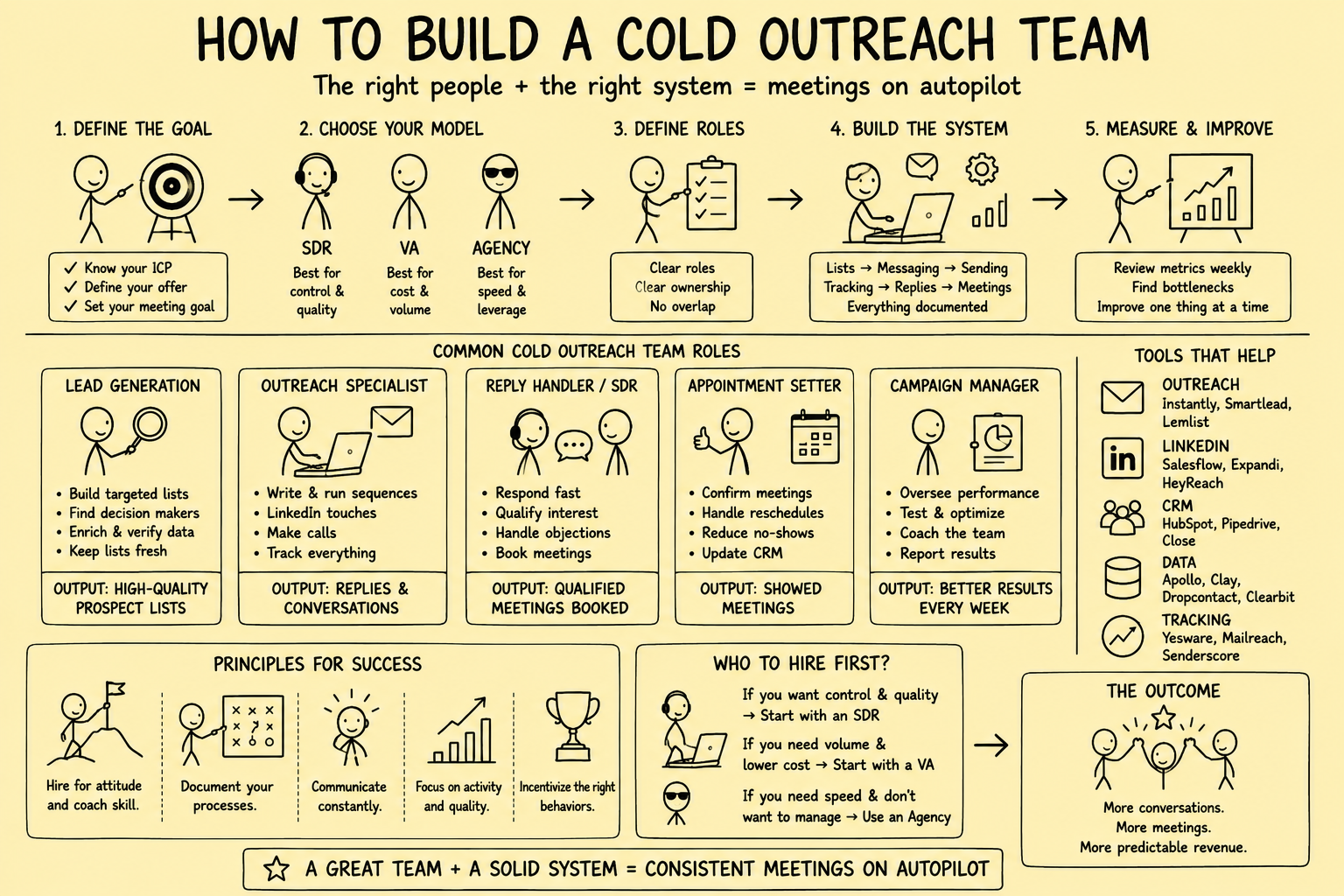
A job title does not tell a brokerage which work is safe to delegate. An internal sales development representative, virtual assistant, contractor, managed service, or agency can each be suitable for some tasks and unsuitable for others. The decision depends on authority, access, supervision, evidence, operating risk, and total cost.
This article previously presented unsupported UK salary and overhead figures, location-based contractor prices, agency retainers, pay-per-meeting prices, daily email volumes, monthly meeting ranges, ramp times, management hours, and quality ceilings. It then declared a best option for each growth stage. Those figures, geographic labor assumptions, vendor mentions, performance promises, and universal recommendations were removed.
Direct answer: Define the work before choosing the worker. Keep seller intent, buyer qualification, valuation, confidential disclosure, representation, negotiation, complaints, and live-deal decisions with authorized owners. Compare internal staff, assistants, agencies, and hybrid models against the same work sample, controls, supervision load, evidence quality, total cost, and exit requirements.
This is operating guidance, not legal, employment, tax, privacy, marketing, licensing, cybersecurity, valuation, or transaction advice. Worker classification, brokerage authority, communication rules, and professional duties vary by jurisdiction and facts. Qualified owners and advisers should approve the model.
Replace titles with a work inventory
“Hire an SDR” and “outsource outreach” are solution labels. Start with the activities the brokerage actually needs:
| Work area | Example activities | Default authority boundary |
|---|---|---|
| Strategy | Define markets, seller and buyer purposes, positioning, capacity, and risk appetite | Brokerage leadership owns |
| Research operations | Collect approved fields, preserve sources, resolve entities, check recency, and flag uncertainty | Delegable under controlled access and review |
| Eligibility | Apply jurisdiction, channel, relationship, purpose, and suppression rules | Policy owner approves; deterministic controls enforce where possible |
| Campaign operations | Prepare approved segments, load reviewed copy, schedule tests, monitor delivery, and reconcile status | Delegable after approval; no unilateral scope change |
| Reply operations | Preserve replies, apply stops, propose labels, and route exceptions | Low-risk administration may be delegated; sensitive or consequential replies escalate |
| Appointment coordination | Offer approved availability and maintain calendar evidence | Delegable for defined meeting types and service rules |
| Seller and buyer decisions | Infer intent, qualify, value, disclose, represent, negotiate, or change a matter | Authorized broker or designated professional owns |
| Quality and risk | Approve policies, sample decisions, review incidents, audit access, and stop operations | Named internal owner remains accountable |
For each activity, document the input, output, permitted decision, prohibited decision, system access, evidence standard, reviewer, service level, escalation path, retention, and failure consequence.
Separate prospect operations from deal work
A prospect list and a live transaction should not sit inside the same permission envelope.
Use distinct access classes for:
- General business and market research
- Prospective seller records
- Prospective buyer records
- Existing relationships and referrals
- Qualified buyer profiles
- Seller mandates and engagement records
- Confidential opportunities and marketing materials
- Offers, diligence, financing, negotiation, and closing records
Someone who can clean prospect data does not thereby need access to valuations, buyer identities, confidential information memoranda, data rooms, offers, or negotiation notes. Someone who schedules a general introduction does not need authority to characterize a buyer as qualified or a seller as motivated.
Make authority visible in the system. A task assignment is not professional authority, and a CRM permission is not permission from the parties to disclose information.
Define the accountable internal owner first
Every model—including a fully outsourced one—needs an internal owner who can:
- Approve purpose, audience, claims, channels, and capacity
- Decide what requires licensed or professionally authorized judgment
- Approve data sources, vendors, models, templates, and changes
- Control suppression, complaints, confidential data, and incidents
- Review performance and quality evidence
- Stop campaigns and revoke access
- Accept, reject, or escalate seller and buyer progression
- Own vendor renewal, remediation, and exit
If no one has time or competence to perform these duties, outsourcing does not fix the operating gap. It can hide it behind a retainer.
Option 1: build internal capability
An internal employee can develop firm-specific context, sit closer to brokers, and support fast feedback. Internal status does not automatically produce quality, reduce risk, or eliminate management work.
This model may fit when the brokerage has durable work, a trained manager, stable policies, enough learning value to justify internal capability, and systems that support supervision.
Assess:
- Which activities fill a sustained role rather than a temporary project
- Whether the manager can coach research, communications, preference handling, and escalation
- How local employment, compensation, monitoring, and recordkeeping requirements apply
- Whether the role can succeed without making unauthorized brokerage decisions
- Whether quality can be reviewed from retained evidence rather than activity counts
- What happens during absence, turnover, or a change in market focus
Do not define success as messages sent or meetings booked. A worker can increase those counts while degrading fit, consent, confidentiality, broker capacity, and reputation.
Option 2: use an assistant or independent specialist
An assistant or contractor can add flexible execution capacity for bounded, documented work. The model is not inherently “cheap,” and geography is not a capability or risk rating.
Good candidate tasks include approved research, source capture, data-quality review, sequence administration, calendar coordination, reporting, and routing. The brokerage should validate what local employment, contractor, licensing, privacy, and marketing rules permit.
Do not ask a generalist to improvise:
- Why an owner should sell
- Whether a buyer is qualified
- What a business may be worth
- Which confidential facts can be disclosed
- How to overcome a stop or complaint
- What position to take in a live transaction
Use named instructions, bounded systems, representative training cases, approval gates, and sampled review. Contractor status should never become a reason to reduce supervision or security.
Option 3: engage a managed provider or agency
An agency may supply specialized infrastructure, campaign operations, staffing coverage, or management. It does not guarantee faster learning, qualified meetings, lower oversight, vertical expertise, or a compliant system.
The ICO controller-processor guidance describes contract topics including documented instructions, confidentiality, security, sub-processors, rights assistance, audits, and end-of-contract provisions in the UK context. Its controller-responsibility guidance says controllers should assess sufficient guarantees and monitor processor compliance; the ICO currently notes that this guidance is under review following legislative change.
Before procurement, require evidence for:
- Legal entity, ownership, locations, insurance, and accountable contacts
- Exact scope, exclusions, deliverables, acceptance criteria, and change control
- Data sources, provenance, permitted purposes, and deletion
- Systems, hosting regions, model providers, subprocessors, and approval rights
- Identity, access, authentication, logging, exports, devices, and support access
- Copy, claim, channel, preference, and suppression controls
- Human review, training, quality sampling, escalation, and incident response
- Source-record ownership, portability, transition support, and secure deletion
- Reporting definitions and raw evidence available to the brokerage
- Term, renewal, pricing units, pass-through costs, remedies, and exit
The NIST cybersecurity supply-chain publication provides a structured approach to identifying, assessing, and mitigating risks introduced through acquired products, services, and suppliers. Review the full delivery chain, not only the agency brand.
The brokerage cannot outsource accountability by assumption
Contracts can allocate operational responsibilities, but a vendor relationship does not automatically transfer every obligation.
The FTC CAN-SPAM business guide states that a business whose offering is promoted may retain responsibility even when another company sends the email. The FTC telemarketing guide addresses seller and telemarketer responsibilities, written procedures, training, do-not-call controls, monitoring, and recordkeeping under the rule's scope.
For every channel and jurisdiction, identify:
- Who determines purpose and audience
- Who sources, verifies, and licenses the data
- Who approves the message and claim evidence
- Who checks eligibility immediately before contact
- Who sends or places the call
- Who receives replies, stops, complaints, and privacy requests
- Who updates suppression and proves propagation
- Who preserves records and answers an audit
- Who pauses the system and manages an incident
Have qualified counsel determine the actual roles and duties. Marketing language such as “fully managed” or “compliance included” is not a role analysis.
Option 4: design a hybrid model
Many brokerages need a deliberate combination rather than one provider type.
For example:
- Brokerage leadership owns strategy, policy, claims, and capacity.
- A research specialist prepares evidence-linked candidate records.
- An operations coordinator runs approved workflows and exception queues.
- A managed provider maintains bounded infrastructure under contract.
- A qualified broker handles seller and buyer conversations and all deal decisions.
- An independent security or privacy reviewer tests controls periodically.
The advantage is specialization. The risk is fragmented ownership. Use one system of record, stable event IDs, explicit handoffs, shared definitions, and reconciliation so that no party assumes another party handled a stop, reply, disclosure, or incident.
Compare total cost, not the headline fee
Do not use generic salary, hourly-rate, retainer, or cost-per-meeting tables as a substitute for quotes and internal data.
Build a common cost model:
Internal total cost = compensation + employment costs + recruiting + onboarding + management time + tools + data + security + workspace + absence coverage + quality review + rework + expected transition cost.
Contractor total cost = fees + sourcing + onboarding + management time + tools + data + security + quality review + rework + classification or tax advice + continuity + transition cost.
Agency total cost = setup + retainer or usage fees + pass-through tools and data + brokerage input + governance + security review + quality review + rejected work + remediation + overlap + exit and migration.
Then model failure exposure separately. Include the consequence of wrong recipients, missed stops, misleading claims, leaked confidential data, duplicate contact, unavailable source records, provider lock-in, and broker time spent on unqualified conversations.
Use ranges from actual quotes and internal time records. State currency, geography, period, taxes, employment treatment, inclusions, exclusions, volume basis, and uncertainty. Do not turn one vendor quote into a market benchmark.
Compare evidence, not promises
Give each feasible option the same bounded work sample. Include:
- Clear and ambiguous seller records
- Buyer records with missing qualification evidence
- Duplicate and stale data
- Existing relationships and suppressed contacts
- Wrong-person and entity-resolution cases
- Positive, negative, complaint, and privacy replies
- Referral and alternate-channel requests
- Confidential live-deal content that must be isolated
- Tool outage, duplicate event, and access-revocation scenarios
Score the output before revealing which option produced it where practical.
| Dimension | Evidence to inspect |
|---|---|
| Accuracy | Source match, identity resolution, field correctness, and uncertainty handling |
| Policy | Eligibility, approved claims, preferences, suppression, and prohibited actions |
| Judgment | Correct escalation and refusal to make unauthorized decisions |
| Security | Access boundaries, logging, export control, incident recognition, and deletion |
| Operations | Timeliness, idempotency, reconciliation, coverage, and recoverability |
| Commercial quality | Owner acceptance, relevant conversations, qualification progression, and broker capacity fit |
| Management | Training, review, correction, coordination, and escalation time required |
| Economics | Comparable total cost and failure exposure at the tested quality level |
A case study, testimonial, reference, or dashboard may inform due diligence, but it does not prove performance for the brokerage. Ask for definitions, denominators, exclusions, observation windows, source systems, and raw evidence.
Build the operating playbook
A useful playbook is a controlled specification, not a stack of scripts.
Include:
- Purpose and audience definitions
- Role, authority, and escalation matrix
- Approved sources, fields, uses, and retention
- Identity and entity-resolution rules
- Channel eligibility and suppression logic
- Claim register and evidence requirements
- Seller, buyer, referral, service, and live-deal boundaries
- Approved message and response patterns
- Confidentiality and opportunity-access controls
- System procedures, idempotency, and reconciliation
- Quality sampling, metric contracts, and incident thresholds
- Access reviews, offboarding, deletion, and exit procedures
Version the playbook. Record acknowledgments and training. Test competence with examples before granting production access, and retest after material changes.
Design access around the task
Use named accounts and least privilege. Separate research, campaign, CRM, calendar, reporting, and live-deal permissions. Restrict exports and bulk actions. Require strong authentication, log administrative and data actions, review access on a schedule, and remove access promptly when work ends.
Never share one administrator credential across workers or agencies. Do not grant an agency unrestricted CRM or mailbox access merely because the engagement is “done for you.” Use approved service accounts and scoped integrations where possible.
The contract and technical controls should address data return, deletion, backups, model-provider retention, support access, subprocessor change, incident notification, and evidence the brokerage can verify.
Govern AI separately from the staffing model
An internal employee, assistant, or agency may all use AI. The job title does not control the model's access or output.
The NIST Generative AI Profile provides voluntary guidance for managing risks including privacy, information security, confabulation, human-AI configuration, and ongoing evaluation.
Require disclosure of models, versions, data flows, retention, training use, retrieval sources, tools, permissions, and subprocessors. Keep eligibility, suppression, seller intent, buyer qualification, valuation, confidential disclosure, negotiation, and sending authority outside autonomous model control. Test prompt injection, unsupported claims, sensitive inferences, data leakage, and escalation failures.
Use balanced operating metrics
Define each numerator, denominator, time window, cohort, source, exclusion, and owner.
Track:
- Source and field accuracy
- Duplicate, stale, and wrong-person rates
- Eligible records as a share of reviewed records
- Suppression latency and propagation failures
- Claim and copy rejection rates
- Reply-classification accuracy and high-risk false negatives
- Correct-owner routing and unresolved-reply age
- Qualified seller and buyer progression under approved definitions
- Broker acceptance and meeting capacity
- Complaint, privacy, security, and confidentiality incidents
- Human review, correction, rework, and management time
- System availability, duplicate actions, and reconciliation failures
- Total cost by accepted unit of work and qualified progression
Messages sent, replies, and meetings are diagnostic counts. They are not proof of quality, causality, pipeline value, or completed transactions.
Pilot with stop conditions
Use a bounded segment, limited permissions, approved messages, named reviewers, and a defined observation window. Establish acceptance thresholds and immediate stop conditions before launch.
Stop or narrow the pilot for events such as:
- A missed stop or complaint
- Unauthorized confidential disclosure
- Material identity or claim errors
- Unapproved source, model, subprocessor, or channel
- Inability to reconstruct an action
- Repeated routing or reconciliation failure
- Broker capacity overload
- Quality below the agreed acceptance threshold
Compare the pilot with a valid baseline where possible. Account for list source, audience, message, channel, period, seasonality, broker availability, and cohort maturity. Do not expand merely because activity volume increased.
Plan the exit before access is granted
Whether a person leaves or a contract ends, the brokerage needs a controlled transition:
- Inventory records, workflows, domains, mailboxes, numbers, accounts, credentials, code, prompts, templates, and documentation.
- Confirm ownership and export formats before procurement.
- Transfer open replies, exceptions, approvals, suppression, and live tasks to named owners.
- Revoke accounts, sessions, API keys, forwarding, shared links, and support access.
- Rotate secrets and verify integrations.
- Return or delete data under the approved schedule, including authorized treatment of backups.
- Preserve required evidence and obtain deletion confirmation where appropriate.
- Monitor for residual sending, access, or automation after termination.
A low monthly price is not economical if the brokerage cannot recover its domains, source records, suppression history, workflows, or operational knowledge.
A decision sequence for brokerages
- Map work, authority, data, systems, risks, capacity, and current evidence.
- Remove activities that should not be delegated under the brokerage's policy and applicable requirements.
- Define the internal accountable owner and realistic supervision capacity.
- Design access, evidence, review, escalation, incident, and exit controls.
- Request comparable internal estimates and external proposals against the same scope.
- Run representative work samples and security, privacy, and operational due diligence.
- Calculate total cost and failure exposure at the required quality level.
- Pilot the best-supported model with bounded access and stop conditions.
- Review quality, progression, risk, broker capacity, and cost before expansion.
- Reassess the model when strategy, jurisdiction, systems, providers, or deal mix changes.
The operating principle
The best resourcing model is the one the brokerage can govern. It gives capable people the minimum access and authority needed for defined work, preserves evidence, escalates consequential decisions, protects seller and buyer confidentiality, and remains measurable and recoverable.
Systemify helps business brokers design buyer and seller pipeline systems, role boundaries, controlled handoffs, and operating governance. Start with the Business Broker Pipeline & Operations Assessment, review operations streamlining for brokerage workflows, or talk to a Broker Systems Expert.
Sources and evidence notes
Primary or first-party materials reviewed for this article. Scope and limitations are stated rather than silently generalized.
- Contracts and liabilities between controllers and processorsUK Information Commissioner's Office · Accessed
Current UK guidance on controller-processor roles, required contract topics, documented instructions, confidentiality, security, sub-processors, rights assistance, audits, and end-of-contract provisions. The ICO notes that this guidance is under review following legislative change.
- What responsibilities and liabilities do controllers have when using a processor?UK Information Commissioner's Office · Accessed
Current UK guidance on assessing whether a processor provides sufficient guarantees, using documented instructions, monitoring compliance, and retaining controller accountability. The ICO notes that this guidance is under review.
- Cybersecurity Supply Chain Risk Management Practices for Systems and OrganizationsU.S. National Institute of Standards and Technology · Published · Accessed
NIST SP 800-161 Revision 1 Update 1 provides guidance for identifying, assessing, and mitigating cybersecurity risks across acquired products, services, suppliers, and the wider supply chain.
- CAN-SPAM Act: A Compliance Guide for BusinessU.S. Federal Trade Commission · Accessed
Official U.S. guidance on commercial email duties and the promoted business's responsibility when another company handles sending.
- Complying with the Telemarketing Sales RuleU.S. Federal Trade Commission · Accessed
Official U.S. business guidance on the rule's scope, seller and telemarketer responsibilities, disclosures, misrepresentations, do-not-call controls, monitoring, and recordkeeping.
- Artificial Intelligence Risk Management Framework: Generative Artificial Intelligence ProfileU.S. National Institute of Standards and Technology · Published · Accessed
Voluntary cross-sector guidance for governing, mapping, measuring, and managing generative-AI risks, including privacy, information security, confabulation, human-AI configuration, and ongoing evaluation.
Brokerage data stays governed. Material deal decisions stay human.
We design business broker systems around least-privilege access, documented data flows, protected credentials, traceable activity, and approval gates. Systemify does not use client information to train its own models. When a workflow uses an external AI provider, its purpose, data fields, and retention approach are documented and approved before client data is transferred.
Apply this to your brokerage
We can assess your buyer and seller pipeline, valuation and vetting workflows, communications, documents, controls, and handoffs before recommending what to build.
Talk to a Broker Systems Expert