
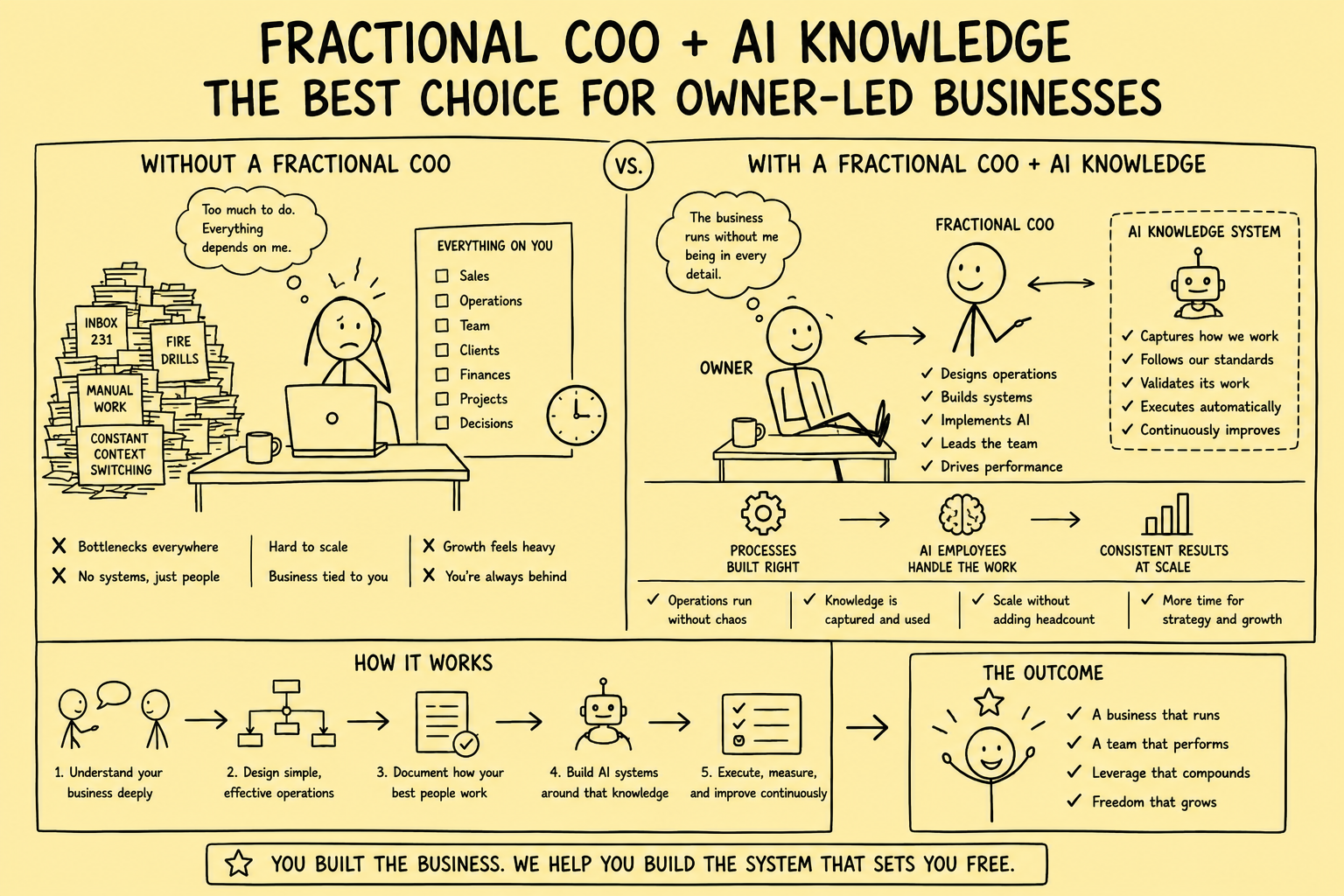
A business brokerage that depends heavily on its owner may need stronger operating leadership. It does not follow that a fractional COO—whether AI-literate or not—is automatically the best hire.
This article previously declared a fractional COO with AI knowledge the best choice, defined readiness using unsupported revenue and team-size bands, contrasted provider types with generalized limitations, predicted implementation in six to twelve weeks, and suggested that reducing owner dependency could support a stronger valuation and sale price. Those universal recommendations, arbitrary thresholds, timelines, competitive claims, and valuation implications were removed.
Direct answer: Diagnose the operating constraint before selecting a role. Separate executive accountability, broker authority, process ownership, systems delivery, data governance, and change management. Then decide whether the evidence supports clearer internal ownership, an operations manager, full-time executive, fractional leader, consultant, systems partner, technical specialist, or a controlled combination.
This is operating guidance, not legal, employment, tax, accounting, privacy, cybersecurity, licensing, valuation, investment, or transaction advice. Authority and professional duties vary by jurisdiction, firm, engagement, and matter. Qualified owners and advisers should approve the model.
Start with the problem, not the title
“The owner is a bottleneck” is an observation, not a diagnosis. The same symptom can come from different causes:
| Possible constraint | Evidence to collect | Possible response |
|---|---|---|
| Unclear decision rights | Repeated approvals, reversals, and escalations without a named owner | Clarify authority and policy before hiring |
| Insufficient management capacity | Valid responsibilities consistently exceed available owner and manager time | Add internal or fractional operating capacity |
| One broken workflow | Delays and rework cluster in a bounded process | Use a process or systems engagement |
| Weak implementation | Approved processes exist but systems, training, or adoption are incomplete | Add program, change, or technical delivery support |
| Missing professional capacity | Brokerage judgments wait for one authorized person | Add qualified brokerage capacity; do not substitute an operator |
| Fragmented data and controls | Duplicate records, missing evidence, inconsistent access, or failed reconciliation | Assign data and systems ownership |
| Strategy uncertainty | The firm has not chosen markets, services, priorities, or capacity | Leadership must decide before process optimization |
| Temporary transition | Acquisition, succession, integration, departure, or platform change creates bounded work | Use interim or project leadership with an exit plan |
Collect event-level evidence: what stopped, who waited, which decision was missing, the consequence, recurrence, workarounds, systems involved, and whether the owner intervention added necessary judgment or merely compensated for poor design.
Separate six kinds of authority
An operating-leadership engagement fails when access, responsibility, and authority are treated as the same thing.
- Governance authority: owners or directors set strategy, risk appetite, capital priorities, and executive accountability.
- Brokerage authority: appropriately authorized professionals control representation, qualification, valuation conclusions, conflicts, disclosure, negotiation, and live matters.
- Process ownership: a named person defines outcomes, service levels, exceptions, controls, and improvement.
- People leadership: an authorized manager assigns work, coaches performance, resolves capacity issues, and manages change.
- Systems authority: designated owners approve architecture, access, integrations, data flows, releases, incidents, and recovery.
- Delivery responsibility: staff, consultants, or providers complete defined work within those boundaries.
A fractional title does not grant corporate authority. A system login does not grant permission to disclose seller or buyer information. An AI recommendation does not transfer professional accountability.
Create an authority register for every major workflow. Record who is accountable, who may decide, who performs, who reviews, who must be consulted, and who receives evidence.
Map the brokerage operating system
Do not begin with generic departments. Trace the actual seller, buyer, and deal journeys:
- Market and relationship development
- Seller sourcing, inquiry, and qualification
- Engagement, discovery, and information collection
- Valuation inputs, professional analysis, and approval
- Buyer development, identity, criteria, and qualification
- Listing preparation and controlled opportunity disclosure
- Matching, introductions, and confidentiality gates
- Offers, negotiation, diligence, financing, and closing coordination
- Post-close obligations and relationship management
- Finance, reporting, people, vendors, security, and compliance support
For each stage, map inputs, source evidence, owner, decisions, handoffs, systems, permissions, outputs, exceptions, service levels, risks, controls, and reconciliation. Distinguish a missing process from a process people do not follow and from a process the system cannot support.
Preserve professional and transaction boundaries
An operations leader or systems partner can help design how work moves. That does not make the person a broker, appraiser, lawyer, accountant, tax adviser, lender, or transaction principal.
Keep qualified authority over:
- Whether and how the firm represents a seller or buyer
- Conflicts and engagement terms
- Seller intent, readiness, and approved positioning
- Buyer identity, authority, criteria, capacity, and qualification
- Valuation methods, assumptions, adjustments, conclusions, and communication
- Confidentiality, staged disclosure, and opportunity access
- Offers, negotiation positions, diligence judgments, financing, and closing decisions
- Legal, tax, accounting, licensing, and regulatory interpretation
The operating model should make these gates easier to execute and audit. It should not route around them in the name of speed or owner independence.
Decide which capability is actually missing
Clearer internal ownership
Sometimes the firm already has capable people but has not assigned decisions, measures, or exception authority. A responsibility matrix, policy update, workflow redesign, and management cadence may solve the problem without a new executive role.
Operations manager or program lead
This may fit when the work is execution, coordination, reporting, and continuous improvement inside an established strategy. Define which decisions the role owns and which remain with leadership or qualified brokers.
Full-time operating executive
This may fit when executive operating accountability is continuous, broad, sufficiently complex, and supported by the organization's governance and resources. Estimate the full scope and total cost using current employment and market evidence rather than a generic revenue threshold.
Fractional or interim operating leader
This may fit when senior cross-functional leadership is needed but the scope or duration does not support a permanent executive, or during a defined transition. Specify authority, availability, conflicts, deliverables, knowledge transfer, decision forums, and the conditions for renewal, conversion, or exit.
Operations consultant
This may fit when diagnosis, target-state design, policy, facilitation, or independent review is the main need. Make clear whether the consultant recommends, implements, manages, or accepts operating responsibility.
Growth and deal-operations systems partner
This may fit when the brokerage has an approved operating direction but needs buyer and seller pipeline architecture, workflow controls, integrations, data quality, automation, reporting, or implementation. A systems partner should not present itself as the brokerage's executive or qualified transaction decision-maker unless a separate, valid role actually exists.
Technical specialist
This may fit for a bounded platform, integration, data, security, or AI requirement. Do not ask a software implementer to redesign governance by accident, and do not let a tool determine the operating model.
Hybrid team
A brokerage may use leadership, broker owners, internal operations, systems delivery, and specialist review together. The model works only when interfaces are explicit and one internal owner can resolve conflicts.
Compare options using one operating brief
Write the brief before speaking with candidates:
- Current state and evidence
- Desired operating outcomes
- In-scope and excluded workflows
- Governance and professional authority boundaries
- Systems and data access
- Confidentiality and conflict constraints
- Required deliverables and acceptance tests
- Internal participants and available supervision
- Decision forums and reporting
- Risk, incident, and stop authority
- Knowledge-transfer and exit requirements
- Pricing units, assumptions, pass-through costs, and change control
Give feasible options the same representative case. Ask each to diagnose the cause, define the target state, identify what should not be automated, show authority and control points, propose evidence, explain implementation risk, and state what remains the brokerage's responsibility.
Calculate total cost without invented benchmarks
Do not choose between an employee, fractional executive, consultant, or systems partner using generic monthly prices.
Use current internal estimates and comparable proposals:
Internal role total cost = compensation + employment costs + recruitment + onboarding + leadership time + systems + security + training + quality review + absence coverage + expected turnover and transition.
Fractional or consulting total cost = professional fees + discovery + internal participation + travel where applicable + tools + data + security review + implementation + change requests + quality review + knowledge transfer + transition and exit.
Systems delivery total cost = design + build + infrastructure + licenses + data + migration + integration + testing + training + monitoring + maintenance + incident readiness + documentation + decommissioning.
State the currency, geography, tax treatment, time period, capacity assumptions, included work, excluded work, dependencies, uncertainty, and owner time. Compare cost at an accepted quality and risk level—not cost per automation or headline hourly rate.
Define evidence before promising transformation
The FTC advertising guidance explains that objective claims need an appropriate evidentiary basis before publication in the U.S. context. Claims that an operator will reduce owner hours, speed work, improve consistency, raise capacity, strengthen valuation, or increase sale price need defined support; a confident narrative is not evidence.
Create a measurement contract for each proposed outcome:
- Operational definition
- Numerator and denominator where applicable
- Baseline and comparison period
- Included workflows and exclusions
- Source systems and data-quality checks
- Cohort maturity and seasonality
- Owner and review frequency
- Confidence and known confounders
- Decision or corrective action tied to the measure
Distinguish activity, adoption, operating quality, capacity, business outcomes, and transaction outcomes. A documented SOP or deployed automation is an output. It is not proof that the operation improved.
Measure owner dependency precisely
Owner dependency is not the same as owner involvement. Some decisions properly remain with an owner or qualified broker.
Track categories separately:
- Required governance decisions
- Required professional or transaction decisions
- Exceptions caused by policy gaps
- Exceptions caused by missing data
- Rework caused by quality failure
- Approvals retained by preference rather than necessity
- Emergency intervention
- Relationship activity only the owner can appropriately perform
- Work that can be transferred after training or system changes
For each intervention, preserve the trigger, reason, decision, time, consequence, and whether the system should prevent, support, or continue escalating it. The goal is not zero owner involvement; it is intentional involvement at the correct layer.
Design controls before automation
The NIST Cybersecurity Framework 2.0 is voluntary cross-sector guidance organized around Govern, Identify, Protect, Detect, Respond, and Recover. Its governance emphasis includes organizational context, roles, responsibilities, authorities, policies, oversight, and supply-chain risk.
For brokerage systems, define:
- Data and system owners
- Named accounts, strong authentication, and least privilege
- Separation of prospect, relationship, valuation, buyer, and live-deal records
- Approved devices, locations, integrations, exports, and support access
- Logging for sensitive reads, writes, approvals, downloads, and disclosures
- Source provenance, retention, correction, suppression, and deletion
- Vendor and subprocessor review
- Backup, recovery, outage, reconciliation, and incident procedures
- Access review and offboarding
The ICO controller-processor guidance describes documented instructions, confidentiality, security, subprocessors, audit rights, assistance, and end-of-contract provisions in the UK context. The ICO notes that this guidance is currently under review following legislative change. Determine actual roles and requirements with qualified advisers.
Treat AI literacy as a governed capability
“AI knowledge” is not a job qualification by itself. Ask what the candidate has designed, how evidence was retained, how errors were measured, which risks were identified, what remained under human control, and how the system was stopped or recovered.
The NIST Generative AI Profile provides voluntary guidance for governing, mapping, measuring, and managing generative-AI risks, including confabulation, privacy, information security, human-AI configuration, testing, and incident disclosure.
For every proposed AI use case, document:
- User, purpose, and affected parties
- Approved inputs and prohibited data
- Model, version, provider, hosting, retention, and training use
- Source grounding and provenance
- Allowed output and prohibited claims
- Human reviewer and final authority
- Downstream tools and permissions
- Representative and adversarial tests
- Quality, fairness, privacy, security, and reliability measures
- Monitoring, incident, appeal, correction, and retirement procedures
Do not let AI autonomously establish seller intent, buyer qualification, valuation, conflict decisions, confidential access, representation, negotiation, or a transaction outcome.
Build adoption into the operating design
Adoption is not a training meeting after implementation. Involve the people who perform, review, and receive the work.
For each change:
- Document the current evidence and target outcome.
- Name the process owner and decision authority.
- Test the proposed workflow with representative cases and exceptions.
- Define the standard, service level, escalation, and failure mode.
- Train by role using the actual system and evidence.
- Observe use, sample outputs, and collect correction reasons.
- Resolve process, policy, capacity, or system causes rather than blaming users.
- Approve expansion only after acceptance criteria are met.
Run old and new paths in parallel only when the risk and reconciliation plan justify it. Set a cutover owner and prevent duplicate messages, tasks, documents, or deal updates.
Keep exit readiness separate from valuation promises
Operational documentation may help an owner and prospective buyer understand how the brokerage works. It does not establish a valuation or guarantee that a transaction will occur.
The U.S. Small Business Administration guidance on selling a business discusses sale planning, business valuation, multiple valuation approaches, and professional review of transaction documents. A qualified valuation and transaction team should determine how facts affect a specific business and deal.
An operating-readiness evidence room may include:
- Organization, role, authority, and succession records
- Documented seller, buyer, valuation, and deal processes
- System inventory, ownership, licenses, integrations, and access controls
- Data definitions, quality reports, retention, and incident history
- Vendor, subprocessor, contract, renewal, and exit information
- Service levels, exceptions, reconciliations, and operating metrics
- Training, adoption, quality review, and change history
- Known dependencies, limitations, remediation plans, and required owner involvement
Do not hide dependency or relabel it as proprietary knowledge. Date every artifact, identify its source and owner, and distinguish current evidence from a target-state plan.
Avoid claims that operating improvements will produce a valuation multiple, sale-price uplift, shorter diligence, faster closing, or buyer confidence unless the exact claim is supported for the stated context. Financial performance, market conditions, concentration, margins, legal and tax issues, licensing, contracts, liabilities, financing, transition, and deal structure can all matter.
Use balanced operating measures
Measure the system, not the charisma of the operator:
- Decisions with a current owner and authority record
- Workflows with complete inputs, outputs, controls, and exception paths
- Required versus avoidable owner interventions
- Cycle time by stage and exception type
- First-pass acceptance, rework, correction, and reopening
- Missing-data and evidence rates
- Service-level attainment with valid exclusions
- Adoption by eligible user and workflow
- Access, policy, confidentiality, privacy, and security incidents
- Duplicate actions and reconciliation failures
- AI unsupported-claim, reviewer-correction, and escalation rates
- Knowledge-transfer tests completed by backup owners
- Internal management and supervision time
- Total cost at the accepted quality and risk level
Business outcomes such as engagements, qualified buyers, listings, completed deals, margin, cash flow, and owner capacity should be evaluated separately with appropriate attribution. Do not treat correlation after a program as proof of causation.
Establish stop conditions and an exit plan
Pause or narrow the engagement when:
- Authority is unclear for a consequential decision
- Required evidence is missing or unreliable
- Confidential information crosses an unapproved boundary
- A provider, model, source, or subprocessor changes without review
- A material control cannot be tested
- Incidents cannot be reconstructed
- The team cannot support the change safely
- Quality falls below the approved threshold
- Scope expands without an owner, risk review, or change approval
Before access is granted, define ownership and export of documentation, workflows, code, prompts, data, domains, accounts, credentials, logs, and metrics. Include handover, open exceptions, account revocation, secret rotation, data return or deletion, backup treatment, residual automation monitoring, and verification.
A brokerage decision sequence
- Collect evidence about dependency, delay, quality, capacity, and risk.
- Map governance, brokerage, process, people, systems, and delivery authority.
- Identify the specific missing capability and duration.
- Decide what must remain with owners and qualified professionals.
- Write one operating brief with deliverables, controls, acceptance tests, and exit requirements.
- Compare feasible internal, fractional, consulting, systems, technical, and hybrid options.
- Validate claims, references, conflicts, security, data treatment, AI use, and total cost.
- Test representative work before expanding scope or access.
- Implement in controlled stages with adoption evidence and stop conditions.
- Reassess the role when strategy, volume, regulation, systems, risk, or transaction context changes.
The operating principle
The right answer is not the most impressive title or the provider with the strongest AI pitch. It is the smallest accountable operating model that solves the evidenced constraint while preserving professional authority, confidentiality, measurable control, and the brokerage's ability to operate after the engagement ends.
Systemify is a growth and deal-operations systems partner for business brokers—not the brokerage's executive, appraiser, lawyer, accountant, or transaction decision-maker. Start with the Business Broker Pipeline & Operations Assessment, review operations streamlining for brokerage workflows, or talk to a Broker Systems Expert.
Sources and evidence notes
Primary or first-party materials reviewed for this article. Scope and limitations are stated rather than silently generalized.
- Close or sell your businessU.S. Small Business Administration · Accessed
Current SBA guidance on planning a transfer or sale, using business valuation, considering multiple valuation approaches, and obtaining appropriate professional review for transaction documents.
- Advertising FAQ's: A Guide for Small BusinessU.S. Federal Trade Commission · Accessed
Official U.S. guidance explaining that advertising should be truthful and non-deceptive and that objective claims need an appropriate evidentiary basis before publication.
- The NIST Cybersecurity Framework (CSF) 2.0U.S. National Institute of Standards and Technology · Published · Accessed
Voluntary cross-sector guidance for governing, identifying, protecting, detecting, responding to, and recovering from cybersecurity risk, including roles, responsibilities, authorities, and supply-chain risk.
- Artificial Intelligence Risk Management Framework: Generative Artificial Intelligence ProfileU.S. National Institute of Standards and Technology · Published · Accessed
Voluntary cross-sector guidance for governing, mapping, measuring, and managing generative-AI risks, including confabulation, privacy, information security, human-AI configuration, testing, and incident disclosure.
- Contracts and liabilities between controllers and processorsUK Information Commissioner's Office · Accessed
Current UK guidance on controller-processor roles, documented instructions, confidentiality, security, subprocessors, audit rights, assistance, and end-of-contract treatment. The ICO notes that this guidance is under review following legislative change.
Brokerage data stays governed. Material deal decisions stay human.
We design business broker systems around least-privilege access, documented data flows, protected credentials, traceable activity, and approval gates. Systemify does not use client information to train its own models. When a workflow uses an external AI provider, its purpose, data fields, and retention approach are documented and approved before client data is transferred.
Apply this to your brokerage
We can assess your buyer and seller pipeline, valuation and vetting workflows, communications, documents, controls, and handoffs before recommending what to build.
Talk to a Broker Systems Expert