
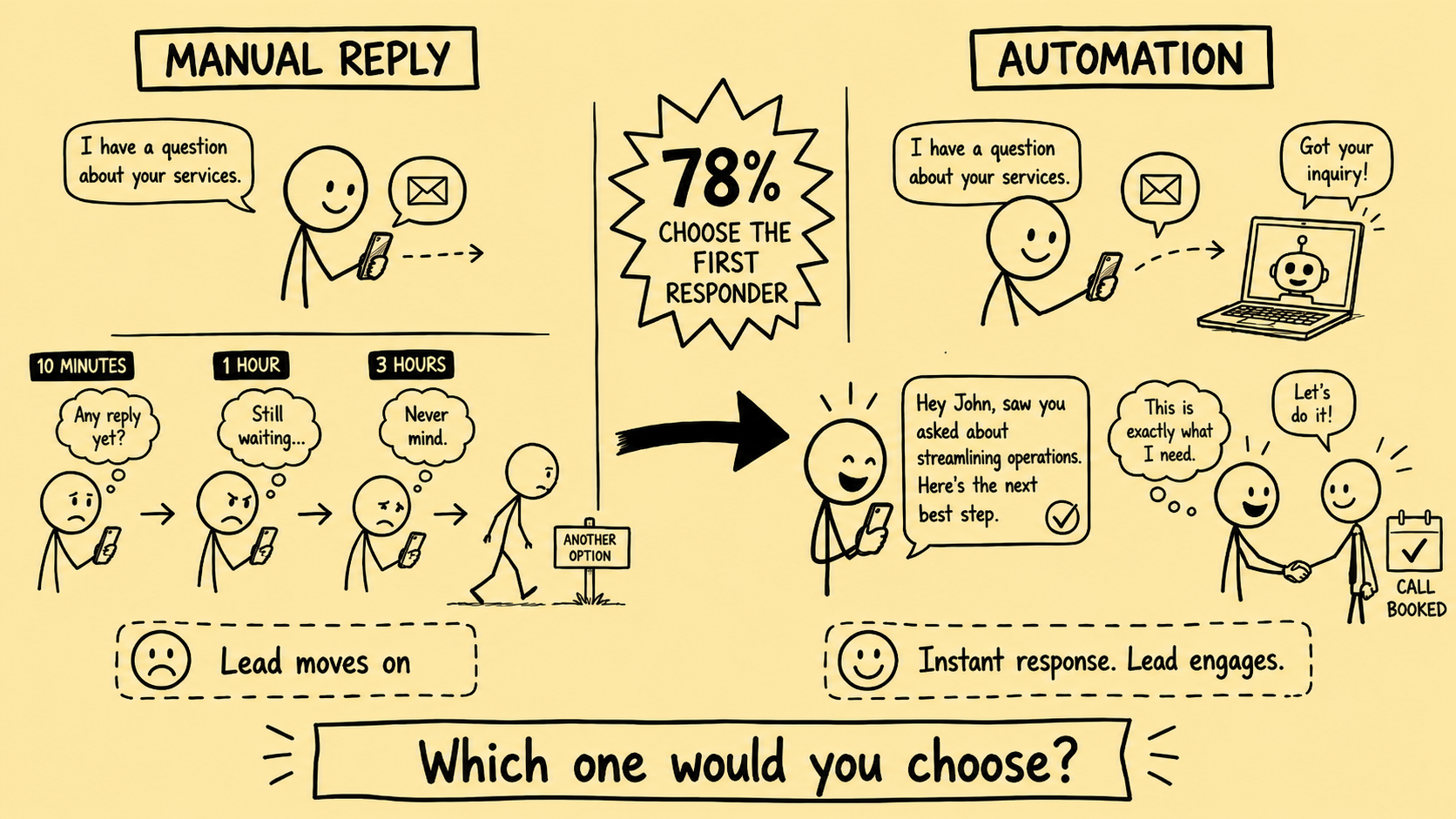
Business brokers should respond to serious buyer and seller inquiries deliberately and without avoidable delay. That operating principle is reasonable. The problem begins when a brokerage turns an unattributed internet statistic into a service promise, staffing rule, or automation requirement.
This article previously repeated two popular claims: that 78% of buyers choose the first business to respond and that the average business takes 47 hours to reply. After reviewing the available source trail, those statements needed correction.
Direct answer: We could not verify the 78% claim in the primary research reviewed. A nearly 47-hour mean does appear in a 2012 vendor audit, but the same source says slow outliers skewed the mean and its median response times were under three hours. Neither number should be presented as a current, universal business-broker benchmark.
The useful question is not whether a brokerage can repeat the fastest statistic. It is whether the brokerage can measure its own response process, protect confidential information, route each inquiry correctly, and improve the points where qualified opportunities are being lost.
What the available research actually supports
Harvard Business Review's 2011 article reports research showing that many companies handled online inquiries slowly and that faster follow-up was associated with better lead qualification. It is frequently cited in modern speed-to-lead marketing.
That study is historically important, but it does not establish that every market, inquiry, or transaction has the same optimal response window. It predates today's messaging channels, AI tools, privacy expectations, and business-broker workflows.
InsideSales' 2021 Lead Response Management report describes an analysis of millions of marketing leads and sales activities. It reports meaningful differences by response time and follow-up behavior. It is first-party vendor research, so its population, product context, definitions, and commercial incentives should remain visible when applying the findings.
The 2012 InsideSales ResponseAudit summary is the traceable source we found for the nearly 47-hour figure. Crucially, the source also says that the average was skewed by slow responses and that median response times in its reported groups were under three hours. Removing that context turns an old, scoped observation into a misleading universal claim.
Why the 78% claim was removed
A usable statistic needs more than repetition. At minimum, a brokerage should be able to identify:
- The original publisher and named researchers
- The publication date
- The population and sample size
- What counted as a buyer, response, qualification, and completed deal
- The industries, channels, and jurisdictions studied
- Whether the result shows correlation or causation
- Who funded or commercially benefits from the research
We could not establish those basics for the statement that 78% of buyers choose the first responder. The reviewed primary sources do not provide support for publishing it as fact. This article therefore no longer uses the number as a headline, promise, or decision rule.
That correction does not mean response time is irrelevant. It means the case for improving response operations should be built on traceable research and the brokerage's own pipeline data.
Measure four different response events
One response-time field is rarely enough. A useful brokerage dashboard separates at least four events:
| Event | What it measures | Why it matters |
|---|---|---|
| Receipt | Time from submission to successful capture | Detects broken forms, integrations, and imports |
| Acknowledgment | Time until the sender receives confirmation | Sets expectations without pretending qualification occurred |
| Meaningful response | Time until a responsible person addresses the inquiry | Measures actual service response rather than an automated receipt |
| Qualified next step | Time until the opportunity is routed, declined, or advanced | Shows whether speed produces useful pipeline movement |
An instant acknowledgment and a meaningful broker response are not the same thing. Reporting only the automated event can make performance look excellent while a seller inquiry still waits unassigned.
Segment before comparing response time
A seller considering a confidential exit should not necessarily enter the same workflow as a buyer requesting public listing information. Create separate measurements for:
- Potential sellers
- Active and prospective buyers
- Referral partners
- Existing clients and live deal participants
- General, vendor, recruiting, and spam inquiries
Then segment by source, working hours, geography, owner, qualification status, and outcome. Averages across unrelated inquiry types can conceal the exact failure the team needs to fix.
For every segment, report the median and a high percentile such as the 90th percentile—not only the mean. A small number of abandoned records can distort an average, exactly as the 2012 ResponseAudit source warned.
Define a brokerage-owned target
There is no responsible universal promise such as every message answered in five minutes. A practical service target should reflect:
- Inquiry intent. A seller requesting a confidential conversation may need faster human ownership than a newsletter question.
- Coverage. Working-hour and after-hour targets should be explicit rather than blended.
- Consent and channel rules. Permission to reply by email does not automatically authorize every SMS, call, enrichment, or sequence.
- Confidentiality. An automated message should not expose seller identity, financial information, deal status, or buyer criteria.
- Human authority. Automation can route and prepare context; qualified people remain responsible for valuation, matching, disclosure, and transaction decisions.
Start with the current median and 90th-percentile response times for each segment. Investigate unassigned records and failure reasons. Set an achievable improvement target, test it, and compare qualified progression—not merely reply speed.
A controlled first-response workflow
A broker-focused workflow can follow this sequence:
- Capture the inquiry and preserve its source, timestamp, consent record, and submitted fields.
- Classify the inquiry using approved rules, with a safe fallback when confidence is low.
- Assign an accountable owner and start the appropriate service timer.
- Send a limited acknowledgment that states what happens next and how to reach a person.
- Prepare a concise context summary for the assigned broker.
- Escalate unowned or overdue opportunities without exposing confidential information.
- Record the meaningful response, disposition, next step, and reason for delay.
- Review performance by segment and outcome on a regular cadence.
AI may help classify a message or draft a response, but it should not invent facts, imply that a valuation has been performed, promise buyer suitability, or release confidential deal information. Low-confidence classifications and consequential communications need human review.
What success should look like
The strongest response system is not simply the fastest. It should improve several measures together:
- Fewer inquiries lost between form, inbox, CRM, and owner
- Clearer ownership and escalation
- Faster meaningful responses within each priority segment
- Better completion of agreed next steps
- Fewer inappropriate or duplicated messages
- Documented consent, suppression, and communication history
- No material disclosure or decision released without the required approval
Track qualified conversations, signed engagements, buyer activity, and deal progression separately. A faster acknowledgment may improve the experience without causing a transaction outcome, and the reporting should not imply otherwise.
The practical conclusion
Speed-to-lead folklore is not a measurement system. Business brokers need definitions, timestamps, segments, owners, controls, and outcomes they can inspect.
Remove statistics that cannot be traced. Preserve context around older studies. Measure the brokerage's actual pipeline. Then improve response time in a way that protects confidentiality and keeps people in control of the decisions that matter.
For the next step, review buyer and seller pipeline systems or request a Business Broker Pipeline & Operations Assessment.
Frequently Asked Questions
Is the claim that 78% of buyers choose the first responder reliable?
We could not verify that claim in the primary research reviewed for this article. It should not be used as an established fact without a traceable study, sample, methodology, and population.
Does the average business really take 47 hours to respond?
A 2012 InsideSales ResponseAudit report stated a nearly 47-hour mean across its historical audit data. The same source says slow responses skewed the mean and that its median response times were under three hours. That result is not a current universal benchmark for business brokers.
What response-time target should a business brokerage use?
Set a target from the brokerage's inquiry types, staffing, consent rules, service expectations, and measured outcomes. Separate automated acknowledgment from meaningful human response and monitor both.
Should buyer and seller inquiries receive the same workflow?
Usually not. Seller opportunities, active buyers, referral partners, general inquiries, and existing deal participants can require different fields, owners, confidentiality rules, escalation paths, and response targets.
Can AI send the first response automatically?
AI can prepare or send a limited acknowledgment when the message, permissions, data use, and escalation rules are approved. Valuation opinions, buyer matching decisions, confidential disclosures, and consequential deal communications should remain under authorized human control.
Sources and evidence notes
Primary or first-party materials reviewed for this article. Scope and limitations are stated rather than silently generalized.
- The Short Life of Online Sales LeadsHarvard Business Review · Published · Accessed
Research summary about company response to online inquiries; useful historical evidence, not a current business-broker benchmark.
- Lead Response Management 2021InsideSales / XANT · Published · Accessed
First-party analysis describing its dataset and response-time findings; vendor research with scope limitations.
- ResponseAudit Research – AA-ISP 2012InsideSales / XANT · Published · Accessed
Source of the nearly 47-hour historical mean; it also reports skewed data and median response times under three hours.
Brokerage data stays governed. Material deal decisions stay human.
We design business broker systems around least-privilege access, documented data flows, protected credentials, traceable activity, and approval gates. Systemify does not use client information to train its own models. When a workflow uses an external AI provider, its purpose, data fields, and retention approach are documented and approved before client data is transferred.
Apply this to your brokerage
We can assess your buyer and seller pipeline, valuation and vetting workflows, communications, documents, controls, and handoffs before recommending what to build.
Talk to a Broker Systems Expert