
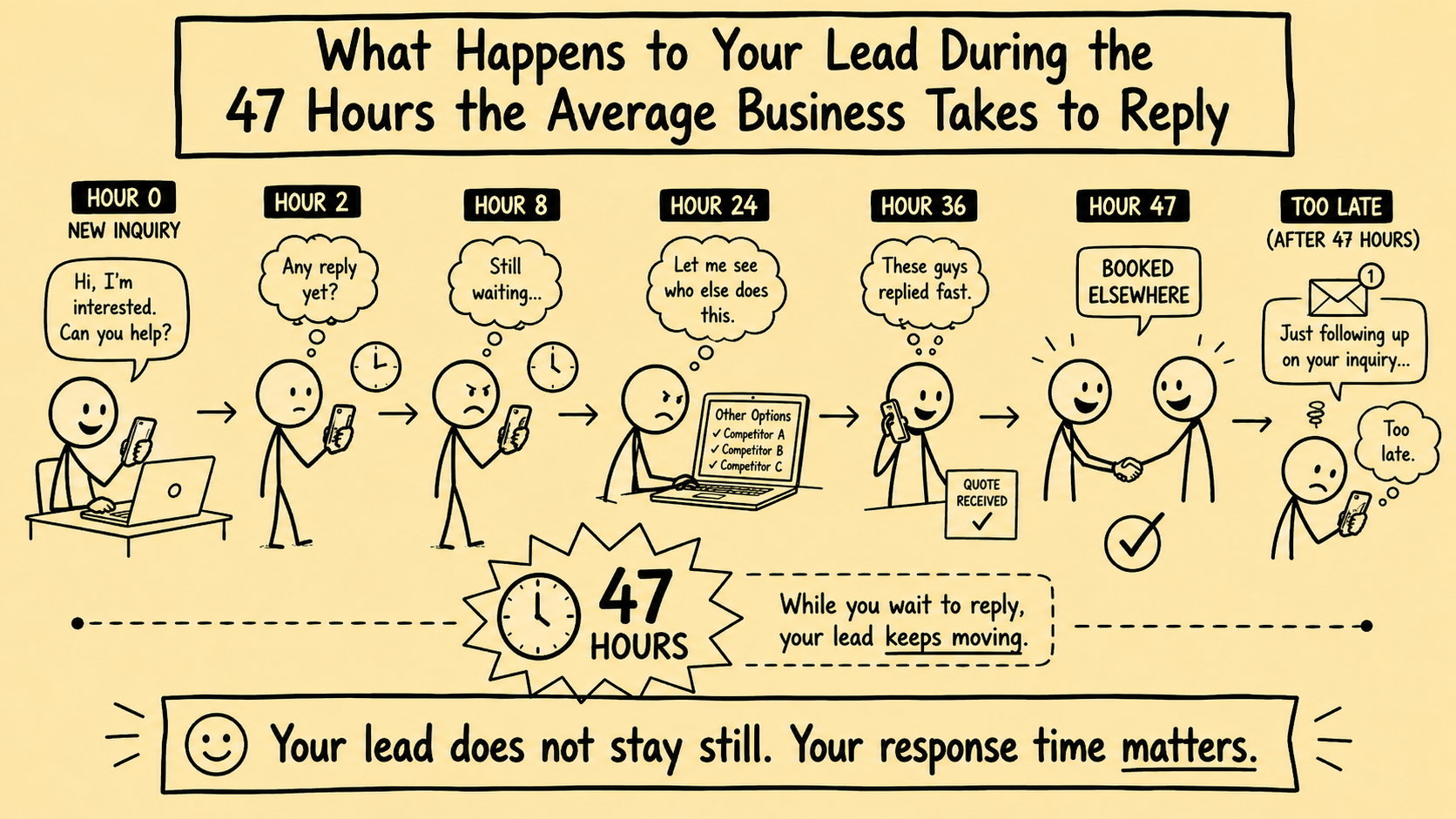
No analytics system can tell a business broker exactly what every buyer or seller does while waiting for a reply. A prospect may contact another intermediary, continue independent research, postpone the decision, speak with an adviser, or simply become unavailable. Presenting one invented timeline as universal behavior is not evidence.
What a brokerage can know is what happened inside its own pipeline: when the inquiry arrived, whether it was captured, who received it, when ownership was accepted, when acknowledgment went out, when a responsible person replied, and whether an appropriate next step occurred.
Direct answer: A response delay creates operational risk because intent can change while a record sits unowned. The fix is to measure observable workflow events, segment buyer and seller inquiries, expose assignment failures, and keep confidential or consequential communication under human control.
Why the old 47-hour story was misleading
This article previously described a fictional 47-hour sequence in which competitors replied at predetermined hours, sent personalized documents, held calls, and won the opportunity before the original business responded. Those events were not sourced and cannot be assumed for every prospect.
The traceable historical basis for the number is a 2012 InsideSales ResponseAudit publication. It reported a nearly 47-hour mean across historical secret-shopper audits. The same publication warned that a small number of slow responses pulled the average upward and stated that reported medians were under three hours.
That context matters. A historical, vendor-produced mean is not a current universal benchmark, and it says nothing specific about business-broker seller inquiries, buyer registrations, referral introductions, or live deal communications.
Harvard Business Review's 2011 research summary provides broader historical support for taking online inquiry response seriously. It still should not be converted into a guarantee that a particular response time causes a mandate or transaction.
For the full evidence correction, see Speed-to-Lead Statistics: What the Evidence Must Show.
Build a timeline from facts you control
Start with timestamps that describe the brokerage workflow rather than assumptions about the prospect:
| Timestamp | Operational question | Common failure |
|---|---|---|
| Submitted | Did the inquiry reach the intended endpoint? | Broken form, spam filter, failed import |
| Captured | Is a complete, deduplicated CRM record available? | Missing fields, duplicate record, integration delay |
| Classified | Was the inquiry type identified safely? | Buyer treated as seller, low-confidence AI result accepted |
| Assigned | Does a named person own the next action? | Round-robin failure, absent owner, unclear territory |
| Acknowledged | Did the sender receive an accurate receipt? | No confirmation, misleading promise, wrong channel |
| Accepted | Did the assigned person accept responsibility? | Notification sent but ignored or reassigned silently |
| Meaningful response | Did a person address the inquiry and set a next step? | Auto-reply counted as service response |
| Dispositioned | Was the outcome and reason recorded? | Records left open with no learning signal |
The interval between each timestamp identifies a different problem. Faster copy does not fix a form that never created a record, and a faster acknowledgment does not fix an inquiry that no one owns.
Separate acknowledgment from meaningful response
An automated acknowledgment can be useful. It confirms receipt, sets an expectation, provides a safe way to add information, and tells the sender what to do if the matter is urgent.
It should not be reported as though a broker reviewed the opportunity. A meaningful response requires enough context and authority to address the inquiry appropriately.
For a potential seller, that may mean a broker confirms the business type, location, timing, confidentiality preference, and next conversation. For a buyer, it may mean confirming acquisition criteria, capital position, geography, and the correct qualification step. The workflow should never imply that a valuation, buyer match, or engagement decision has occurred when it has not.
Track both metrics:
- Time to acknowledgment: submission to accurate confirmation
- Time to meaningful response: submission to an accountable human response
If only the first number improves, the system may be creating the appearance of responsiveness rather than better pipeline operations.
Route seller, buyer, and deal inquiries differently
A single inbox and one response target can hide important differences.
Potential seller inquiries
Seller messages may contain sensitive ownership, financial, health, partnership, or exit information. Route them to approved people, minimize copied data, and avoid revealing details in notifications or automated replies.
Buyer inquiries
Buyer registrations and listing inquiries can require identity, mandate, capital, experience, geography, sector, and confidentiality checks. Automation can collect and organize the information; an authorized person should decide suitability and disclosure.
Referral and partner introductions
An introduction from an accountant, attorney, lender, wealth adviser, or existing client may carry a service expectation and relationship context that generic scoring cannot capture.
Live deal communications
Messages tied to an active transaction are not ordinary leads. They may involve deadlines, diligence, documents, counterparties, or legal obligations and should follow the deal's communication and escalation rules.
Diagnose the six most common delay points
1. Capture failure
The message never enters the system or arrives without critical information. Monitor form delivery, integration errors, blocked messages, and required fields.
2. Classification uncertainty
Rules or AI cannot confidently determine the inquiry type. Send uncertain records to a human review queue instead of making an aggressive automatic decision.
3. Assignment without acceptance
A notification is not ownership. Require acceptance, reassignment, or escalation within a defined period.
4. Coverage gaps
Evenings, weekends, leave, and time zones create unowned periods. Define what can be acknowledged automatically and who handles true exceptions.
5. Missing context
The assigned broker must search across email, forms, CRM notes, and documents before responding. A controlled context summary can reduce preparation time without making the decision.
6. No exception management
Overdue records disappear into personal queues. Maintain a shared exception view with the owner, age, priority, failure reason, and next action.
Set service targets without inventing certainty
Create targets by inquiry segment and working-hours status. A simple starting matrix might include:
| Segment | Acknowledgment target | Ownership target | Meaningful-response target |
|---|---|---|---|
| Potential seller | Brokerage-defined | Brokerage-defined | Brokerage-defined |
| Qualified buyer | Brokerage-defined | Brokerage-defined | Brokerage-defined |
| General buyer inquiry | Brokerage-defined | Brokerage-defined | Brokerage-defined |
| Referral introduction | Relationship-defined | Relationship-defined | Relationship-defined |
| Active deal matter | Deal protocol | Deal protocol | Deal protocol |
The word “defined” is intentional. The right target depends on staffing, market, service promise, confidentiality, channel consent, and deal responsibilities. Measure the existing baseline before setting a public promise.
Review the median and 90th percentile for each segment. Also review the percentage of records with no meaningful response, because averages exclude the practical seriousness of abandoned opportunities.
Use automation at the safe points
Automation can help with:
- Capturing timestamps and source data
- Deduplicating records
- Applying approved routing rules
- Sending limited receipt confirmations
- Preparing context summaries
- Reminding and escalating
- Monitoring exceptions
- Producing daily warm-opportunity queues
It should not autonomously issue valuations, decide whether a buyer is suitable, disclose confidential seller information, or send consequential transaction communications unless the specific workflow has an explicitly approved control design.
Review outcomes, not only speed
Response time is a process measure. Evaluate it alongside:
- Percentage of inquiries successfully captured
- Percentage assigned and accepted
- Percentage receiving a meaningful response
- Qualified seller conversations
- Qualified buyer progression
- Meetings held and next steps completed
- Decline and disqualification reasons
- Complaints, opt-outs, duplicate contacts, and incorrect routing
- Exceptions resolved within policy
An improvement is credible when it reduces preventable loss without increasing inappropriate communication or weakening human judgment.
The practical conclusion
Do not narrate what every prospect supposedly did during an arbitrary 47-hour window. Instrument what the brokerage actually did, find where ownership or context failed, and improve that part of the system.
For help mapping the workflow, review broker growth and pipeline operations or request a Business Broker Pipeline & Operations Assessment.
Frequently Asked Questions
Is 47 hours the current average lead response time?
It should not be presented as a current universal average. The traceable figure comes from a 2012 InsideSales ResponseAudit summary, whose authors also said slow responses skewed the mean and that reported medians were under three hours.
What counts as a meaningful response?
A meaningful response is sent or made by an accountable person and addresses the inquiry sufficiently to set an appropriate next step. A generic automated receipt is an acknowledgment, not a meaningful response.
Should seller inquiries be prioritized over buyer inquiries?
Priority should follow the brokerage's approved rules, not a universal hierarchy. Inquiry intent, confidentiality, mandate fit, deal stage, service obligations, and existing relationships can all affect routing.
What should happen when no broker accepts an inquiry?
The record should enter an exception queue with an accountable escalation owner, a visible timer, and a defined fallback. Silent assignment failure is a systems problem, not merely an individual follow-up problem.
Can an automated acknowledgment include valuation or buyer-match conclusions?
It should not. An acknowledgment can confirm receipt and explain the next step, but valuations, suitability, confidential disclosures, and buyer–seller matching decisions should remain under authorized human review.
Sources and evidence notes
Primary or first-party materials reviewed for this article. Scope and limitations are stated rather than silently generalized.
- The Short Life of Online Sales LeadsHarvard Business Review · Published · Accessed
Historical research summary about responses to online inquiries; it supports measuring delay but is not a current brokerage service standard.
- ResponseAudit Research – AA-ISP 2012InsideSales / XANT · Published · Accessed
Historical source for the nearly 47-hour mean; the publication also states that slow values skewed the average and reported medians were under three hours.
Brokerage data stays governed. Material deal decisions stay human.
We design business broker systems around least-privilege access, documented data flows, protected credentials, traceable activity, and approval gates. Systemify does not use client information to train its own models. When a workflow uses an external AI provider, its purpose, data fields, and retention approach are documented and approved before client data is transferred.
Apply this to your brokerage
We can assess your buyer and seller pipeline, valuation and vetting workflows, communications, documents, controls, and handoffs before recommending what to build.
Talk to a Broker Systems Expert