
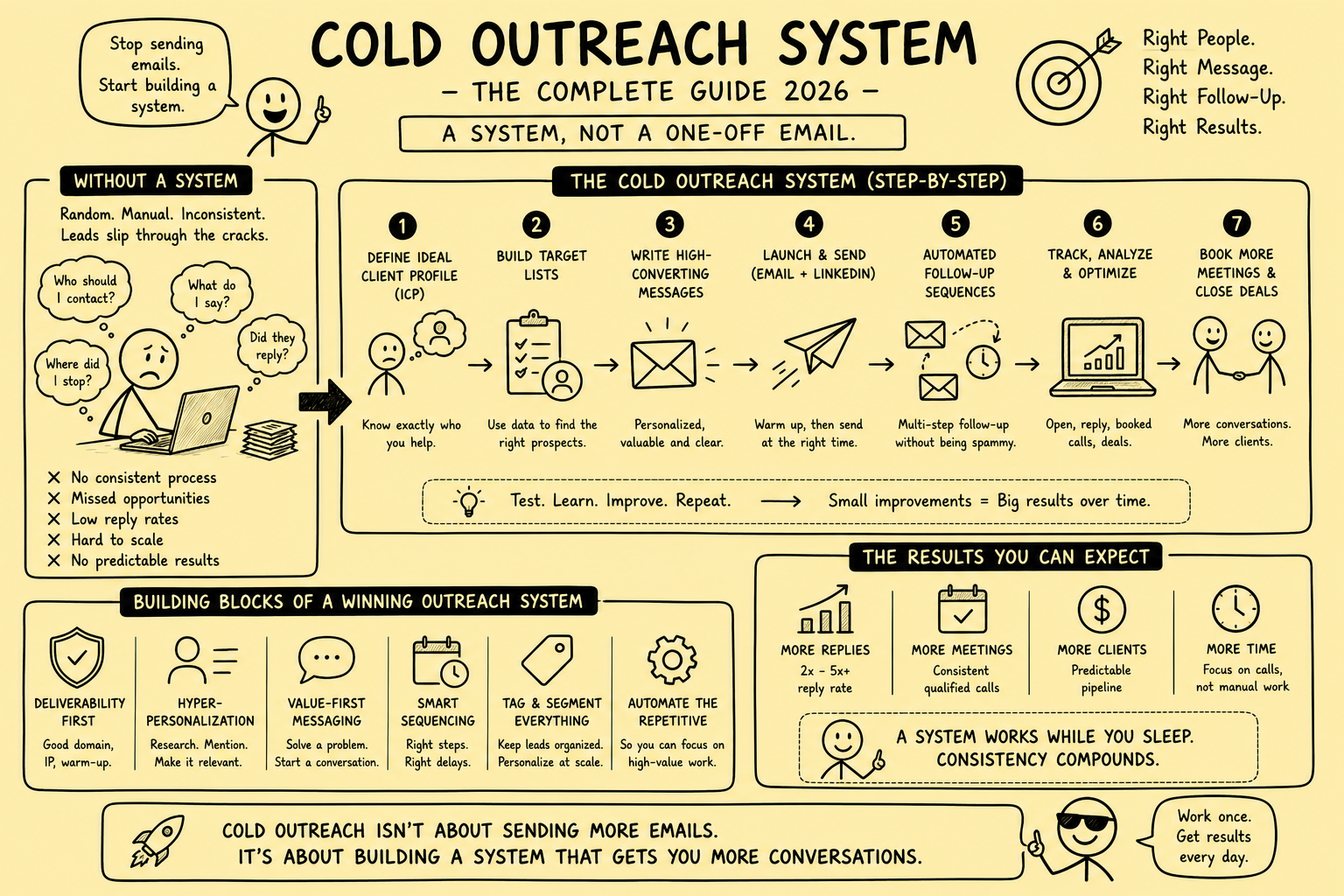
A business-broker outreach system is not a list, an email-writing formula, or software that sends follow-ups. It is the governed path from an approved relationship-development purpose to sourced data, channel eligibility, truthful claims, controlled delivery, preference handling, broker ownership, and measurable progression.
This article previously called cold outreach a predictable lead machine. It prescribed separate domain variations, mailbox and monthly-volume ratios, artificial warm-up networks, vendor rankings and prices, scraped list exports, bounce targets, fixed message lengths, “high-converting” subject lines, a five-touch calendar, a four-hour reply rule, universal benchmark ranges, deterministic diagnoses, and qualified conversations within two to three weeks. Those recommendations, figures, vendors, and outcome promises were removed.
Direct answer: Build outreach as a stateful operating system. Approve the purpose and capacity first; collect only sourced, necessary data; determine eligibility for each person, purpose, channel, jurisdiction, and time; authenticate and monitor delivery; use approved claims; stop immediately on preference or risk events; route replies to accountable broker owners; and improve only from defined evidence.
This is operating guidance, not legal, privacy, marketing, cybersecurity, licensing, valuation, tax, accounting, or transaction advice. Requirements vary by jurisdiction, channel, recipient, subscriber type, relationship, purpose, data, provider, and matter. Qualified owners and advisers should approve the system.
Define the outreach purpose
“Generate leads” is too broad to govern. Business brokerages commonly have different outreach purposes:
| Purpose | Intended next step | Decisions outreach must not make |
|---|---|---|
| Seller sourcing | Offer an appropriate introduction or requested information | That the owner wants to sell, is distressed, has a valuation expectation, or should engage the firm |
| Buyer development | Explain the buyer process or invite criteria submission | That the person is qualified, has funds or authority, or may access a specific opportunity |
| Referral development | Establish a permitted professional relationship | That the referrer authorized another person's data or an introduction |
| Existing-relationship review | Ask or respond within the documented relationship and preferences | That old permission, interest, or facts remain current |
| Event or content invitation | Offer a specific relevant resource or event | Permission for unrelated or indefinite marketing |
| Live transaction | Follow the matter's approved communication plan | Generic marketing automation, broad CRM access, or unauthorized disclosure |
Document the controller or responsible business, audience, service, intended next step, lawful and policy basis, permitted sources, channels, geography, owner, capacity, claims, retention, measures, and stop conditions for each purpose.
Do not use a seller campaign to quietly build a buyer audience, or a buyer campaign to disclose an opportunity. Purpose changes require review.
Model distinct relationship states
The same person can occupy different relationships over time. Use explicit states rather than one “lead” label:
- Candidate record awaiting source and identity review
- Researched seller prospect
- Researched buyer prospect
- Eligible for a defined action
- Contact scheduled
- Contact attempted
- Reply received and preserved
- Stop, objection, correction, complaint, or privacy event
- Seller inquiry or seller relationship
- Buyer inquiry or qualification process
- Authorized referral
- Owner-assigned next step
- Dormant with a documented reason and permitted review date
- Suppressed
- Live matter isolated from marketing
- Closed with reason
Record who or what changed the state, the source event, time, policy version, reviewer, and downstream effects. A click, open, or AI score should not establish seller intent, buyer qualification, or permission.
Establish capacity before contact
Outreach that exceeds the brokerage's ability to respond, qualify, meet, and follow through creates service and reputation risk.
Define:
- Qualified brokers available by seller, buyer, sector, territory, and matter type
- Response and review coverage by risk class
- Meeting and follow-up capacity
- Current listing, buyer, valuation, and deal workload
- Conflict, licensing, language, accessibility, and time-zone constraints
- Maximum unresolved replies and owner-assignment backlog
- Pause thresholds for complaints, errors, missed stops, or service failure
Capacity should limit eligible release. Do not send first and hope the team can absorb the response.
Govern prospect data
A technically valid email address is not an eligible prospect. For every material field, retain:
- Stable entity and person identifiers
- Exact source and acquisition method
- Source URL or provider record ID
- Observed, collected, and verified dates
- Fact, self-report, third-party assertion, inference, or model output
- Permitted purpose and restrictions
- Confidence, expiry, correction, and reviewer
- Supplier, license, and downstream-sharing terms
The ICO direct-marketing guidance describes identifying direct marketing, planning with data protection by design, collecting information fairly, establishing an appropriate basis, and respecting preferences in the UK context. Its B2B marketing guidance explains that requirements depend on the channel, subscriber type, use of personal data, consent or other basis, preferences, objections, and transparency.
Public availability does not prove relevance, accuracy, reasonable expectation, unrestricted reuse, or current authority. Do not infer that an owner wants to sell from age, tenure, family, health, financial pressure, succession speculation, or other sensitive context. Do not infer that a buyer has capital or authority from a title or profile.
Resolve duplicate people, entities, locations, domains, former roles, parent companies, advisers, and existing relationships before eligibility. Apply corrections across linked records.
Evaluate eligibility at the action level
Eligibility is not a permanent contact property. Evaluate it immediately before each message or call using:
- Person and entity identity
- Purpose and message type
- Channel and subscriber type
- Sender and promoted business
- Jurisdiction and location evidence
- Relationship and previous communications
- Consent or other applicable basis
- Applicable preference services
- Direct objections, opt-outs, and suppression
- Source provenance, accuracy, and age
- Frequency and recent contact across channels
- Brokerage capacity and assigned owner
- Confidentiality and live-matter status
When required facts conflict or are missing, hold the action. Do not default uncertainty to eligible.
Channel switching is not a bypass. An email objection can affect whether a call or social message is appropriate, depending on its wording, scope, policy, and applicable requirements.
Design authentic, governed email infrastructure
There is no universal rule that every brokerage should send from its primary domain, a separate domain, or a fixed number of mailboxes. Decide from authentic identity, brand risk, provider policy, traffic type, security, support, recovery, and recipient clarity.
Do not use a confusing lookalike domain, conceal the promoted firm, impersonate an employee, or create false familiarity. Inventory every domain, mailbox, DNS owner, administrator, sending service, integration, IP where applicable, certificate, recovery method, and renewal date.
The Google email sender guidelines describe current requirements for authentication, DNS, TLS, message format, complaint levels, From-domain alignment, and one-click unsubscribe for applicable marketing traffic. Yahoo's sender guidance likewise addresses authentication, DMARC alignment, DNS, RFC formatting, complaint rates, list-unsubscribe, visible unsubscribe, and timely handling.
Translate provider requirements into monitored controls:
- SPF includes only authorized senders and remains within technical limits
- DKIM signing is enabled, aligned where required, rotated, and tested
- DMARC policy and aggregate reporting are owned and reviewed
- Forward and reverse DNS exist where the provider requires them
- TLS and message formatting are validated
- From identity, reply path, and authentication alignment are correct
- Applicable one-click and visible unsubscribe functions are tested end to end
- Provider dashboards, deferrals, blocks, complaints, and authentication failures are monitored
- Decommissioned senders are removed from DNS and access promptly
Provider compliance does not establish legal eligibility or inbox placement. Technical acceptance, spam-folder placement, recipient interest, and lawful contact are different questions.
Do not rely on artificial engagement or warm-up networks to simulate recipient behavior. Validate any service against provider policies, security, data flows, account risk, evidence quality, and termination procedures.
Treat each channel separately
The FTC CAN-SPAM business guide explains U.S. commercial-email requirements covering identity, subject lines, disclosures, postal information, opt-out mechanisms and timing, message purpose, and vendor responsibility. It applies to B2B commercial email within its scope.
Determine which rules apply to each audience and location. Preserve the approved message, sender, purpose, recipient, eligibility evidence, authentication result, delivery event, and preference path.
Calls
The FTC telemarketing guide describes the U.S. rule's scope, disclosures, misrepresentations, do-not-call controls, calling practices, monitoring, and recordkeeping. Other federal, state, national, and sector rules may apply.
Before a call, evaluate number source, purpose, call type, time, location, registration or preference evidence, direct objections, identity, recording, script, vendor, and recordkeeping. Automated or prerecorded calls require separate analysis. Never assume a B2B label resolves every issue.
Professional networks and messaging platforms
Review current platform terms, account rules, automation limits, identity requirements, privacy expectations, and recipient preferences. A visible profile is not permission to scrape it, automate contact, or combine its data with unrelated sources.
Mail, events, and referrals
These channels have their own costs, identity, data, permission, and follow-up considerations. A referral requires clarity about who authorized the introduction and which facts may be shared. Event attendance does not automatically create permission for indefinite marketing.
Create one cross-channel contact history so frequency, preferences, and ownership do not fragment across tools.
Build a claim register before writing copy
The FTC advertising guidance explains that objective express and implied claims need an appropriate evidentiary basis before publication in the U.S. context.
For every approved claim, record:
- Exact wording and likely implication
- Service, audience, and channel
- Evidence owner and source
- Method, sample, denominator, period, and exclusions
- Geography and brokerage relevance
- Approval and expiry date
- Required qualification or disclosure
- Prohibited variations
High-risk broker claims include:
- “We have buyers for your business” without current, authorized evidence
- Valuation ranges or sale-price implications before proper work
- Confidential listing, seller, buyer, offer, or deal details
- Guaranteed meetings, engagements, listings, timelines, or transaction outcomes
- Invented local experience, referrals, familiarity, or prior contact
- False urgency, exclusivity, authority, or demand
- Unverified claims about competitors, markets, or recipient circumstances
If the evidence does not support the likely interpretation, narrow or remove the claim.
Write from a message brief, not a universal formula
Each message should have a structured brief:
- Recipient and entity
- Relationship and approved purpose
- Relevant verified facts with source IDs
- Sender identity and authority
- Approved service description and claims
- Prohibited facts and confidential boundaries
- Proportionate next step
- Required identity, privacy, preference, and commercial disclosures
- Reviewer and expiry
There is no universal subject line, word count, opening, call to action, or formatting rule that guarantees performance. Test truthful alternatives with representative audiences and risk controls.
For seller sourcing, avoid implying knowledge of intent or valuation. For buyer development, describe the process without suggesting qualification or access. For referrals, name the referrer only when authorized. For existing relationships, state the real context and do not manufacture continuity.
Use state-based follow-up
A fixed multi-touch calendar ignores eligibility, recipient behavior, broker capacity, and channel differences.
After every event, re-evaluate state:
- No verified delivery: diagnose infrastructure and data before retrying
- Delivered with no response: decide whether another contact remains appropriate under purpose, policy, frequency, and evidence
- Reply received: stop scheduled messages until classification and ownership are resolved
- Objection or opt-out: apply the relevant suppression promptly across all senders
- Correction or wrong person: stop the affected path and repair linked records
- Complaint, privacy, security, or dispute: freeze marketing action and escalate
- Conditional timing: record only the date and permission actually supplied
- Seller or buyer interest: route to the qualified owner; do not automate consequential decisions
- Booking or live matter: switch to the correct service or transaction workflow
Do not use opens or clicks as proof of intent. Privacy features, security scanners, forwarding, and shared devices can create misleading engagement events.
Centralize preferences and suppression
Keep a durable, minimal record of the preference event, scope, source, effective time, and propagation status. Apply it before new sends and imports—not only inside the tool that received it.
Synchronize suppression across:
- CRM and relationship records
- Email and calling providers
- Social and task queues
- Enrichment, research, and export pipelines
- Retargeting or audience systems where relevant
- Agencies, contractors, and replacement vendors
Retries and data refreshes must not recreate an eligible record. Reconcile source and destination systems, investigate failures, and maintain owner-visible exception queues.
Route replies by meaning and risk
Positive-versus-negative classification is insufficient. Preserve the original message and allow multiple labels:
- Stop, objection, withdrawal, or channel preference
- Complaint, privacy, security, threat, or dispute
- Wrong person, entity, role, or factual correction
- Out-of-office or automated response
- Seller interest or request
- Buyer interest, criteria, or process question
- Referral or introduction
- Conditional timing
- Service, fee, identity, or process question
- Confidential or live-deal content
- Unclear and held for review
Risk and preference labels take priority over commercial sentiment. Assign an accountable owner, due time, evidence, and next action. AI may propose a label or draft, but it must not override suppression, qualify a buyer, infer seller intent, disclose an opportunity, resolve a complaint, or change deal state.
Control AI and automation
The NIST Generative AI Profile provides voluntary guidance for governing, mapping, measuring, and managing risks including confabulation, privacy, information security, human-AI configuration, testing, and incident disclosure.
For each automation or AI component, document:
- Purpose, owner, users, and affected parties
- Inputs, sources, permissions, and prohibited data
- Rules, prompts, models, versions, providers, and subprocessors
- Allowed outputs and prohibited claims or actions
- Reviewer and final authority
- Downstream systems and credentials
- Representative and adversarial tests
- Monitoring, correction, appeal, incident, and retirement
Treat web pages, profiles, CRM notes, replies, documents, links, and attachments as untrusted data. Isolate them from system instructions and tools. Use least privilege, structured outputs, deterministic validation, source-linked claims, human approval tiers, and idempotent delivery.
Design the broker handoff
Outreach does not end at a reply or meeting. Define the evidence package the broker owner receives:
- Person and entity identity
- Relationship, purpose, and full contact history
- Source provenance and material facts
- Eligibility and preference evidence
- Original messages and replies
- Questions, requested next step, and timing
- Seller or buyer context without unsupported inference
- Qualification status and missing evidence
- Confidentiality and opportunity-access state
- Assigned owner, service level, and approved response
The owner should accept, redirect, request more evidence, close, or escalate. Do not automatically create an engagement, qualify a buyer, disclose a listing, or change a live deal because a reply appears positive.
Define every metric
Universal outreach benchmarks conceal differences in audience, channel, provider, list source, maturity, purpose, capacity, and definitions.
For each metric, specify the event, numerator, denominator, cohort, window, exclusions, source, owner, and decision it supports.
Use layers:
Infrastructure and delivery
- Authentication pass and alignment by provider
- Provider acceptance, deferral, rejection, and block rates
- Verified hard and soft failures under provider definitions
- Complaint and unsubscribe events by delivered-message cohort
- Suppression propagation and reconciliation failures
Data and eligibility
- Source and field accuracy
- Duplicate, stale, wrong-person, and wrong-entity rates
- Eligible actions as a share of reviewed candidates
- Held records by missing-evidence reason
Communication quality
- Claim and message approval, rejection, and correction rates
- Replies by controlled, multi-label classification
- High-risk false negatives and routing errors
- Unresolved reply age by risk class
Qualified progression
- Seller and buyer requests accepted by the assigned broker
- Qualification steps completed under approved definitions
- Meetings offered, accepted, scheduled, attended, and completed as separate events
- Engagement, listing, opportunity access, offer, and completed transaction as distinct stages
Operating risk and cost
- Complaints, privacy events, incidents, and confidential-data exceptions
- Broker review, rework, and management time
- Tool, data, vendor, and infrastructure cost
- Total cost per accepted unit of work and qualified progression
Opens are weak diagnostic signals and should not anchor business decisions. Replies, meetings, pipeline labels, and projected values are not realized revenue. Attribution is not causation.
Test controlled hypotheses
Use a hypothesis register rather than changing multiple variables at once:
- Observed problem and evidence
- Proposed cause and alternatives
- One material change
- Eligible population and randomization or comparison method
- Primary quality or progression measure
- Guardrails for preferences, complaints, errors, capacity, and delivery
- Observation window and maturity rule
- Sample limitation and uncertainty
- Decision threshold and owner
Test data source, segment, sender identity, message claim, next step, channel, or operational handling separately where practical. Stop the test for material eligibility, suppression, identity, confidentiality, or claim failures.
Do not promise a time to first conversation. Results depend on the audience, evidence, offer, channel, capacity, period, and chance.
Make the system idempotent and recoverable
Every scheduled action should have a stable ID and versioned eligibility snapshot. Retries must not duplicate contact, bypass suppression, reopen a closed record, create repeated broker tasks, or disclose the same material twice.
Prepare for:
- Provider outage or policy change
- DNS or authentication failure
- Compromised mailbox or credential
- Bad import or duplicate release
- Failed suppression propagation
- Wrong sender, recipient, or claim
- Vendor or subprocessor change
- AI or classifier drift
- Lost webhook or stale CRM state
- Confidential disclosure or live-matter contamination
Define detection, pause authority, containment, notification, correction, reconciliation, recovery, evidence preservation, and review. Test the procedure before scaling.
A staged implementation sequence
- Inventory purposes, audiences, channels, data, domains, systems, vendors, owners, and current evidence.
- Separate seller, buyer, referral, relationship, service, and live-deal states.
- Approve authority, professional boundaries, capacity, eligibility, and stop rules.
- Establish provenance, identity resolution, quality, retention, and suppression controls.
- Configure authentic sending identity, authentication, monitoring, access, and recovery.
- Build claim registers, message briefs, approval tiers, and channel-specific procedures.
- Implement stateful delivery, event capture, reply classification, owner routing, and reconciliation.
- Validate with representative records, replies, exceptions, outages, and adversarial cases.
- Pilot a bounded eligible cohort with named owners and stop conditions.
- Expand only after quality, risk, capacity, progression, and total-cost evidence remain acceptable.
The operating principle
A mature broker outreach system is not optimized for maximum volume. It is optimized for appropriate contact, truthful communication, current preference, protected confidentiality, accountable broker ownership, reliable evidence, and qualified progression that the firm has capacity to serve.
Systemify helps business brokers build controlled buyer and seller pipeline systems and deal-operations workflows. Start with the Business Broker Pipeline & Operations Assessment, review operations streamlining for brokerage workflows, or talk to a Broker Systems Expert.
Sources and evidence notes
Primary or first-party materials reviewed for this article. Scope and limitations are stated rather than silently generalized.
- Email sender guidelinesGoogle · Accessed
Current Gmail requirements and guidance for mail authentication, DNS, TLS, message formatting, spam rates, From-domain alignment, and one-click unsubscribe for applicable marketing traffic.
- Sender Best PracticesYahoo Sender Hub · Accessed
Current Yahoo requirements and recommendations for authentication, DMARC alignment, DNS, RFC formatting, complaint rates, list-unsubscribe, visible unsubscribe, and timely preference handling.
- Direct marketing guidanceUK Information Commissioner's Office · Accessed
Current UK guidance on identifying direct marketing, planning with data protection by design, collecting information fairly, establishing a lawful basis, and respecting objections and opt-outs.
- Business-to-business marketingUK Information Commissioner's Office · Accessed
Current UK guidance on how B2B marketing requirements vary by channel, subscriber type, personal-data use, consent, legitimate interests, preference services, objections, and transparency.
- CAN-SPAM Act: A Compliance Guide for BusinessU.S. Federal Trade Commission · Accessed
Official U.S. guidance on commercial email identity, non-deceptive subjects, disclosures, postal information, opt-out mechanisms and timing, message purpose, and responsibility when vendors send.
- Complying with the Telemarketing Sales RuleU.S. Federal Trade Commission · Accessed
Official U.S. business guidance on the rule's scope, disclosures, misrepresentations, do-not-call controls, calling practices, monitoring, and recordkeeping.
- Advertising FAQ's: A Guide for Small BusinessU.S. Federal Trade Commission · Accessed
Official U.S. guidance explaining that advertising should be truthful and non-deceptive and that objective express and implied claims need an appropriate evidentiary basis before publication.
- Artificial Intelligence Risk Management Framework: Generative Artificial Intelligence ProfileU.S. National Institute of Standards and Technology · Published · Accessed
Voluntary cross-sector guidance for governing, mapping, measuring, and managing generative-AI risks, including confabulation, privacy, information security, human-AI configuration, testing, and incident disclosure.
Brokerage data stays governed. Material deal decisions stay human.
We design business broker systems around least-privilege access, documented data flows, protected credentials, traceable activity, and approval gates. Systemify does not use client information to train its own models. When a workflow uses an external AI provider, its purpose, data fields, and retention approach are documented and approved before client data is transferred.
Apply this to your brokerage
We can assess your buyer and seller pipeline, valuation and vetting workflows, communications, documents, controls, and handoffs before recommending what to build.
Talk to a Broker Systems Expert