
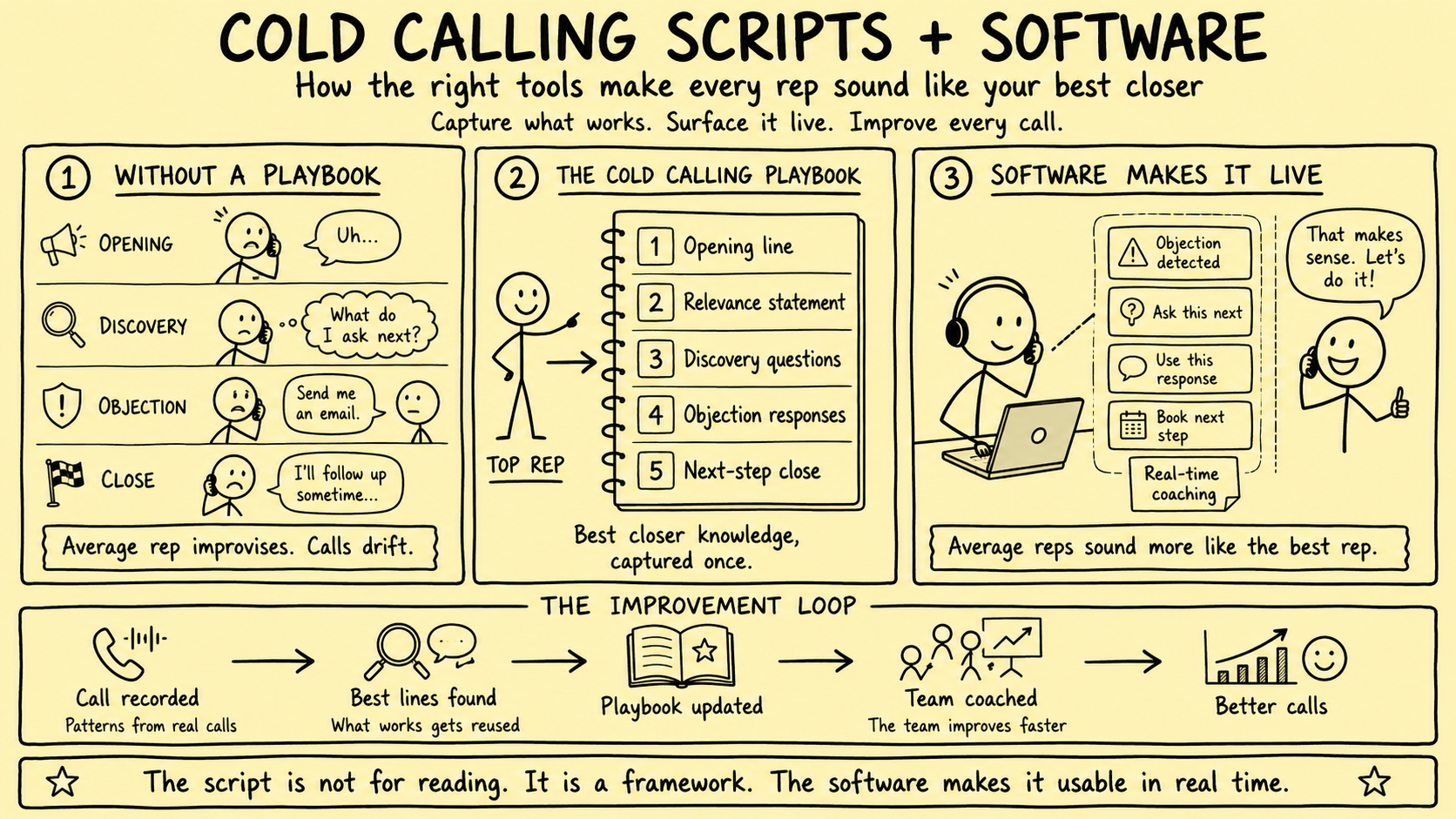
Call software cannot make every person sound like a brokerage’s best closer. It can surface approved guidance, capture call evidence, and support coaching. It cannot reproduce judgment, relationships, credibility, market knowledge, or the ability to recognize when the right answer is to stop.
This article previously claimed top callers converted at several times the team average, assumed a fixed learning curve, prescribed canned pressure responses, named changing software features, and treated longer conversations, automatic summaries, messages, and CRM actions as signs of success. Those claims and recipes were removed.
Direct answer: Build separate conversation maps for seller sourcing, buyer qualification, dormant-opportunity reactivation, and live-deal calls. Define truthful claims and prohibited implications, give people respectful exit paths, test guidance against reviewed call samples, treat AI output as draft material, and keep consequential decisions with authorized humans.
This is an operating framework, not legal advice. Calling, recording, privacy, employment, advertising, licensing, and transaction requirements vary by jurisdiction, call type, recipient, purpose, and data. Qualified legal, privacy, compliance, and professional owners should review the real program.
Start with the call’s job
One generic “winning script” is unsafe and operationally weak. The purpose, evidence, authority, and acceptable next step differ by call.
| Call type | Legitimate objective | Useful next step | Material boundary |
|---|---|---|---|
| Seller sourcing | Learn whether a private, exploratory conversation is welcome | Permission for a confidential follow-up | Do not imply a buyer, valuation, or likely sale outcome |
| Buyer outreach | Confirm interest and basic acquisition criteria | Approved qualification or information step | Do not disclose a confidential opportunity prematurely |
| Dormant-opportunity reactivation | Ask whether circumstances or interest changed | Updated status or a scheduled review | Do not assume prior permission, facts, or intent remain current |
| Existing relationship follow-up | Complete an agreed action | Specific owner and date | Do not turn service communication into unrelated solicitation |
| Live-deal call | Resolve an authorized transaction matter | Documented professional action | This is not a cold-call workflow; access and authority are deal-specific |
Define the objective before writing language. A playbook should help the caller discover whether the next step is appropriate, not force every conversation toward a meeting.
Build a claim register before a script
The FTC advertising guide explains that promotional claims, including those made through telemarketing, should be truthful, non-deceptive, and supported by an appropriate reasonable basis. A brokerage should apply that principle to express claims and to what a reasonable recipient could infer.
Maintain an approved claim register with:
- Exact claim and permitted wording
- Audience and context in which it may be used
- Evidence owner, source, scope, and review date
- Required qualification or disclosure
- Prohibited variation or implication
- Expiration or reapproval condition
- Escalation owner for questions
Examples requiring evidence and careful scope include the brokerage’s experience, geographic coverage, buyer reach, process, confidentiality controls, fees, timelines, transaction history, and services. Statements about a specific buyer, seller, price, valuation, mandate, financing, tax treatment, legal effect, or closing likelihood require matter-specific authority.
Public records and marketing data do not establish that an owner wants to sell. A script may identify why the call is relevant without presenting an inference as a known fact.
Use a conversation map, not a performance script
A useful playbook separates required language from optional prompts.
Required elements
- Accurate caller and brokerage identity
- Clear, approved purpose for the call
- Any required disclosure or recording notice
- Eligibility and suppression confirmation
- Claim and confidentiality boundaries
- Stop, complaint, wrong-party, and escalation paths
- Approved dispositions and next steps
Flexible guidance
- Open questions suited to the call type
- Plain-language explanations of the brokerage process
- Clarifying questions and reflective summaries
- Evidence-linked answers to common questions
- Transitions that preserve choice
- Notes on when to slow down or involve a qualified owner
The caller should not hide behind “pattern interrupts,” manufacture urgency, assume relevance, or frame reluctance as a problem to defeat. A respectful opening identifies the caller, gives a truthful reason, and lets the person decide whether to continue.
Design seller discovery around permission and confidentiality
A seller-sourcing conversation might explore:
- Whether the owner is open to a confidential discussion now or later
- What prompted the owner to consider options, if anything
- The desired level of privacy and approved communication channel
- Whether other owners or advisers must participate
- What the owner wants to understand about the process
- Whether a qualified broker follow-up is appropriate
Do not ask a caller or AI system to estimate value, declare readiness, infer distress, promise a buyer match, or create a seller-qualified stage from a few phrases. The safe output can be a factual note and a proposed follow-up for review.
Design buyer discovery around fit and information access
A buyer conversation can explore:
- Acquisition criteria, geography, sector, and size range
- Operating background and decision participants
- Timing and current search status
- Financing readiness at an appropriately scoped level
- Confidentiality status and information-access prerequisites
- Preferred next step and relationship owner
The playbook must distinguish self-reported information from verified information. A conversational answer does not complete financial, identity, suitability, or other diligence. It should not automatically unlock a confidential listing or data room.
Treat objections as information and boundaries
An objection library should classify what happened before suggesting a response.
| Signal | Appropriate behavior |
|---|---|
| Clarifying question | Give an approved, evidence-backed answer or escalate |
| Timing concern | Ask whether a later contact is welcome and record the exact scope |
| Existing adviser or broker | Respect the relationship and applicable professional boundaries |
| Not a fit | Close courteously and record the factual reason if appropriate |
| Wrong person or number | Correct identity data without exposing confidential context |
| Skepticism or complaint | Stop the pitch, capture the concern, and route it visibly |
| Do-not-call request | Acknowledge it and execute suppression; do not rebut it |
The FTC Telemarketing Sales Rule guide addresses required disclosures, prohibited misrepresentations, written do-not-call procedures, training, monitoring, and recordkeeping within its scope. Its application and exemptions are fact-specific, and other federal, state, sector, and international requirements may also apply.
Build the playbook so a stop request is easier to execute than another rebuttal. The caller should be able to record the request immediately, cancel pending activity, and confirm the correct suppression scope.
Give software a limited role
Software can help at three points without becoming the decision-maker.
Before the call
- Confirm identity, source, owner, eligibility, and suppression
- Show only the minimum relevant relationship context
- Select the approved playbook version for the call type
- Flag stale, contradictory, or sensitive data for review
During the call
- Display required disclosures and claim boundaries
- Offer optional questions linked to the playbook
- Make stop and escalation actions prominent
- Capture timestamps and user-selected markers
After the call
- Create a raw call event
- Draft a factual summary with source links or timestamps
- Propose, rather than silently execute, consequential updates
- Route exceptions and required follow-up to an accountable owner
Live prompts can be late, irrelevant, or wrong. They should never override what the person actually said or encourage the caller to ignore uncertainty. A non-AI fallback must remain available.
Govern recordings and coaching evidence
Call recording is not automatically justified because it helps coaching. Notice, consent, worker privacy, recipient privacy, purpose limitation, access, security, retention, and deletion require jurisdiction- and context-specific review.
The ICO guidance on monitoring workers recommends considering necessity, proportionality, transparency, and less intrusive alternatives. It specifically notes that itemized call records may sometimes meet a need without recording call content.
Document:
- The purpose and approved legal basis or permission model
- Which call types may be recorded or transcribed
- Required notices and what happens if permission is withheld
- Who can listen, annotate, export, share, and delete
- Whether recordings may be used for individual evaluation
- Retention, legal hold, redaction, and deletion rules
- Treatment of financial, personal, and deal-confidential information
- Review sampling method and protections against selective scoring
Choose call samples across callers, call types, outcomes, lengths, and time periods. A library containing only successful calls teaches survivorship bias, not reliable practice.
Treat AI guidance as a versioned draft system
The NIST Generative AI Profile provides voluntary guidance for governing, mapping, measuring, and managing generative-AI risk. Apply it to research briefs, live prompts, transcripts, summaries, scoring, and playbook suggestions.
Record the model, version, prompt or rule set, playbook version, source data, timestamp, user action, correction, and approval status. Test for:
- Invented owner circumstances or buyer interest
- Unsupported company, market, valuation, or outcome claims
- Missed negation, uncertainty, sarcasm, and speaker identity
- Incorrect currencies, numbers, names, and commitments
- Prompts that continue after an objection or stop request
- Leakage across buyers, sellers, listings, or deal workspaces
- Different error rates across accents, languages, audio conditions, and call types
- Summaries that convert tentative statements into approved facts
Do not let a generated score decide whether an owner is “motivated,” a buyer is qualified, or a representative is competent without defined evidence, review, appeal, and monitoring.
Create a call-quality scorecard
Measure behaviors the brokerage actually wants, not a theatrical version of confidence.
| Dimension | Review question |
|---|---|
| Eligibility | Was the call appropriate for this person, channel, purpose, and time? |
| Identity and purpose | Did the caller identify the brokerage and reason accurately? |
| Claim integrity | Were express and implied claims supported and properly qualified? |
| Listening | Did the caller respond to what was said rather than follow a rigid branch? |
| Discovery | Were questions relevant, proportionate, and non-assumptive? |
| Confidentiality | Was information limited to the recipient’s authorized context? |
| Boundaries | Were objections, wrong-party signals, complaints, and stop requests handled correctly? |
| Next step | Was the next step appropriate, understood, and assigned? |
| Record quality | Does the record distinguish raw events, self-reported facts, drafts, and approvals? |
Meeting rate, call duration, and talk ratio can be diagnostic inputs, but none proves call quality. A long conversation may be confused or coercive; a short call may correctly identify no fit and protect both parties’ time.
Run controlled playbook experiments
Before changing live guidance:
- State the problem using reviewed call evidence.
- Define the proposed change and why it might help.
- Identify risks, protected language, and stop conditions.
- Review the change with the required professional owners.
- Test it in role-play and representative historical samples.
- Pilot it with a limited, eligible cohort and trained callers.
- Compare quality, complaints, corrections, next-step acceptance, and downstream validity.
- Approve, revise, or roll back the version with a recorded decision.
Do not declare one phrase “proven” because it appeared in more calls that continued. Account mix, caller skill, timing, prior relationship, disposition errors, and selection bias can explain the difference.
Maintain the playbook as a controlled record
Each version should show its owner, purpose, audience, approved claims, required language, sources, effective date, reviewers, training status, change history, and retirement date.
Review it when the brokerage changes positioning, services, fees, markets, call technology, recording behavior, data sources, AI models, qualification policy, confidentiality process, or applicable requirements. Give callers one current source rather than copies scattered through documents and personal notes.
Provide a visible feedback path. Callers should be able to flag missing scenarios, misleading prompts, recurring questions, and unsafe guidance without rewriting the approved playbook themselves.
Measure system quality, not closer mythology
Track:
- Eligibility and suppression failures
- Required-disclosure and claim-accuracy exceptions
- Wrong-party, complaint, and stop-request handling
- Accepted qualified next steps by call type and cohort
- Downstream rejection of proposed seller or buyer updates
- Recording and transcript access exceptions
- AI prompt dismissals, corrections, and material errors
- Coaching sample coverage and reviewer consistency
- Playbook adoption by version
- Follow-up ownership and completion
- Reconciliation and incident resolution time
Segment results by call purpose, audience, source, relationship state, caller experience, and playbook version. Report uncertainty and sample size. Do not imply that scripts or software independently caused pipeline or transaction outcomes.
The practical conclusion
A strong broker playbook does not make every caller identical. It makes approved facts, good questions, stop conditions, confidentiality boundaries, and accountable next steps easier to follow—and makes errors easier to find and correct.
Start with the call’s legitimate job. Substantiate the claims. Preserve the person’s choices. Treat objections as information. Use recordings proportionately. Keep AI in a reviewable role. Coach from representative evidence, then measure whether the complete process is becoming more accurate and trustworthy.
To design the surrounding controls, review broker growth operations and automation and AI systems, or request a Business Broker Pipeline & Operations Assessment.
Frequently Asked Questions
Should a business broker read a cold-call script word for word?
Usually no. Use an approved conversation map with required disclosures, factual claim boundaries, discovery prompts, stop conditions, and next-step options. The broker should listen, adapt, and avoid implying facts that have not been established.
Can software make every caller perform like the best broker?
No responsible system can promise that. Software can make approved guidance easier to find, capture evidence for coaching, and reduce some administrative gaps. Outcomes still depend on judgment, experience, audience, offer, data quality, market conditions, and execution.
What should happen when a prospect objects?
Classify the objection before responding. A question or misunderstanding may deserve a factual answer; a lack of fit may deserve a graceful exit; a do-not-call request must enter the suppression process. An objection is not permission to pressure the person.
Should AI prompts and summaries write directly to the CRM?
Treat consequential output as attributed draft material. Preserve the source call, model and version, prompt or rule, uncertainty, reviewer, corrections, and approval before using it to change seller, buyer, valuation, qualification, mandate, or transaction records.
How should a brokerage measure whether a playbook is improving?
Use reviewed samples and measures tied to quality: accurate identity and purpose, eligibility and suppression compliance, question quality, claim accuracy, listening, correct next steps, clean records, complaints, corrections, and accepted qualified conversations. Do not optimize only for duration or meetings booked.
Sources and evidence notes
Primary or first-party materials reviewed for this article. Scope and limitations are stated rather than silently generalized.
- Advertising FAQs: A Guide for Small BusinessU.S. Federal Trade Commission · Accessed
Official guidance stating that advertising and promotional claims, including telemarketing claims, must be truthful, non-deceptive, and supported by an appropriate reasonable basis.
- Complying with the Telemarketing Sales RuleU.S. Federal Trade Commission · Accessed
Official U.S. guidance on telemarketing scope, required disclosures, misrepresentations, do-not-call procedures, calling practices, training, monitoring, and recordkeeping.
- Specific data protection considerations for different ways or methods of monitoring workersUK Information Commissioner’s Office · Accessed
Current UK guidance on necessity, proportionality, transparency, and less intrusive alternatives when monitoring worker calls and communications.
- Artificial Intelligence Risk Management Framework: Generative Artificial Intelligence ProfileU.S. National Institute of Standards and Technology · Published · Accessed
Voluntary cross-sector guidance for governing, mapping, measuring, and managing generative-AI risks across the AI lifecycle.
Brokerage data stays governed. Material deal decisions stay human.
We design business broker systems around least-privilege access, documented data flows, protected credentials, traceable activity, and approval gates. Systemify does not use client information to train its own models. When a workflow uses an external AI provider, its purpose, data fields, and retention approach are documented and approved before client data is transferred.
Apply this to your brokerage
We can assess your buyer and seller pipeline, valuation and vetting workflows, communications, documents, controls, and handoffs before recommending what to build.
Talk to a Broker Systems Expert