
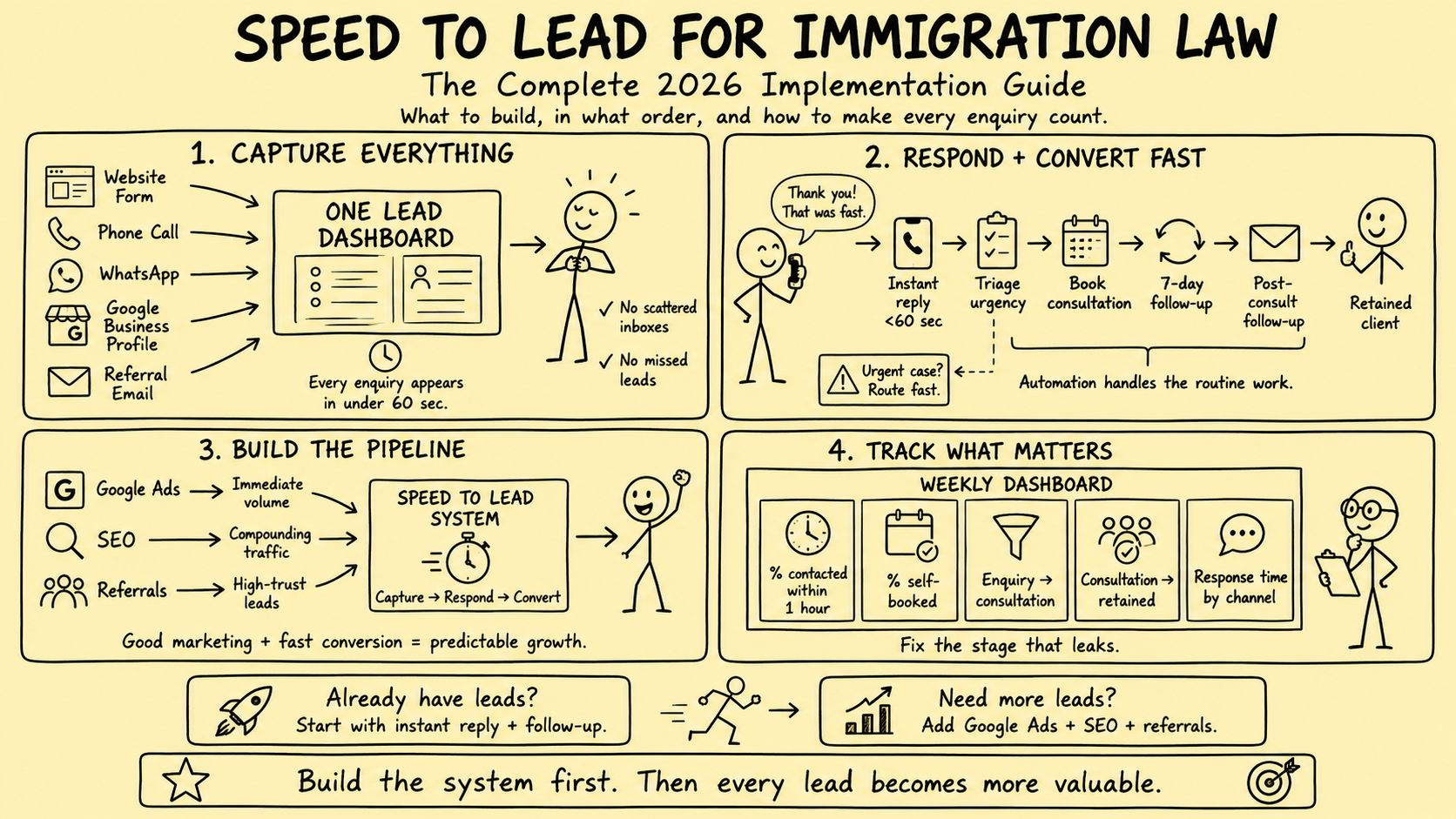
This is the guide we wish every immigration law firm had before spending a single pound on marketing.
It covers every component of a speed to lead system for immigration practices: what to build, in what order, which tools to use, and how to measure whether it's working. It is written for two types of firms — those with more leads than their system can handle, and those building a reliable client pipeline from scratch.
Both start with the same infrastructure. The emphasis differs; the system is the same.
Part 1: Understanding the Problem You're Solving
If Your Firm Has More Leads Than You Can Handle
Your problem is not lead volume — it is lead handling. You are generating enquiries through your website, referrals, directories, and word of mouth, but the gap between enquiry and retained client is wider than it should be.
Symptoms:
- Response times creep above 1–2 hours during busy periods
- Cases slip through when your intake coordinator is sick or on holiday
- You occasionally discover an unanswered enquiry from several days ago
- Attorneys are spending time on intake admin instead of legal work
- Your conversion rate from enquiry to retained client is below 25%
The core issue: your intake process is manually operated and therefore capped at human speed and human availability. Automation removes that ceiling.
If Your Firm Is Building Its Pipeline
Your problem is either insufficient lead volume, insufficient conversion from the leads you have, or both.
Symptoms:
- Client intake is unpredictable — some weeks good, some weeks slow
- You've tried paid advertising but conversion was disappointing
- You can't identify one reliable channel generating consistent enquiries
- You know good legal work should generate more referrals than it does
- Every lost lead feels painful because you know how hard it was to generate it
The core issue: the system that generates leads and the system that converts them are either absent, disconnected, or both.
For pipeline-building firms, speed to lead is not just a conversion tool — it is a competitive weapon. Responding within 5 minutes to every enquiry, at any hour, when competitors take days, positions you as the obvious choice before the prospect has even spoken to an attorney.
Part 2: The Speed to Lead System — All Components
Component 1: Centralised Lead Capture
What it does: Ensures every enquiry, from every channel, lands in one place where it is visible, trackable, and can trigger automation.
Why it matters: Immigration enquiries arrive via website forms, phone calls, WhatsApp, referral emails, legal directory contact forms, and Google Business Profile messages. Without centralisation, leads are scattered across inboxes and missed.
How to build it:
- Choose a CRM: Clio Grow, HubSpot, or Lawmatics
- Connect your website contact form via native embed or Zapier
- Set up a tracked phone number (via CallRail or Twilio) that logs all calls and missed calls as leads in the CRM
- Connect Google Business Profile messages to your CRM inbox
- If you use WhatsApp for client communication, set up WhatsApp Business API integration
Key output: A single dashboard where every new enquiry appears within 60 seconds, regardless of how it arrived.
Component 2: Instant First Response (< 60 seconds)
What it does: Sends a personalised SMS and email to every new lead within 60 seconds of their enquiry, 24/7.
Why it matters: Research shows that responding within 5 minutes makes a lead 21× more likely to convert than responding in 30 minutes. Most immigration firms take hours or days. Being the firm that responds in 60 seconds — with a personalised message — is a decisive competitive advantage.
How to build it:
- Set up a CRM workflow: "When new contact is created via form → Wait 30 seconds → Send SMS via Twilio → Send email via connected email account"
- Write the SMS template: "Hi [First Name], thank you for reaching out to [Firm Name] about your [enquiry type]. We'll call you within the hour. Book a free consultation here: [Calendly link]"
- Write the email template: personalised acknowledgement, confirmation of next steps, direct booking link
- Test end-to-end: submit your own contact form, verify SMS and email arrive within 60 seconds
For overwhelmed firms: this automation runs whether your team is in court, in meetings, or it's Sunday afternoon. Every lead gets an instant response regardless of internal capacity.
For pipeline-building firms: your first impression is professional, fast, and personalised before a single human interaction has occurred. You look like a firm that has its act together.
Component 3: Triage and Urgency Routing
What it does: Classifies leads by urgency and case type, and routes them to the appropriate response protocol.
Why it matters: A deportation hearing in 5 days is not the same as a general enquiry about citizenship. Without triage, everything gets the same generic response and the same queue — and emergency cases wait just as long as routine ones.
How to build it:
Add to your intake form:
- Case type (dropdown: Spouse Visa, Work Permit, Asylum, Deportation/Removal, Naturalisation, Student Visa, Other)
- Urgency indicator ("Do you have an upcoming deadline or court date?" Yes/No)
- If yes: deadline date
Set up automation branches:
- Deportation / removal OR court date within 7 days → EMERGENCY: immediate SMS to duty attorney
- Visa expiry within 30 days → HIGH: call within 15 minutes
- Upcoming appointment within 60 days → MEDIUM: call within 1 hour
- General enquiry → STANDARD: call within same business day
Output: Every lead goes into the right queue automatically. Your team handles the highest-stakes cases first without manual sorting.
Component 4: Direct Consultation Booking
What it does: Allows prospects to book a consultation immediately from the first automated response, without waiting for a callback.
Why it matters: Prospects who self-schedule are significantly more likely to show up and retain. A booking link in the first automated response eliminates the scheduling back-and-forth entirely for leads who are ready to commit.
How to build it:
- Set up Calendly (or your CRM's booking module) with your consultation availability
- Offer a free 15–20 minute initial consultation (standard practice in immigration law; removes friction)
- Embed the booking link in: the first automated SMS, the first automated email, and every follow-up touch
- Set up automatic confirmation email + SMS on booking
- Set up automatic reminders: 24-hour and 1-hour before the consultation
Post-booking automation:
- Immediately after booking: send pre-consultation questionnaire (name, nationality, visa history, current situation, documents available, upcoming deadlines)
- 24 hours before: reminder + "Please bring [document list] to your consultation"
- 1 hour before: reminder with meeting link (if video) or directions (if in-person)
Component 5: 7-Day Follow-Up Sequence
What it does: Automatically follows up with leads who don't immediately book a consultation, over a structured 7-day period.
Why it matters: Most immigration leads do not convert on the first touch. They are in the middle of a stressful, complex decision. A structured follow-up sequence converts the 60–70% of leads that a single-touch approach writes off prematurely.
The sequence:
| Touch | Day | Channel | Content |
|---|---|---|---|
| 1 | 0 (immediate) | SMS + Email | Personalised acknowledgement + booking link |
| 2 | 0 (within 2 hours) | Phone call | First human contact from intake team |
| 3 | 1 | SMS | Brief check-in with booking link |
| 4 | 2 | Personalised resource relevant to their visa type | |
| 5 | 3 | Phone call | Second call attempt (different time of day) |
| 6 | 5 | Social proof (anonymised client testimonials relevant to their case type) | |
| 7 | 7 | Email + SMS | Final offer — low-pressure closing touch |
After day 7: move to monthly newsletter nurture list.
For overwhelmed firms: the automated touches run without staff involvement; only the two phone calls require manual effort.
For pipeline-building firms: this sequence squeezes maximum value out of every lead and keeps your firm present for prospects who aren't ready yet but will be soon.
Component 6: Post-Consultation Conversion Sequence
What it does: Automatically follows up with prospects who attended a consultation but haven't yet signed a retainer.
Why it matters: Consultation no-conversion is a surprisingly common leak. The prospect had a good conversation but left without committing — and then got distracted, compared options, or waited too long for a response.
The sequence:
- Within 2 hours of consultation: thank-you email + summary of what was discussed + clear next steps
- Day 2: follow-up email — "Did you have any further questions after our conversation?"
- Day 5: email with a relevant resource + restatement of the path forward
- Day 10: final check-in — "If you're ready to move forward, here's how to get started: [link to retainer/payment]"
This sequence, combined with a strong consultation process, can move consultation-to-retained conversion from 45% to 65%+ — a 45% improvement in the yield from every consultation your firm runs.
Component 7: Review and Referral Automation
What it does: Systematically generates Google reviews and referrals from completed cases.
Why it matters:
- For pipeline-building firms: Google reviews improve your local search ranking (Google Business Profile), which generates organic enquiries — free leads that compound over time.
- For all firms: Referrals are the highest-converting, lowest-cost lead source in immigration law. Systematising referral generation turns satisfied clients into an ongoing acquisition engine.
How to build it:
- 48 hours after case completion: send thank-you email + Google review request (with direct link to your review page)
- 1 week after review is posted: brief follow-up thanking them and mentioning you'd be grateful for any referrals
- Add to case completion checklist: "Review automation triggered: Yes/No"
For every 10 completed cases, a well-implemented review automation should generate 4–6 new reviews and 1–2 referrals.
Part 3: Lead Generation for Pipeline-Building Firms
The speed to lead system above maximises the value of every enquiry you receive. But for firms with an inconsistent pipeline, optimising conversion is only half the equation. The other half is generating a reliable flow of enquiries to convert.
The Three Channels That Work for Immigration Law
Google Search (Paid and Organic)
- Paid: Google Ads targeting high-intent keywords ("spouse visa solicitor [city]", "work permit help", "visa refusal appeal")
- Organic: SEO targeting the same keywords through dedicated service pages and content
- Highest-intent channel; fastest to paid results; best long-term compounding value via SEO
Google Business Profile
- Appearing in the local "3-pack" for "immigration lawyer near me" searches is one of the most valuable positions in local legal marketing
- Built by consistently collecting reviews, posting updates, and maintaining complete profile information
- Free to maintain; requires only a consistent 30-minute/week investment once set up
Referral Network Activation
- Map who is most likely to encounter immigration clients in their work: HR managers, employment solicitors, accountants with international clients, community organisations
- Build systematic relationships with these referrers
- Acknowledge every referral personally and within 24 hours
The Combination That Builds a Predictable Pipeline
No single channel is sufficient. The firms that build genuinely predictable pipelines run all three:
- Google Ads for immediate, scalable volume
- SEO for compounding free leads over time
- Referral network for high-converting word-of-mouth
Pair these with the speed to lead system from Parts 1 and 2, and the economics become very strong: high-intent paid traffic converting at 30%+ instead of the 10–15% that most firms achieve.
Part 4: Tracking and Optimisation
The Weekly Dashboard
Track these metrics every week:
| Metric | Target |
|---|---|
| New enquiries this week | Baseline + trend |
| % contacted within 1 hour | > 85% |
| % self-booking consultation | > 25% |
| Enquiry-to-consultation rate | > 40% |
| Consultation-to-retained rate | > 55% |
| End-to-end conversion | > 22% |
| Average time from enquiry to retained | < 14 days |
| Response time by channel | Track separately |
If any metric is below target, diagnose the specific stage where the breakdown occurs before making changes.
The Monthly Review
Once per month:
- Review lead source attribution: which channels are generating the most retained clients per pound spent?
- Review lost lead reasons: why did leads that didn't convert not convert? (Price, chose other firm, not qualified, no response, timing)
- Identify the single biggest conversion lever to improve in the next 30 days
Part 5: Getting the System Running
For Firms With Leads But Broken Intake
Start with Components 2 (instant first response) and 5 (follow-up sequence). These two alone will visibly improve conversion within the first two weeks and immediately stop the most acute revenue leaking.
Then add Components 3 (triage), 4 (booking), and 6 (post-consultation sequence) over the following month.
For Firms Building Their Pipeline
Start with Components 1 (centralised capture), 2 (instant response), and 4 (booking), then launch a small Google Ads campaign (£500–£800/month is sufficient to test the economics in most UK markets). Measure cost-per-retained-client and scale from there.
Add the full follow-up sequence and referral automation once the lead flow is consistent.
The Firms That Win in 2026
The immigration law market is competitive in every major UK city. The firms that are growing fastest share one characteristic: they have built the front end of their client acquisition process as systematically as they have built their legal service delivery.
They show up within 60 seconds. They follow up seven times. They make it effortless to book a consultation. They appear in every relevant Google search. They have clients who send referrals because the experience was outstanding from first contact.
None of that requires exceptional marketing spend or a large team. It requires the right infrastructure — built once, running continuously, generating compounding returns.
If you want this system built for your practice, Systemify Automation can design, build, and install the full stack for your immigration firm. We handle the technical setup, write the sequences, and train your team on the workflow. Most firms are live and running within two weeks.
Whether you're trying to stop leaking cases you've already won, or building the pipeline that makes your practice predictable and scalable — this is the system that gets you there.
Brokerage data stays governed. Material deal decisions stay human.
We design business broker systems around least-privilege access, documented data flows, protected credentials, traceable activity, and approval gates. Systemify does not use client information to train its own models. When a workflow uses an external AI provider, its purpose, data fields, and retention approach are documented and approved before client data is transferred.
Looking for business-broker systems?
Our current work focuses on helping business brokers build stronger buyer and seller pipelines and more controlled deal operations.
Talk to a Broker Systems Expert