
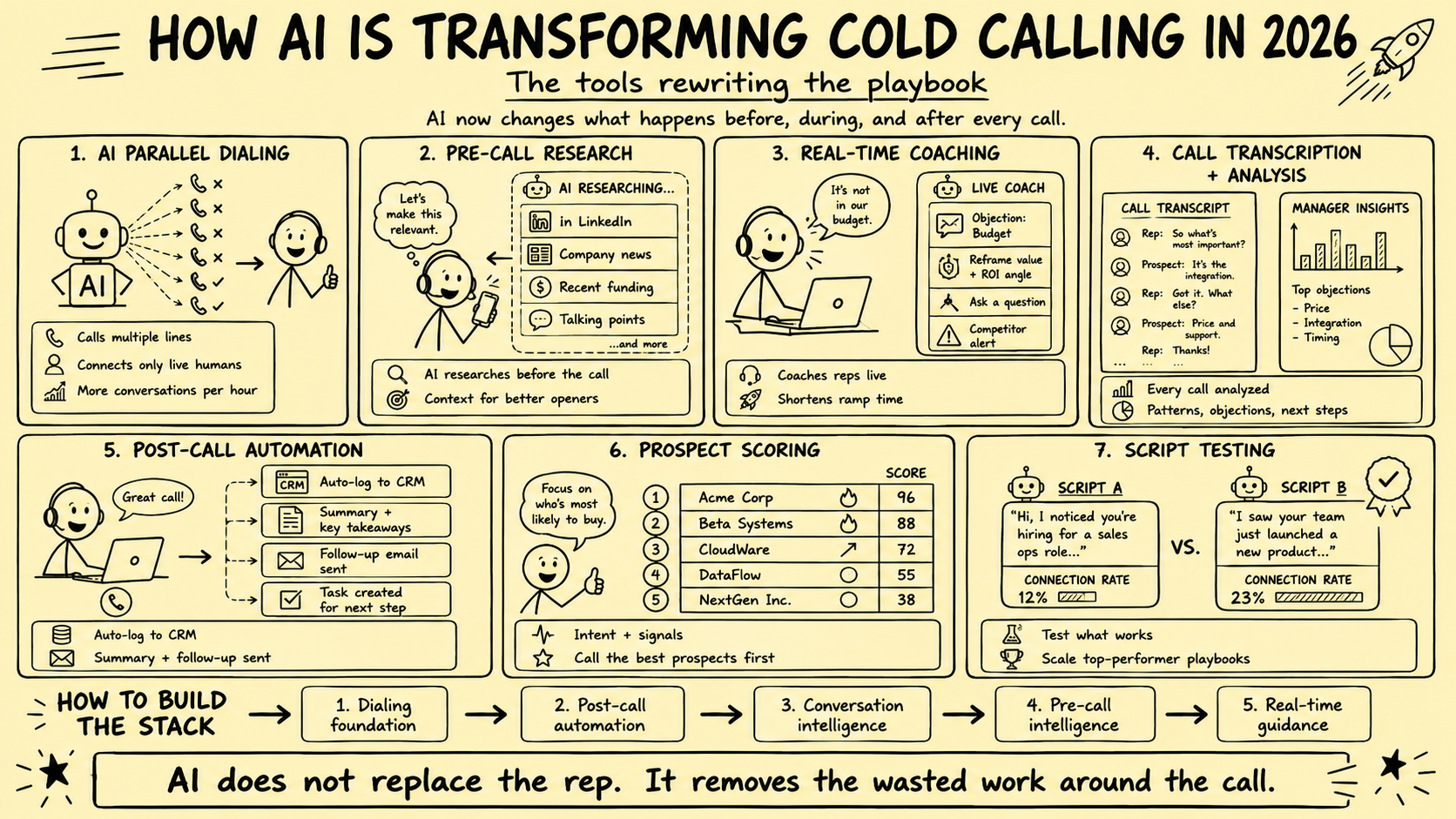
AI can assist with research, prompts, transcription, summaries, routing, and record updates around a call. It can also create convincing errors, expose confidential information, infer facts that were never said, or turn an ordinary human-led workflow into an artificial-voice communication with different requirements.
This article previously named a changing set of vendors and claimed dramatic gains in conversations, dialing, coaching, conversion, and administrative time without verifiable evidence. Those claims were removed. The responsible question is not whether AI is “transforming” calling in general; it is whether a specific feature is suitable, lawful, accurate, secure, and controllable in a defined brokerage workflow.
Direct answer: Separate assistive AI from autonomous or synthetic-voice activity. Map the data and decision involved, test realistic failure cases, preserve evidence, require human approval for material actions, and measure errors and negative signals alongside any operating benefit.
This is an operating framework, not legal advice. Telemarketing, privacy, recording, employment, communications, professional, and AI requirements vary by jurisdiction, recipient, number type, purpose, data, and technology. Qualified counsel should review the actual workflow and configuration.
Separate six different capabilities
Calling products often package distinct capabilities under one “AI” label. Evaluate them separately.
| Capability | Example output | Primary broker risk | Appropriate default |
|---|---|---|---|
| Pre-call research | Short briefing from approved sources | False, stale, sensitive, or improperly collected facts | Show sources and require caller review |
| Live prompts | Suggested question or disclosure | Distracting, mistimed, or incorrect guidance | Advisory only; caller remains in control |
| Transcription | Searchable call text | Wrong speaker, missed negation, confidential data exposure | Restricted access with recording controls |
| Summary and extraction | Draft outcome, commitment, or task | Invented agreement or lost nuance | Draft until reviewed by an authorized person |
| Scoring and prioritization | Suggested review order | Unsupported inference, bias, or hidden exclusion | Prioritize review, not automatic treatment |
| Synthetic voice or autonomous call | Generated speech delivered to a recipient | Consent, disclosure, deception, abandonment, and escalation risk | Disabled unless separately approved |
The first five can support a human caller. The sixth changes who or what is speaking to the recipient and must not inherit approval from a human-led workflow.
Apply the controls to actual brokerage calls
Seller sourcing
Research may help a broker understand a business, but a public fact is not automatically accurate, current, permitted for reuse, or relevant to an owner’s willingness to sell. An AI system should not infer retirement, health, distress, succession pressure, valuation, or intent and present it as fact.
The caller should see the source, date, exact supporting evidence, exclusions, prior relationship history, and approved outreach basis. If the evidence is weak or sensitive, the system should route the record for review rather than fabricate a personalized premise.
Buyer qualification and follow-up
Transcription and structured extraction may help capture acquisition criteria, financial capacity, geography, sector, timeline, and agreed next steps. These are still consequential records. A missed “not,” wrong currency, confused speaker, or invented commitment can misroute opportunities or expose confidential information.
AI should prepare proposed fields and highlight the supporting passage. An authorized person should approve material criteria, identity, confidentiality status, readiness, and next actions.
Active deal communications
Calls involving valuation inputs, negotiations, financing, diligence, legal or tax matters, personally identifiable information, and transaction documents require narrower access and higher review. Do not assume that a feature approved for prospecting is approved for an active deal.
Consider disabling general-purpose recording, transcription, model processing, broad search, and automated CRM writes for protected matters unless the engagement, parties, jurisdiction, security review, and professional owners permit them.
Treat synthetic voice as a separate program
An AI-generated voice is not merely a productivity feature. The FCC’s Declaratory Ruling FCC 24-17 confirms that TCPA restrictions on “artificial or prerecorded voice” encompass current AI technologies that generate human voices. The ruling discusses prior express consent, emergency purposes, exemptions, identification, and opt-out requirements under the applicable rules.
The FTC Telemarketing Sales Rule guide explains that the technology used does not remove responsibility. It covers truthful identity and purpose disclosures, records, calling restrictions, do-not-call controls, prerecorded-message requirements, abandonment, and the interaction with other federal and state rules.
For UK programs, the ICO’s business-to-business marketing guidance distinguishes live and automated marketing calls and addresses PECR, TPS and CTPS screening, prior objections, caller identity, consent, and UK GDPR where personal data is processed.
Do not launch synthetic voice because a vendor says it is compliant or because the audience is labeled B2B. Document the exact numbers, recipients, jurisdictions, call purpose, consent evidence, identity and disclosure, opt-out behavior, transfer to a human, records, vendor role, and counsel approval.
Never clone a broker, client, seller, buyer, celebrity, or other person’s voice without explicit, documented authority and an approved purpose. Do not design the experience to mislead a recipient about whether they are hearing a person or a machine.
Build an AI deployment register
The NIST Generative AI Profile is voluntary cross-sector guidance organized around governing, mapping, measuring, and managing AI risks. A brokerage can translate that structure into a practical register for each feature.
Record:
- Business owner and technical owner
- Specific call type, users, audience, and jurisdiction
- Model, provider, version, subprocessors, and hosting path
- Inputs, outputs, personal data, confidential data, and retention
- Training-use settings and contractual restrictions
- Approved sources and prohibited sources
- Decision supported and decisions the system may not make
- Human reviewer, evidence shown, and approval action
- Test set, acceptance thresholds, known limitations, and residual risks
- Monitoring signals, incident path, kill switch, and review date
“AI call assistant” is too broad for a register entry. Research, transcription, summary generation, scoring, CRM writes, and synthetic voice should be separately owned and tested even when one vendor provides them all.
Control the data path
Create a field-level data map before connecting calls to an AI provider. Identify what is captured, why it is needed, where it travels, who can retrieve it, how long it remains, and how deletion propagates through recordings, transcripts, embeddings, prompts, logs, backups, analytics, and CRM copies.
Use data minimization. A system preparing a callback task may not need the entire recording. A coaching tool may not need valuation documents or banking details. A prospect-research feature may not need access to every active deal.
Verify:
- Role-based access and multifactor authentication
- Separation among prospecting, buyer, seller, and live-deal workspaces
- Encryption, audit logs, exports, support access, and incident notification
- Provider retention, deletion, backup, and model-training terms
- Redaction or pause controls for sensitive portions
- Number, recording, transcript, and derived-data ownership at exit
Keep consequential decisions under human authority
AI can propose a summary or workflow action. It should not silently decide that:
- An owner wants to sell
- A buyer is qualified or suitable
- A party has consented to marketing, recording, or data sharing
- A valuation input is correct
- A buyer matches a seller
- A confidentiality obligation has been satisfied
- A negotiation point or commitment was agreed
- A legal, tax, accounting, financing, or diligence conclusion is valid
- A message or document may be released externally
For each output, show the underlying evidence and confidence or uncertainty where available. Define which fields can be auto-populated as low-risk drafts, which require a click-to-approve action, and which the model may never write.
Test failure cases before useful cases
A polished demonstration usually shows clear audio, one speaker, familiar vocabulary, and an expected result. Production calls do not.
Build a test set that includes:
- Similar names, companies, and phone numbers
- Multiple speakers and incorrect diarization
- Accents, code-switching, industry terms, currencies, and numbers
- Negation, uncertainty, sarcasm, hypotheticals, and corrections
- Background noise, hold music, silence, voicemail, and dropped audio
- Wrong parties, assistants, referrals, and unauthorized participants
- Opt-outs, objections, complaints, and revocation of consent
- Confidential, financial, health, employment, and identity information
- Attempts to manipulate the model through spoken instructions
- CRM duplicates, unavailable APIs, retries, partial writes, and reassignment
Measure field-level precision and recall where appropriate, material-error severity, reviewer agreement, unsupported statements, missed stop signals, data exposure, latency, integration failures, and time required for review. Averages can hide severe failures; retain examples and investigate the highest-risk errors.
Measure operations without inventing ROI
Do not start with a promised multiplier. Establish a baseline using the brokerage’s own workflow, then track:
| Measure | What it reveals |
|---|---|
| Research claims with valid sources | Whether pre-call context is traceable |
| Unsupported or sensitive inferences | Whether personalization creates risk |
| Transcript and speaker error rate | Whether the call record is dependable |
| Summary corrections by field | Where human review remains essential |
| Missed objections and opt-outs | Whether stop signals are respected |
| CRM write failures and duplicates | Integration integrity |
| Material errors reaching production | Actual control effectiveness |
| Reviewer time and queue age | Human workload, not assumed savings |
| Complaints and wrong-party contacts | Recipient and brand impact |
| Qualified, accepted next steps | Progress defined by the brokerage |
Compare a controlled cohort with the prior workflow where feasible. Document other changes occurring during the test. Do not convert correlation into a claim that AI caused more engagements or completed transactions.
Use a staged deployment
- Define one narrow use case and its prohibited actions.
- Complete the legal, privacy, security, data, and professional review.
- Test offline with controlled recordings and synthetic records.
- Run in shadow mode: produce outputs without writing or sending them.
- Let authorized users review drafts and record every correction.
- Permit only tested low-risk actions, with logs and reversal.
- Monitor errors, objections, complaints, access, and model or vendor changes.
- Expand only after the evidence meets the approved thresholds.
- Re-review after material model, feature, data, jurisdiction, or workflow changes.
Keep a kill switch that operational owners can use without waiting for the vendor. Preserve the non-AI path so a provider outage or disabled feature does not stop critical buyer, seller, or deal communication.
The practical conclusion
AI does not turn every calling feature into a good brokerage system. Its value depends on the task, evidence, data controls, measured accuracy, human authority, and the ability to stop or reverse an action.
Use AI to prepare and surface information. Keep the caller in control. Treat summaries and CRM changes as drafts until proven otherwise. Separate synthetic voice from human-led assistance. Measure harmful failures as carefully as useful outputs.
To evaluate this within your brokerage, review broker automation and AI systems or request a Business Broker Pipeline & Operations Assessment.
Frequently Asked Questions
Which AI calling features are useful for business brokers?
Potentially useful features include approved pre-call research, live prompts, transcription, draft summaries, draft CRM updates, quality-review queues, and workflow routing. Each feature should be tested against a defined broker use case before production use.
Can AI call sellers or buyers using a synthetic voice?
Synthetic or AI-generated voice is not equivalent to a human caller using an assistive tool. In the United States, FCC 24-17 confirms that TCPA artificial-or-prerecorded-voice restrictions encompass current AI-generated voices. Requirements vary by workflow and jurisdiction, so obtain qualified legal review and required consent before use.
Can AI summaries update the brokerage CRM automatically?
Use them as drafts until testing establishes which low-risk fields can be written safely. Material commitments, qualification, confidentiality status, valuation inputs, buyer fit, and transaction decisions should require authorized human review.
Can AI score which owners are likely to sell?
A score may prioritize review, but it should not present an inferred intention or sensitive circumstance as fact. Preserve source provenance, test error and bias, give users the supporting evidence, and require a person to decide whether outreach is appropriate.
How should a brokerage test an AI calling feature?
Use controlled recordings and test records covering accents, multiple speakers, ambiguous commitments, sensitive data, objections, opt-outs, wrong parties, silence, background noise, integration failures, and adversarial instructions. Define acceptance thresholds and a rollback owner before live use.
Sources and evidence notes
Primary or first-party materials reviewed for this article. Scope and limitations are stated rather than silently generalized.
- Declaratory Ruling, FCC 24-17U.S. Federal Communications Commission · Published · Accessed
Official ruling confirming that TCPA restrictions on artificial or prerecorded voice encompass current AI technologies that generate human voices, subject to consent, emergency-purpose, and exemption provisions.
- Complying with the Telemarketing Sales RuleU.S. Federal Trade Commission · Accessed
Official U.S. telemarketing guidance covering scope, truthful disclosures, caller identity, records, prerecorded messages, call abandonment, do-not-call controls, and overlapping federal and state requirements.
- Artificial Intelligence Risk Management Framework: Generative Artificial Intelligence ProfileU.S. National Institute of Standards and Technology · Published · Accessed
Voluntary cross-sector guidance for governing, mapping, measuring, and managing generative-AI risks across the AI lifecycle.
- Business-to-business marketingUK Information Commissioner’s Office · Accessed
Official UK guidance on PECR and data-protection requirements for live and automated B2B marketing calls, suppression, caller identification, consent, and personal data.
Brokerage data stays governed. Material deal decisions stay human.
We design business broker systems around least-privilege access, documented data flows, protected credentials, traceable activity, and approval gates. Systemify does not use client information to train its own models. When a workflow uses an external AI provider, its purpose, data fields, and retention approach are documented and approved before client data is transferred.
Apply this to your brokerage
We can assess your buyer and seller pipeline, valuation and vetting workflows, communications, documents, controls, and handoffs before recommending what to build.
Talk to a Broker Systems Expert