
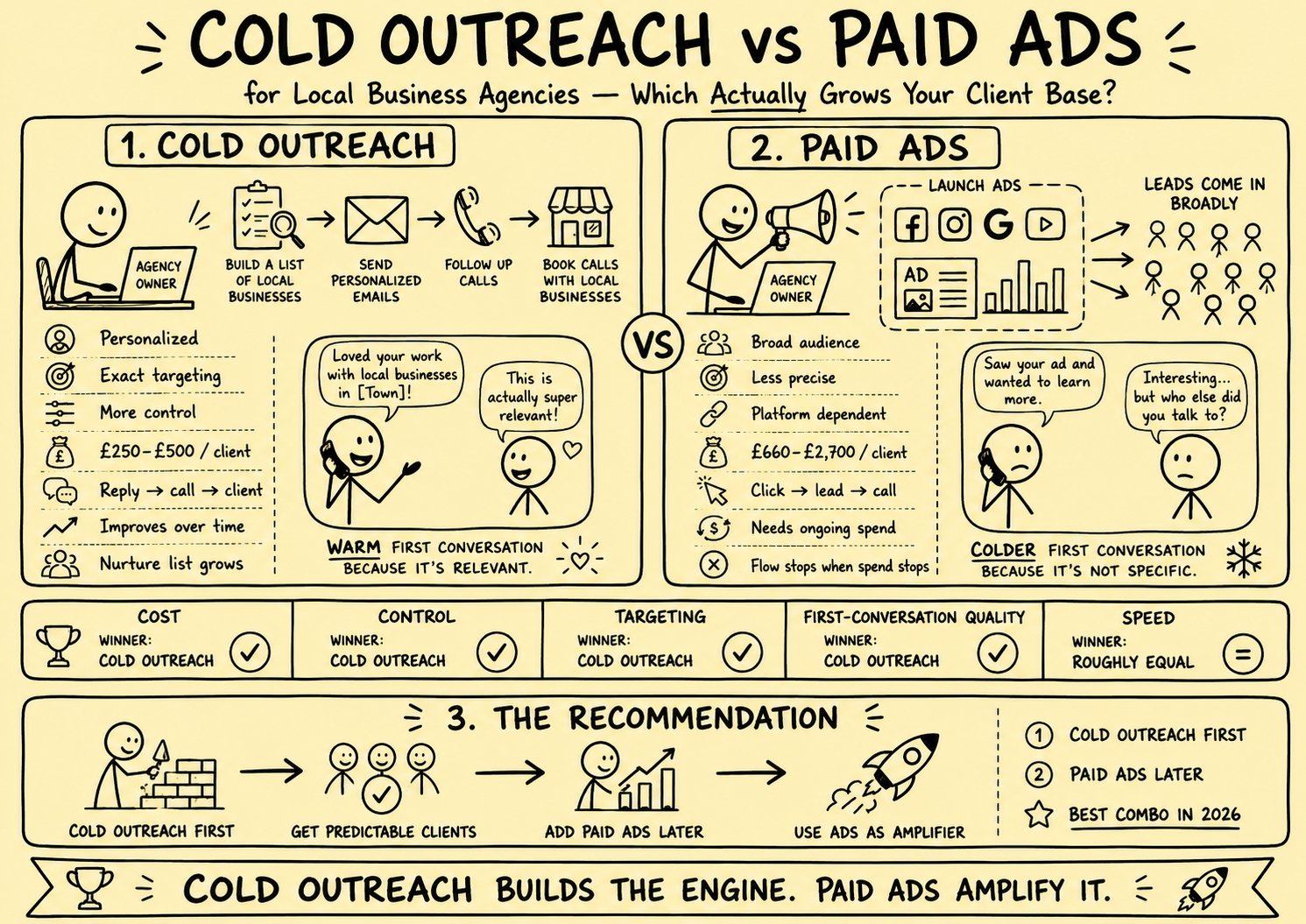
When an agency decides it needs a more predictable way to win new clients, two options dominate the conversation: cold outreach (email and calling) and paid advertising (Google Ads, Facebook/Instagram Ads, LinkedIn Ads).
Both can work. Both have worked for agencies at various stages. But they are not equal — they have fundamentally different economics, timelines, risk profiles, and compounding characteristics.
This guide compares them honestly, across every dimension that matters for a growing agency.
The Setup: What We Are Comparing
Cold outreach: Proactively contacting potential clients — local business owners — through personalised cold email, cold calling, or both. The agency identifies prospects, researches their situation, and initiates contact directly.
Paid advertising: Running ads on Google, Facebook, Instagram, or LinkedIn to attract potential clients inbound. The agency creates ads, spends money to distribute them, and converts interested inbound leads.
These are not the only client acquisition channels available to agencies — referrals, content marketing, SEO, and partnership deals also exist. But cold outreach and paid ads are the two that can generate meaningful new client volume within a reasonable timeframe and without requiring years of brand building first.
Comparison 1: Cost Per Acquired Client
Cold Outreach
The primary cost of cold outreach is time. Tools (email sending platform, CRM, list enrichment) typically cost £200–£600 per month for a well-equipped outreach stack. List building and research time is either the founder's time or a part-time researcher at £15–£25 per hour.
A realistic cost breakdown for an agency acquiring 3–5 new clients per month via cold outreach:
- Tools: £300/month
- Research/list building (20 hrs at £20/hr): £400/month
- Founder time on conversations and proposals (5–8 hrs at implied cost): £500–£800/month
- Total: ~£1,200–£1,500/month
- Clients acquired: 3–5
- Cost per acquired client: £250–£500
At an average retainer of £500–£1,500/month with an 18-month average client lifetime, the LTV of each client is £9,000–£27,000. A cost per acquisition of £250–£500 is an exceptional return.
Paid Advertising
Paid advertising for B2B agency services — targeting local business owners — is expensive. The audience is small (business owners are a small percentage of the population), the platforms charge significant CPMs for targeting this audience, and the conversion journey from ad click to signed client involves multiple steps.
A realistic paid advertising budget for an agency trying to acquire 3–5 new clients per month:
- Ad spend (Google/Facebook/LinkedIn): £2,000–£5,000/month
- Creative production (ad copy, design, video): £500–£1,000/month
- Landing page and conversion optimisation: £300–£500/month
- Agency management fee (if outsourced): £500–£1,500/month
- Total: £3,300–£8,000/month
- Clients acquired: 3–5 (if the campaigns are well-built and optimised)
- Cost per acquired client: £660–£2,700
The cost per acquisition via paid ads is typically 3–5x higher than cold outreach for agency services targeting local business owners.
Winner: Cold outreach — by a significant margin on cost efficiency.
Comparison 2: Time to First Client
Cold Outreach
A cold outreach system built from scratch (as described in How to Build a Cold Outreach System for a Local Business Agency) takes 2–3 weeks to set up (infrastructure, domain warming, list building, message writing). First emails go out in Week 3. First replies typically come in Weeks 3–4. First call booked: Week 4–5. First client signed: Week 6–8.
Time to first client: 6–8 weeks
Paid Advertising
Paid campaigns can go live within days of deciding to run them. However, the learning period — the time Google or Meta needs to optimise the campaign for your target audience — is typically 4–8 weeks. The first few weeks of a paid campaign are often the most expensive and least efficient.
A first client from paid advertising might arrive in Week 4–6 if everything goes well, or Week 8–12 if the campaigns need significant optimisation.
Time to first client: 4–12 weeks
Winner: Roughly equal — paid ads can theoretically move faster, but the optimisation period often erases the theoretical advantage.
Comparison 3: Control and Predictability
Cold Outreach
Cold outreach gives you direct control over every variable:
- Which businesses you contact
- What message they receive
- How many contacts you reach each week
- How aggressively you follow up
If you need more pipeline next month, you increase outreach volume. If a certain niche is converting well, you double down on it. If a message is not working, you change it and see results within days.
The pipeline is as predictable as the system is disciplined. If you contact 300 qualified businesses per month with a quality message, you will book roughly the same number of calls month after month.
Paid Advertising
Paid advertising is less controllable than it appears. The platforms — Google, Meta, LinkedIn — are optimising for their own revenue, not yours. Algorithm changes can significantly affect ad performance overnight. Cost per click in competitive markets can spike without warning. iOS privacy changes have reduced targeting precision on Meta significantly.
The experience of many agencies: paid ads work well for a period, then require significant ongoing optimisation to maintain performance. The results are less stable than a disciplined cold outreach system.
Winner: Cold outreach — significantly more controllable and predictable.
Comparison 4: Targeting Precision
Cold Outreach
Cold outreach allows surgical targeting. You can contact exactly the type of business you want to work with — specific industry, specific city, specific qualification criteria (review count, website quality, ad presence, team size). You decide who gets your message.
This level of precision is not achievable in any advertising platform for a B2B audience.
Paid Advertising
Paid advertising targeting has improved significantly — but it is still probabilistic rather than deterministic. You target an audience that probably contains your ideal clients. You do not contact your ideal clients specifically.
LinkedIn Ads are closest to deterministic targeting for B2B audiences (job title, company size, industry), but LinkedIn CPCs are very high (£5–£20 per click is common). Google and Meta offer broader demographic and interest targeting with lower CPCs but less precision.
Winner: Cold outreach — definitively. You choose exactly who gets your message.
Comparison 5: Relationship Quality at First Conversation
Cold Outreach
A prospect who replies to a personalised cold email is a warm prospect. They engaged because you said something specific and relevant about their business. By the time you speak to them, they know you paid attention to their situation. The conversation starts with a degree of rapport already established.
Paid Advertising
A prospect who clicks an ad is in a different mental state. They saw a message while doing something else. They may have clicked out of curiosity. They have no relationship with you. The first conversation is colder — they know nothing about you and you know nothing specific about them.
Winner: Cold outreach — the relationship quality at first contact is consistently higher.
Comparison 6: Compounding Over Time
Cold Outreach
The cold outreach system improves over time. Message templates are refined with data. The research process gets faster. The team gets better at converting conversations. Each iteration produces slightly better metrics than the last.
The infrastructure also becomes a business asset. The list of engaged prospects — those who replied but were not ready to buy — is a nurture list that generates deals months after initial contact. The CRM becomes increasingly rich with data about your market.
Paid Advertising
Paid advertising performance does not inherently compound. You get performance proportional to your spend, which can improve with good campaign management but does not compound in the way that a well-built outreach system does. When you stop spending, the flow stops.
Winner: Cold outreach — cold outreach builds an increasingly valuable asset. Paid ads do not.
Where Paid Ads Are Legitimately Better
This comparison should not be read as "paid ads are bad." There are specific contexts where paid advertising outperforms cold outreach:
When you need inbound intent signals: A prospect who found you through a search ad for "local business marketing agency" has self-identified intent. That intent signal is valuable and often converts faster than a cold outreach prospect.
When your offer is transactional: Lower-price, transactional services (e.g. website audits, one-off reports) can be sold through paid advertising more easily than high-value retainers.
When you are building brand in a market: Paid ads build awareness — even ads that do not convert directly make your agency name familiar to the market, which benefits cold outreach conversion and referral rates.
When your team cannot do outreach: Cold outreach requires consistent execution. If the team has no capacity to run it properly, paid ads are better than a poorly executed outreach system.
The Recommendation: Cold Outreach First, Paid Ads as an Amplifier
For most local business agencies — especially those under £50k monthly revenue — the recommendation is clear:
Build cold outreach first. It has better unit economics, more control, higher targeting precision, better relationship quality at first contact, and compounding value. It can be built for £1,000–£2,000 per month in tool and resource costs and generate 3–6 new clients per month at that scale.
Add paid ads as an amplifier once the outreach system is profitable. Use ads to build market awareness, capture inbound intent, and reduce the cold-to-warm ratio of your pipeline. A prospect who has seen your ads twice before receiving your cold email is a warmer prospect than one who has not.
The combination — a disciplined cold outreach system supplemented by a modest paid ad budget for awareness — is the growth model that the most successful local business agencies are running in 2026.
Getting Started
The fastest path to testing this:
Week 1: Define one specific local business niche. Build a list of 100 qualified contacts.
Week 2: Write one personalised email template. Set up one sending domain and warm it.
Week 3: Send to the first 50 contacts. Track opens and replies.
Week 4: Refine the message based on data. Add follow-ups. Send to the next 50.
After 30 days, you will have real data on what your cold outreach economics look like for your specific niche, message, and offer. Most agencies that run this test honestly — with a quality message to a qualified list — book their first cold outreach client within 45–60 days.
For the full system blueprint, start with: How to Build a Cold Outreach System for a Local Business Agency — From Scratch.
For the email templates that drive replies, see: Cold Email Templates for Agencies Targeting Local Businesses.
Brokerage data stays governed. Material deal decisions stay human.
We design business broker systems around least-privilege access, documented data flows, protected credentials, traceable activity, and approval gates. Systemify does not use client information to train its own models. When a workflow uses an external AI provider, its purpose, data fields, and retention approach are documented and approved before client data is transferred.
Looking for business-broker systems?
Our current work focuses on helping business brokers build stronger buyer and seller pipelines and more controlled deal operations.
Talk to a Broker Systems Expert