
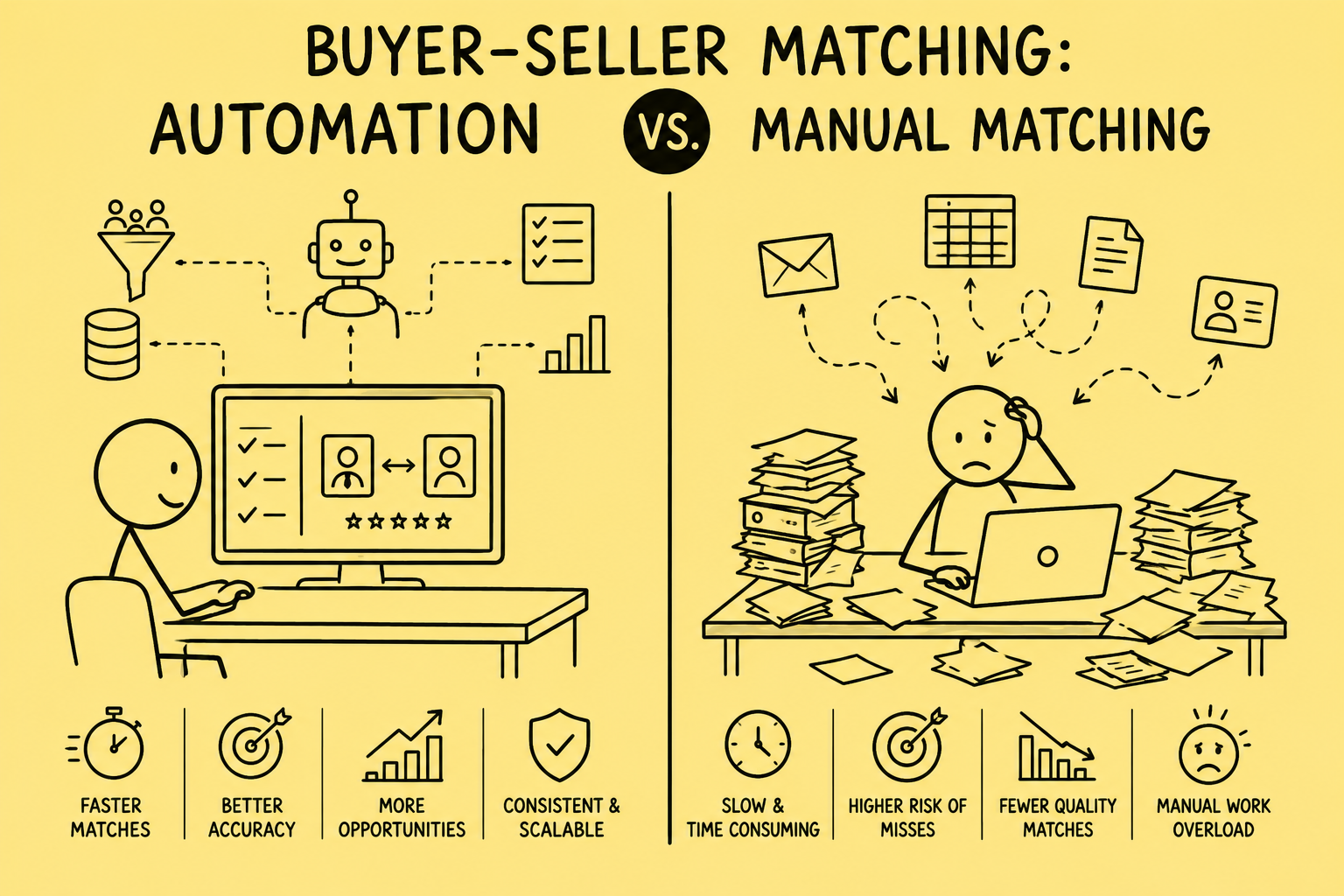
Buyer–seller matching with automation is usually more efficient than traditional manual matching for screening a large database, applying repeatable acquisition criteria, rescoring records when data changes, and producing an initial shortlist. Manual matching remains more effective for interpreting strategic nuance, relationship context, conflicts, buyer credibility, seller sensitivities, and whether an introduction should actually be made.
Direct answer: The most efficient M&A matching model is controlled automation with human approval. The system prepares and explains a ranked shortlist; an experienced deal professional reviews the evidence, applies context the data may not contain, and authorizes outreach. This reduces repetitive search work without delegating the relationship or transaction decision to software.
The practical choice is therefore not automation *or* people. It is deciding which matching tasks should run systematically and which decisions must remain with the broker, advisor, corporate development professional, or acquisition team.
What Is Buyer–Seller Matching in M&A?
Buyer–seller matching is the process of comparing a seller opportunity with potential acquirers whose mandate, resources, strategy, and transaction preferences make them plausible candidates for the deal.
A useful match considers more than industry and geography. Depending on the mandate, the comparison may include:
- Sector, subsector, business model, and products or services
- Revenue, EBITDA, valuation range, and deal size
- Geography and willingness to enter a new market
- Strategic rationale, add-on logic, or investment thesis
- Majority, minority, asset, or full-company acquisition preference
- Available capital, financing capacity, and transaction history
- Customer concentration, recurring revenue, margins, and growth profile
- Management continuity and owner transition requirements
- Regulatory, licensing, or conflict restrictions
- Recency of buyer interest and strength of the relationship
The output should not be a list of every buyer that shares a category label. It should be a defensible shortlist showing why each buyer may fit, which requirements are satisfied, what information is missing, and which exceptions require review.
What Is Manual Buyer–Seller Matching?
Manual matching is the traditional process in which a deal professional searches a CRM, spreadsheet, inbox, notes, previous buyer lists, or personal memory to identify possible acquirers. The person compares what they know about the seller with recorded or remembered buyer criteria, then builds and reviews a shortlist.
Manual matching can be highly effective when an experienced advisor knows a narrow market and maintains close buyer relationships. It is flexible, sensitive to context, and able to use knowledge that was never entered into a system.
Its weakness is repeatability. The result can depend on who performs the search, which records they remember, whether the CRM is current, and how much time is available. When the database grows, the team may review only familiar or recently active buyers while relevant older records remain dormant.
What Is Automated Buyer–Seller Matching?
Automated buyer–seller matching is a controlled workflow that compares structured seller information with buyer mandates and produces candidate matches according to defined rules, scoring logic, or bounded AI analysis.
A well-designed matching workflow usually:
- Normalizes buyer mandates and seller profiles into comparable fields.
- Applies hard exclusions before scoring, such as prohibited sectors or impossible deal sizes.
- Scores the remaining records against weighted criteria.
- Identifies missing, stale, or conflicting data.
- Explains why each candidate ranked where it did.
- Routes the shortlist and exceptions to an authorized reviewer.
- Records the review, decision, and any approved next action.
Automation should not independently decide that a buyer is suitable, disclose confidential seller information, or send consequential outreach. It prepares the work so the deal professional can make a faster, better-supported decision.
Automated vs. Manual Matching: Side-by-Side Comparison
| Efficiency factor | Traditional manual matching | Buyer–seller matching with automation |
|---|---|---|
| Initial database screening | Requires a person to search and compare records | Screens eligible records systematically once criteria are structured |
| Consistency | Varies by person, memory, and time available | Applies the same defined rules to every eligible record |
| Speed at larger volumes | Slows as buyers, sellers, and criteria increase | Handles repeat comparisons and shortlist preparation efficiently |
| New or changed data | Depends on someone remembering to rerun the search | Can rescore affected records when mandates or seller data change |
| Dormant database value | Older records are easy to overlook | Can surface previously inactive but still relevant buyers |
| Nuance and relationship context | Strong when handled by an experienced professional | Limited to the context captured in connected data and rules |
| Explainability | Often remains in the professional's notes or memory | Can show matched criteria, exclusions, weights, and missing data |
| Data quality sensitivity | A person may notice obvious inconsistencies while searching | Poor or stale inputs can produce confidently ranked but weak matches |
| Confidentiality decisions | Professional controls what is disclosed and when | Requires permissions, staged disclosure, logging, and approval gates |
| Final introduction decision | Strongest use of human judgment | Should remain a human decision rather than an autonomous action |
Efficiency verdict
Automation is more efficient for the computational and administrative parts of matching. Manual review is more efficient for the parts where a false positive, premature disclosure, ignored conflict, or poorly timed introduction can damage trust.
The best operating model combines both: automate comparison and monitoring; retain human authority over suitability, prioritization, disclosure, and outreach.
Why Automated Matching Is Faster
It compares the full eligible database
A person working under time pressure naturally starts with familiar buyers, saved lists, and recent conversations. A matching system can compare every eligible record that has sufficient data, including buyers the team has not contacted recently.
This does not guarantee that every surfaced buyer is suitable. It reduces the chance that a potentially relevant buyer is missed simply because the record was not top of mind.
It reuses criteria instead of rebuilding searches
Manual matching often repeats the same work: filter by sector, check size, inspect geography, read notes, and copy names into another spreadsheet. When mandates and seller data are structured, the system can reuse those criteria across opportunities and explain the result in a consistent format.
It can react to changes
A buyer may widen its geographic mandate. A seller may provide verified financials that move the opportunity into a different deal-size band. A previously unsuitable match may become relevant.
Event-driven matching can rescore only the affected records and notify the responsible person. The team does not have to remember to repeat every past search after every update.
It prepares an auditable shortlist
An efficient system records which criteria were used, which records were excluded, why candidates were ranked, which data was missing, and who approved the next action. This creates operational continuity across handoffs and reduces the need to reconstruct reasoning later.
Where Manual Matching Is Still Better
Interpreting strategic intent
Two buyers can have identical written mandates but very different reasons for pursuing a transaction. One may be building a regional platform; another may want a specific capability, customer segment, management team, or license. Experienced professionals interpret those motives and test whether the apparent fit is commercially real.
Understanding relationships and credibility
A database may show that a buyer is active, but not whether it repeatedly misses deadlines, lacks financing certainty, changed leadership, or has damaged trust with a seller or intermediary. Relationship knowledge can materially change the ranking.
Managing confidentiality and timing
Matching is not the same as permission to disclose. A seller may prohibit outreach to named competitors, customers, suppliers, employees, or specific financial sponsors. The advisor must also decide whether to send an anonymous teaser, request an NDA, share a CIM, or hold the buyer back.
Resolving exceptions
Unusual businesses rarely fit a clean taxonomy. A company may appear to be in one industry but derive its value from a different capability. A buyer slightly outside the stated size range may still be credible because of strategic importance or available co-investment. These exceptions require judgment, not silent rule changes.
The Hidden Variable: Data Quality
Automated matching is only as reliable as the buyer and seller data it can use. A sophisticated scoring model cannot repair an expired mandate, inconsistent industry labels, missing deal-size limits, or notes trapped in an inbox.
Before automating matching, a team should define:
- The canonical record for each buyer, mandate, seller, and opportunity
- Required fields and allowed values
- Which source wins when records conflict
- How mandate recency is measured
- Who owns missing-data follow-up
- Which criteria are verified facts, stated preferences, or internal inferences
- Which data can be processed by each system or provider
- When a record becomes too stale to score without review
A confidence indicator should be separate from a fit score. A buyer might have a high theoretical fit but low confidence because its mandate was last confirmed two years ago. Combining those two ideas into a single unexplained percentage hides risk.
A Practical Matching Score
There is no universal buyer–seller matching formula. The score should reflect the firm's mandate, market, and decision process. A transparent example might use:
| Criterion | Example weight | Example question |
|---|---|---|
| Sector and business model | 25% | Does the opportunity match the buyer's stated thesis? |
| Deal size | 20% | Is revenue, EBITDA, enterprise value, or equity requirement within range? |
| Geography | 15% | Does the buyer operate in or explicitly target the location? |
| Strategic rationale | 20% | Is there a credible capability, customer, product, or add-on fit? |
| Structure and transition | 10% | Do control, rollover, and management expectations align? |
| Buyer readiness | 10% | Is the mandate current, funded, and supported by recent activity? |
Hard exclusions should be applied before weighted scoring. If a seller has prohibited contact with a named competitor, a high strategic-fit score must not override that restriction.
The shortlist should display the component scores, source data, last-confirmed dates, exclusions, and missing fields. A single opaque “92% match” is not enough for a material deal workflow.
How to Measure Which Method Is More Efficient
Efficiency should be measured as useful, controlled output—not simply the number of records processed.
Track metrics such as:
- Time from completed seller intake to first reviewed buyer shortlist
- Staff hours required to prepare and update a shortlist
- Percentage of eligible buyer records actually screened
- Percentage of shortlisted buyers accepted by the deal professional
- False-positive rate and reasons candidates were rejected
- Relevant dormant buyers reactivated
- Records excluded because data was missing or stale
- Time from mandate change to affected matches being reviewed
- Unauthorized disclosures or outreach actions, which should remain zero
- User overrides and whether scoring rules improve as a result
Compare the manual baseline with a controlled pilot using the same type of opportunities. A faster shortlist is valuable only if reviewers still trust it and the workflow protects confidentiality and professional judgment.
The Most Efficient Hybrid Workflow
The following model gives automation a defined operating role without giving it transaction authority.
1. Capture and normalize the mandate
Record buyer criteria in consistent fields while preserving the original notes or documents as source evidence. Identify required, optional, and prohibited conditions.
2. Validate seller data
Confirm that the opportunity has the minimum information required for meaningful comparison. Flag estimates, contradictions, missing values, and data that has not been verified.
3. Apply exclusions
Remove candidates that fail hard constraints or appear on restricted-contact lists. Exclusions should be visible and reversible only by an authorized person.
4. Score and explain
Rank the eligible buyers using transparent criteria. Show the matched evidence, gaps, data dates, and confidence level rather than presenting a bare score.
5. Review exceptions
Route borderline candidates, conflicting data, unusual strategic fits, and confidentiality questions to the responsible deal professional.
6. Approve the shortlist
The reviewer accepts, rejects, or reprioritizes candidates and records the reason. This feedback may improve the workflow, but it should not silently rewrite policy.
7. Control disclosure and outreach
No teaser, CIM, financial information, or buyer communication should be released merely because a score crosses a threshold. Apply the required approval, NDA, conflict, and staged-disclosure controls.
8. Monitor for new matches
When a mandate, seller profile, or verified data point changes, rescore the affected records and send the resulting exceptions or new candidates back for review.
This is the operating principle behind a connected M&A automation system: repeatable analysis and coordination move faster, while people retain authority over material decisions.
When Manual Matching May Be Enough
Manual matching may remain appropriate when:
- The buyer and seller universe is small and stable.
- One specialist maintains deep, current knowledge of every relevant relationship.
- Matching requests are infrequent.
- The data cannot yet be standardized reliably.
- The cost of implementing and governing a system exceeds the recurring workload.
Even then, a structured mandate template and documented review checklist can improve consistency without requiring a complex implementation.
When to Automate Buyer–Seller Matching
Automation becomes more valuable when:
- The buyer database is too large for reliable memory-based searching.
- Multiple team members produce inconsistent shortlists.
- New opportunities arrive often enough that matching consumes material staff time.
- Mandates change and past opportunities must be reconsidered.
- Relevant buyers are being rediscovered late or missed entirely.
- The team repeatedly copies data between a CRM, spreadsheets, documents, and email.
- Management cannot see how candidates were selected or excluded.
The first system does not need to be a complex AI model. Clean data, explicit criteria, deterministic exclusions, transparent scoring, and a review queue often create more value than an opaque recommendation engine.
Risks and Controls for Automated Deal Matching
| Risk | Required control |
|---|---|
| Stale or incomplete mandates | Recency rules, required fields, confidence labels, and review queues |
| Biased or poorly designed criteria | Documented weights, test cases, override review, and periodic governance |
| Opaque recommendations | Criterion-level explanations and links to source data |
| Confidentiality breach | Role-based access, restricted lists, staged disclosure, and human approval |
| Premature outreach | Separate matching from communication and require explicit authorization |
| Model or rule drift | Versioning, monitored changes, test sets, and rollback procedures |
| Duplicate or conflicting records | Identity resolution, source-of-truth rules, and exception handling |
| Overreliance on a score | Clear guidance that ranking supports—not replaces—professional judgment |
Systemify Automation treats security and human control as part of the workflow design. Our M&A automation security approach covers data flows, access, providers, retention, logging, recovery, and approval gates for sensitive transaction work.
Final Verdict: Which Is More Efficient?
Buyer–seller matching with automation is more efficient for database-wide screening, consistent criteria application, repeat scoring, monitoring, and shortlist preparation. Traditional manual matching is more efficient for strategic interpretation, relationship knowledge, exception handling, confidentiality, and the final decision to engage a buyer.
For most growing M&A teams, the strongest answer is a hybrid operating model:
- The system compares, ranks, explains, and monitors.
- The deal professional challenges the result and applies context.
- An authorized person approves disclosure and outreach.
- The workflow records what happened and why.
That design improves speed and capacity without pretending that an algorithm can own the judgment, trust, or accountability required to move a transaction forward.
Frequently Asked Questions
Is automated buyer–seller matching better than manual matching?
It is better for repeatable screening, rescoring, and shortlist preparation across a large database. Manual review is better for nuance, relationships, conflicts, confidentiality, and final outreach decisions. A controlled hybrid workflow is usually the most efficient model.
How does automated M&A matching work?
The system normalizes buyer mandates and seller profiles, applies hard exclusions, scores eligible candidates against defined criteria, flags missing or stale data, explains the ranking, and sends the shortlist to a deal professional for review and approval.
Can AI choose the right buyer for a business?
AI can help analyze defined information and prepare candidate matches, but it should not make the final buyer-selection or disclosure decision. The right buyer depends on strategy, credibility, relationships, deal terms, seller priorities, conflicts, and other context that requires professional judgment.
What data is needed for buyer–seller matching automation?
At minimum, teams need consistent buyer mandates and seller profiles covering sector, size, geography, structure, strategic preferences, restrictions, data recency, and relationship status. The exact fields depend on the market and transaction process.
How accurate is automated buyer matching?
There is no universal accuracy rate. Performance depends on data quality, criteria design, market complexity, and how the team defines a useful match. Measure shortlist acceptance, false positives, missed candidates, overrides, and time saved against a manual baseline.
Will automation replace M&A advisors or business brokers?
No. It reduces repetitive comparison, data movement, and monitoring work. Advisors and brokers remain responsible for interpreting fit, managing relationships, protecting confidentiality, negotiating, and approving consequential actions.
Can automated matching find dormant buyers?
Yes. A system can rescreen older buyer records when a new seller or updated mandate enters the database. Those candidates should still be checked for mandate recency, current contacts, financing readiness, and relationship context before outreach.
What is the first step in automating buyer–seller matching?
Map the current matching process and define the data, criteria, exclusions, decisions, and approvals involved. Clean and govern the buyer and seller records before adding sophisticated scoring or AI analysis.
If your team is rebuilding buyer searches across spreadsheets, CRM records, inboxes, and personal memory, talk to a systems expert. Bring the matching workflow or buyer database your team has outgrown.
Brokerage data stays governed. Material deal decisions stay human.
We design business broker systems around least-privilege access, documented data flows, protected credentials, traceable activity, and approval gates. Systemify does not use client information to train its own models. When a workflow uses an external AI provider, its purpose, data fields, and retention approach are documented and approved before client data is transferred.
Apply this to your brokerage
We can assess your buyer and seller pipeline, valuation and vetting workflows, communications, documents, controls, and handoffs before recommending what to build.
Talk to a Broker Systems Expert