
Follow-up should not mean placing every buyer, seller, and dormant contact into the same sequence until they reply. A business brokerage needs to know who owns the relationship, what was agreed, why another contact is appropriate, which channel may be used, what information can be disclosed, and what event ends the workflow.
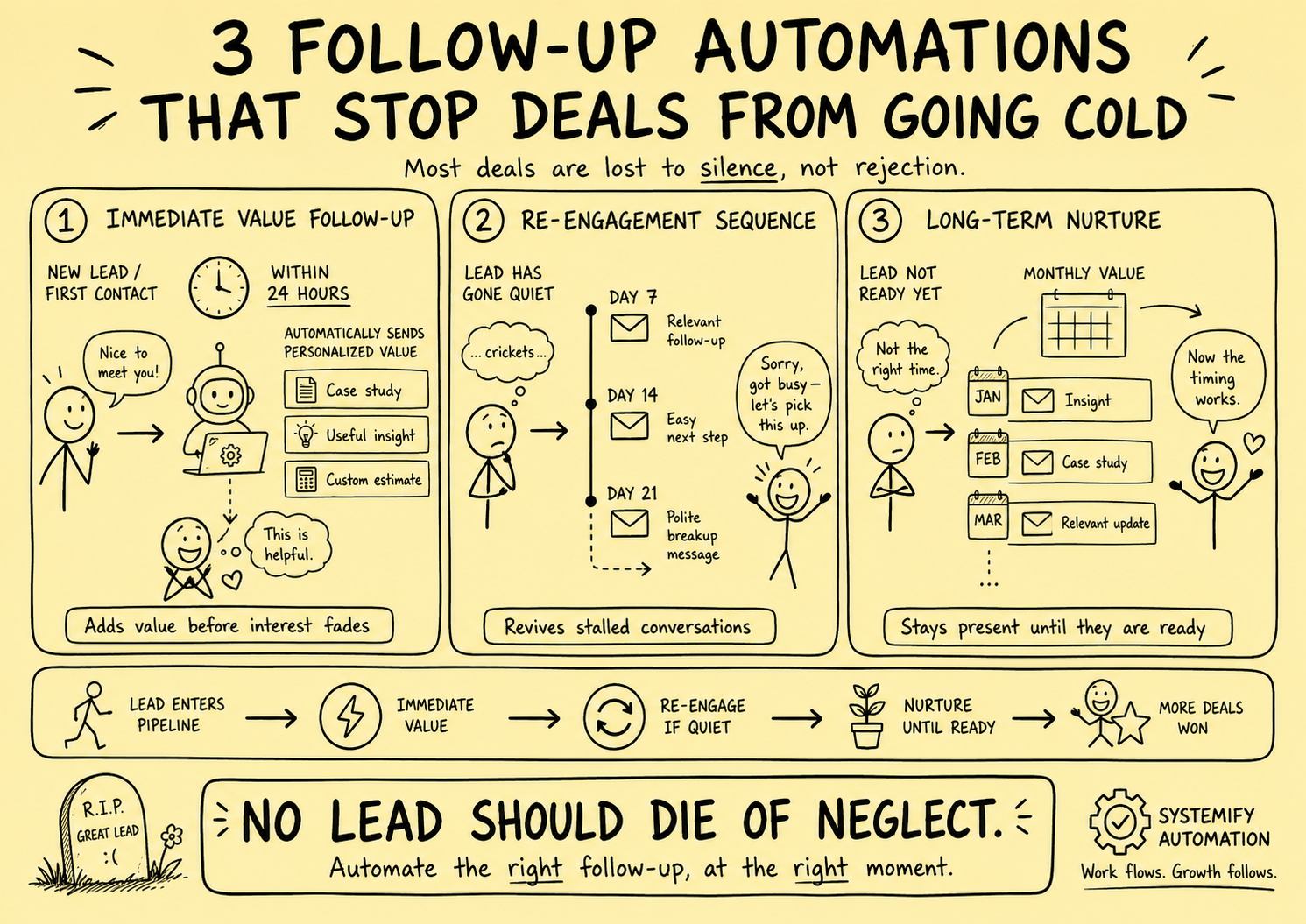
This article previously claimed most silent prospects remained interested, prescribed fixed 7-, 14-, and 21-day touches plus 6–12 months of nurture, described a “breakup” message as an urgency tactic, and promised that automation would keep every lead warm, increase close rates, and prevent opportunities from dying through neglect. Those claims and obsolete service links were removed.
Direct answer: Build three controlled workflows: fulfillment of an agreed next step, internal review of a stalled relationship, and authorized reactivation of an eligible dormant record. Make each workflow state-aware, owner-controlled, suppression-first, confidentiality-safe, idempotent, reviewable, and able to stop immediately.
This is operating guidance, not legal advice. Privacy, marketing, calling, professional, licensing, transaction, retention, and communication requirements vary by jurisdiction, channel, recipient, relationship, purpose, and data. Qualified owners should approve the actual policy.
Define the relationship state before the cadence
Time since last contact is not enough to decide what happens next.
| State | Meaning | Appropriate system behavior |
|---|---|---|
| New inquiry | A person initiated contact but identity, role, and purpose may be incomplete | Acknowledge narrowly, classify, assign, and resolve risk |
| Active seller relationship | Seller-related next step is agreed and owned | Track commitments and authorized professional follow-up |
| Active buyer relationship | Criteria or qualification work is current | Follow the approved buyer process and access controls |
| Awaiting brokerage action | The team owes a document, answer, introduction, or decision | Escalate internally before sending another request |
| Awaiting external action | A specific person agreed to provide something | Remind only within the agreed context and channel |
| Paused relationship | Contact asked to revisit later or an event must occur first | Store the condition and avoid arbitrary touches |
| Dormant but eligible | No active commitment; reviewed reactivation may be appropriate | Require current eligibility, owner, purpose, and message approval |
| Live transaction | Matter-specific process is underway | Use deal workflow, not marketing nurture |
| Closed, restricted, or suppressed | No further promotional contact is appropriate | Block queue creation and preserve the necessary evidence |
Do not use “cold,” “warm,” or “lost” as the only state. Those labels hide whether the brokerage owes the action, the recipient asked for time, a deal is confidential, or contact must stop.
Workflow 1: fulfill an agreed next step
The safest follow-up is tied to something specific that the parties already agreed.
Examples include:
- Send an approved process overview
- Request a defined document through a secure channel
- Confirm a scheduled call or meeting
- Introduce an authorized relationship owner
- Provide an approved buyer-qualification step
- Return with a professionally reviewed answer
The workflow should capture the commitment, responsible owner, due date, recipient, permitted channel, required approval, related matter, and completion evidence. If the brokerage owes the action, the system should alert and escalate internally rather than repeatedly asking the other person to respond.
A missed service commitment must not be hidden by an automated “checking in” email.
Workflow 2: review a stalled relationship
Inactivity should first create an internal decision, not an outbound message.
The review asks:
- What was the last verified interaction and agreed next step?
- Who owns the relationship now?
- Is the record a buyer, seller, adviser, referral source, or several roles?
- Did the brokerage complete its commitments?
- Is the contact identity and channel still valid?
- Is there an objection, suppression, complaint, dispute, or restriction?
- Does a live or confidential matter change access and wording?
- Is there a real event or useful reason to contact the person?
- Should the record remain active, pause, reactivate, archive, restrict, or delete?
The result can be an owner task, data-correction task, approved message draft, archival decision, or no action. Silence is not evidence of interest, rejection, urgency, or consent.
Workflow 3: reactivate an eligible dormant record
Reactivation is a new decision using old relationship context. It is not permission to replay the original campaign.
Before queueing contact, require:
- Stable identity and duplicate resolution
- Original source and relationship provenance
- Current owner and permitted purpose
- Current channel eligibility and jurisdiction logic
- Consent or other approved basis where required
- Suppression, objection, preference-service, and complaint checks
- Retention and data-quality review
- Matter and confidentiality boundary
- A truthful, relevant reason for contact
- Approved message and stop conditions
Old buyer criteria, seller intent, employment, ownership, phone numbers, email addresses, and adviser relationships may no longer be accurate. Treat historical facts as dated evidence, not current truth.
Respect preferences across every channel
The ICO guidance on respecting preferences says people can object to direct marketing, withdraw consent, or opt out, and explains why retaining limited suppression information can prevent future accidental contact. It also warns against contacting an objector later merely to ask whether they changed their mind.
The ICO B2B marketing guidance distinguishes channel and subscriber rules, discusses consent and legitimate interests, and requires attention to transparency and objections in the UK context. B2B is not a blanket exemption.
Maintain an authoritative preference record with:
- Identity and affected addresses or numbers
- Channel, topic, brand, entity, and relationship scope
- Permission or approved-basis evidence where required
- Objection, withdrawal, or opt-out source and time
- Wording or form version shown to the person
- Systems and campaigns affected
- Propagation status, failures, and reconciliation
Check it when creating a task, when queueing a message, and again immediately before sending or calling.
Keep service follow-up separate from promotion
The FTC CAN-SPAM business guide distinguishes commercial and transactional or relationship content by primary purpose and addresses sender identity, subject lines, opt-out mechanisms, prompt handling, and responsibility for vendors.
An agreed deal update, secure-document notice, or scheduled-meeting reminder should not be used as a wrapper for unrelated promotion. Conversely, calling a message “personal” or sending it one-to-one does not necessarily remove marketing obligations.
For every outbound action, record the purpose, message class, channel, recipient, rule applied, supporting evidence, sender identity, template version, and responsible owner.
Treat calling as a separate controlled channel
The FTC Telemarketing Sales Rule guide addresses telemarketing scope, disclosures, misrepresentations, entity-specific do-not-call procedures, calling practices, consent and authorization records, monitoring, and recordkeeping. Its application and exemptions are fact-specific, and other federal, state, sector, and international rules may apply.
Do not assume an email permission, historic conversation, CRM stage, or prior inquiry authorizes every type of call. Define the call purpose, mode, caller identity, number governance, time-zone behavior, suppression checks, recording policy, and escalation path separately.
Protect confidential deal context
A generic follow-up tool should not have unrestricted access to listings, buyer identities, valuation work, financial documents, data-room status, bids, negotiation positions, or adviser communications.
Before inserting matter-specific content, verify:
- Recipient identity and current role
- Relationship and deal owner
- Confidentiality agreement and access state
- Seller authorization and disclosure stage
- Minimum information necessary for the purpose
- Approved delivery channel and link controls
- Whether the information changed since approval
Send authorized users to a controlled record rather than copying sensitive details into broad notifications or ordinary nurture platforms.
Use event-based triggers with explicit evidence
Useful triggers describe a real event:
- A promised document was approved for release
- A scheduled date or recipient-requested revisit point arrived
- A buyer criterion changed and was professionally reviewed
- A seller authorized a defined next step
- A secure link is approaching expiration
- A task is overdue or an owner is unavailable
- A new, relevant opportunity passed confidentiality and fit checks
- A material record changed and invalidated a pending action
Each event should carry a unique ID, occurred-at time, source, internal record IDs, actor, previous and proposed states, policy version, and correlation ID. Make consumers idempotent so retries do not create duplicate messages, tasks, or stage changes.
Scheduled time can be one condition, but it should not be the only evidence that another contact is appropriate.
Put human approval around consequential messages
Automatic after testing may include narrow reminders that repeat an agreed date, secure-upload availability, or internal task escalation.
Human review should normally cover:
- Seller intent, readiness, or valuation language
- Buyer fit, qualification, financing, or access
- A named opportunity or confidential business fact
- Legal, tax, accounting, lending, or transaction interpretation
- Fees, engagement scope, deadlines, and commitments
- Complaints, disputes, threats, and sensitive disclosures
- AI-generated personalization based on uncertain data
The reviewer should see the source relationship, current permissions, pending objections, relevant matter, proposed message, supporting facts, and downstream actions before approval.
Stop for more than an unsubscribe
Stop or reroute a sequence when:
- The person objects, opts out, withdraws consent, or changes channel preference
- Identity, role, or recipient authorization becomes uncertain
- A complaint, dispute, privacy request, or security incident appears
- A relationship owner begins direct handling
- A meeting, document, or decision resolves the sequence’s purpose
- The brokerage owes an overdue action
- A matter becomes live, confidential, paused, closed, or restricted
- Delivery repeatedly fails or contact data is invalid
- The message would repeat without new, useful context
- Retention or policy rules no longer permit the record’s use
Do not send a “breakup” message to create false scarcity. If closing the workflow is appropriate, state that the brokerage will pause contact, explain how the person can restart it, and honor the pause.
Reconcile systems and expose failures
Preference, ownership, task, message, and deal states can diverge across CRM, email, calling, calendar, document, and workflow tools.
Reconcile for:
- Suppressed contacts with pending promotional actions
- Delivered messages without source events or approvals
- Duplicate sends from retried events
- Replies without assigned owners
- Completed meetings with active reminder sequences
- Live deals still present in generic nurture
- Overdue brokerage commitments without escalation
- Records owned by former or unavailable team members
- Confidential links sent after access changed
- Dormant records lacking provenance or retention authority
Use visible exception queues, bounded retries, alerts with accountable owners, safe replay, and documented compensating actions.
Test the complete reactivation story
Use synthetic or controlled contacts before production.
Test:
- Seller, buyer, adviser, referral, and dual-role records
- Active, paused, dormant, closed, restricted, and live-deal states
- Correct, stale, duplicate, merged, and reassigned identities
- Consent present, absent, withdrawn, expired, or outside scope
- Objection in a form, reply, call note, attachment, or free text
- Email, live call, automated call, text, and direct-message boundaries
- Agreed date, changed date, missed commitment, and owner absence
- Confidentiality granted, pending, revoked, and mismatched
- Duplicate, delayed, reordered, malformed, and missing events
- Provider outage, bounce, reply, opt-out, and partial propagation
- Approval, rejection, correction, cancellation, export, and deletion
Acceptance criteria should cover eligibility, suppression propagation, identity accuracy, unauthorized disclosures, duplicate rate, owner assignment, follow-up completion, exception detection, reconciliation lag, and recovery.
Measure relationship quality, not sequence activity
Track:
- Eligible records reviewed and reasons for no action
- Brokerage-owned commitments completed on time
- Correct relationship and matter ownership
- Preference checks, blocks, propagation, and reconciliation
- Messages proposed, approved, corrected, rejected, or canceled
- Duplicate, failed, bounced, and misrouted actions
- Confidentiality and access exceptions
- Responses classified and assigned correctly
- Accepted, qualified next steps by relationship type
- Downstream validation of buyer and seller status changes
- Complaints and time to resolution
- Reviewer workload and exception aging
Do not claim that follow-up automation independently keeps leads warm, revives deals, raises close rates, or creates transaction outcomes. It can improve continuity and make failures visible; results still depend on relationship quality, market conditions, service, judgment, timing, and other factors.
The practical conclusion
The goal is not more touches. It is fewer forgotten commitments, fewer inappropriate messages, clearer ownership, safer reactivation, and a reliable stop path.
Model relationship state before cadence. Fulfill what the brokerage owes. Review inactivity internally. Reactivate only eligible records for a current reason. Protect confidential matters. Reconcile every channel. Keep material decisions and communications under accountable human authority.
To design the surrounding workflow, review broker growth operations and operations streamlining, or request a Business Broker Pipeline & Operations Assessment.
Frequently Asked Questions
How often should a business broker follow up?
There is no universal cadence. Frequency should depend on the relationship, call or message purpose, recipient request, channel rules, current deal state, material events, urgency, service commitments, and the brokerage’s tested policy. Fixed day-based sequences can be inappropriate or excessive.
Can a broker reactivate every old buyer and seller record?
No. First validate identity, ownership, provenance, current relevance, channel eligibility, consent or other approved basis where required, objections, suppression, confidentiality, and retention. Some records should be corrected, archived, restricted, or deleted rather than contacted.
Should a quiet live deal enter a marketing nurture sequence?
No. A live transaction has matter-specific ownership, authority, confidentiality, deadlines, and professional responsibilities. Silence should create an internal review or authorized deal action, not generic marketing messages.
What should happen when someone asks not to be contacted?
Capture the exact request and scope, update the authoritative suppression or preference record, cancel pending promotional actions, propagate the change to connected systems, preserve necessary evidence, and reconcile failures. Do not send a later reactivation message asking whether the person changed their mind.
How should a brokerage measure follow-up quality?
Measure eligibility, ownership, claim accuracy, preference handling, confidentiality, accepted next steps, downstream qualification, duplicate sends, failed handoffs, corrections, complaints, and reconciliation time. Message count and reply rate alone do not establish useful or appropriate follow-up.
Sources and evidence notes
Primary or first-party materials reviewed for this article. Scope and limitations are stated rather than silently generalized.
- Respect people’s preferencesUK Information Commissioner’s Office · Accessed
Current UK guidance on recognizing objections, stopping direct-marketing processing, using suppression lists, honoring the latest preference, and not contacting an objector merely to ask whether they changed their mind.
- Business-to-business marketingUK Information Commissioner’s Office · Accessed
Current UK guidance on B2B channel distinctions, subscriber types, consent and legitimate interests, transparency, objections, preference services, and use of business-contact data.
- CAN-SPAM Act: A Compliance Guide for BusinessU.S. Federal Trade Commission · Accessed
Official U.S. guidance on commercial-email identity, subject lines, opt-out mechanisms and timing, message purpose, and responsibility for vendors sending on another company’s behalf.
- Complying with the Telemarketing Sales RuleU.S. Federal Trade Commission · Accessed
Official U.S. guidance on telemarketing scope, disclosures, misrepresentations, entity-specific do-not-call procedures, consent and authorization records, calling practices, monitoring, and recordkeeping.
Brokerage data stays governed. Material deal decisions stay human.
We design business broker systems around least-privilege access, documented data flows, protected credentials, traceable activity, and approval gates. Systemify does not use client information to train its own models. When a workflow uses an external AI provider, its purpose, data fields, and retention approach are documented and approved before client data is transferred.
Apply this to your brokerage
We can assess your buyer and seller pipeline, valuation and vetting workflows, communications, documents, controls, and handoffs before recommending what to build.
Talk to a Broker Systems Expert