
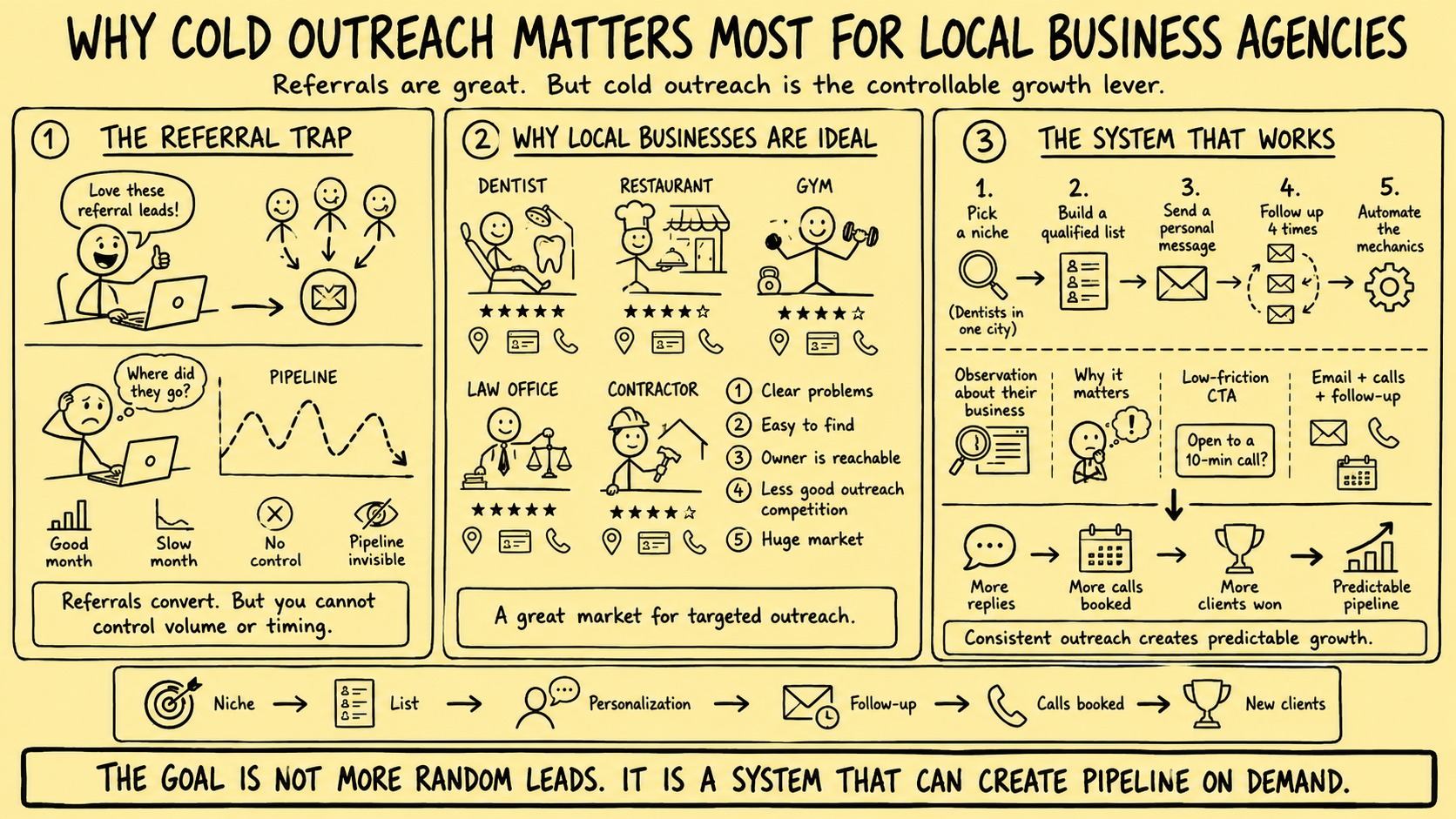
Ask the owner of a marketing agency, an SEO agency, or an automation consultancy how they get new clients, and the most common answer is: referrals.
Referrals are wonderful. They convert at high rates. They arrive pre-sold. They require minimal convincing. But they have a critical flaw that eventually becomes a crisis: you cannot control the volume or the timing.
When referrals are flowing, business is good. When they slow — when your best referral sources get busy, when your existing clients pause their spend, when the market contracts — you have no lever to pull. No way to generate pipeline on demand. No predictable path to the number of new clients you need next month.
Cold outreach is that lever. For agencies serving local businesses specifically, it is the most important growth channel available — not because it is glamorous, but because it is the only one that is fully controllable, scalable, and not dependent on what your existing clients happen to say about you to their network.
This guide explains why cold outreach is essential for local business agencies, why most agencies do it wrong, and what the system looks like when it is built correctly.
The Referral Trap
Most agencies that have been operating for three or more years are in the referral trap. They grew initially through relationships. The work was good. Clients referred friends. Business came in.
Then they hit a plateau.
Revenue is roughly flat year over year. The client base turns over — some leave, some are won — but the overall size does not grow much. The agency owner is too busy delivering to think strategically about sales. New clients come in when they come in. The pipeline is invisible.
The referral trap is comfortable until it is not. A single large client leaving can put the business in a difficult position within 90 days if there is no active pipeline to replace the revenue.
The agencies that grow consistently — that compound their client base year over year — almost always have a proactive outbound system running alongside their referral flow. Not instead of it. Alongside it.
Why Local Businesses Are an Ideal Cold Outreach Market
Local businesses — restaurants, dental practices, law firms, gyms, accountants, estate agents, contractors, med spas — have several characteristics that make them excellent cold outreach targets for agencies:
1. They have clear, identifiable problems
Most local businesses are not maximising their digital presence, their lead generation, or their customer retention. The gap between where they are and where they could be is obvious, measurable, and improvable. This makes it easy to build a relevant, specific outreach message — you are not speculating about their pain, you are observing it.
2. They are easily identifiable
Google Maps, Google Business Profile, Yelp, Facebook business pages, Angie's List — local businesses are among the most publicly indexed entities in the world. Building a highly targeted list of prospects by city, industry, and qualification criteria (reviews, website quality, ad spend, social activity) is faster and cheaper for local businesses than for almost any other market.
3. The decision-maker is accessible
At a local business, the owner or general manager makes the decision. There is no procurement department, no IT committee, no 90-day RFP process. If you reach the right person with the right message, the decision cycle is short. Many local business deals move from cold contact to signed proposal in 1–3 weeks.
4. Competition for their attention is lower than you think
Local business owners receive far less well-structured cold outreach than their enterprise counterparts. Most of what they receive is spam — poorly targeted, irrelevant, obviously templated. A genuinely personalised, relevant message stands out dramatically because the baseline quality of outreach they see is so low.
5. The market is enormous
There are over 33 million small businesses in the United States alone, millions more in the UK, Australia, and Canada. Even a narrow niche — dentists in the Southeast, restaurants in London, gyms in Manchester — contains thousands of qualified prospects. You will not run out of local businesses to contact.
Why Most Agency Cold Outreach Fails
Given all the above, why do most agencies that try cold outreach give up within a few months?
The failure is almost always in one of three areas.
1. The Message Is About the Agency, Not the Prospect
The most common cold outreach failure is an email or call that leads with what the agency does:
"Hi, I'm from [Agency]. We're a full-service digital marketing agency specialising in SEO, social media, and PPC. We work with local businesses to help them grow online. Would you be interested in a free consultation?"
The local business owner reads this and thinks: marketing solicitation, delete.
They do not think: this person might help me solve a problem I actually have.
The message that works leads with a specific observation about the prospect's situation — something you noticed about their business — and frames your outreach around that observation.
"Hi [Name], I came across [Business] on Google Maps while researching [City] [industry]. I noticed you have 47 reviews averaging 4.2 stars — strong reviews, but your profile is missing a few things that typically help similar businesses rank in the top 3 of local results. I've put together a quick overview of what those are specifically for you. Worth a look?"
This message demonstrates that you looked. It says something specific about their situation. It offers value before asking for anything. The conversion rate on this versus the generic version is not marginal — it is typically 5–10x higher.
2. The Volume Is Too Low to Generate Signal
Cold outreach requires volume to be evaluated fairly. An agency that sends 20 emails and makes 30 calls before concluding "cold outreach doesn't work for us" has not run a test — they have made a gesture.
For a local business agency, a meaningful cold outreach test looks like this:
- 200–400 personalised emails to a tightly defined target market
- 100–200 cold calls to the same or overlapping list
- A 4-step follow-up sequence for non-respondents
- 6–8 weeks of consistent execution
At this volume, with a quality message, an agency should expect to book 5–15 calls. At a 30–40% close rate on those calls, that is 1–5 new clients from a single sequence to a single market. The economics become clear quickly.
The problem is that most agencies send 20 emails, get one reply, and call it a failed channel. Volume + consistency + a quality message is the formula. Remove any one of those elements and the results disappear.
3. There Is No System — Just Sporadic Effort
The third failure mode is treating cold outreach as something you do when you have time. In practice, "when I have time" means almost never. Delivery takes over. The agency owner spends the day doing client work. Cold outreach happens in an unfocused burst every few months, produces irregular results, and never builds momentum.
Cold outreach that works is systematised. There is a defined time each week for it. There is a defined process (list building, personalisation, send, follow-up, track). There are defined metrics (reply rate, call booking rate, close rate). And for agencies that want to scale it without it consuming the founder's time, it is partially or fully automated.
The Cold Outreach System for Local Business Agencies
A properly built cold outreach system for an agency serving local businesses has five components.
Component 1: Niche and ICP Definition
The agencies with the highest cold outreach conversion rates are the ones with the most specific targeting.
"Local businesses in the UK" is not a niche. "Independent dental practices in the UK with 1–3 locations and under 200 Google reviews" is a niche.
The more specific your ICP (Ideal Customer Profile), the more relevant your message can be. The more relevant your message, the higher your reply rate. The higher your reply rate, the more conversations you have. The more conversations, the more clients.
Define your niche along these dimensions:
- Industry: What type of local business? Dental, legal, fitness, restaurants, home services, med spa?
- Geography: What city, region, or market are you targeting?
- Size indicators: Number of locations, estimated revenue range, team size
- Qualification signals: What online signals indicate they are a good fit? (Review count, website quality, ad presence, social activity)
- Disqualification signals: What signals indicate they are not a fit? (Part of a national franchise, already running sophisticated marketing, too small to afford your services)
Component 2: List Building
Once the ICP is defined, the list is built from public sources:
- Google Maps / Google Business Profile: Search for the industry in the target geography. Export names, addresses, websites, phone numbers, review counts.
- Apollo.io or Hunter.io: Find decision-maker email addresses for identified businesses
- LinkedIn: For industries where the owner maintains a LinkedIn presence
- Local business directories: Yelp, TripAdvisor, Houzz, Angie's List, Checkatrade (UK)
The list should be qualified before outreach begins. Remove franchises. Remove businesses with large marketing teams. Remove businesses that are obviously already working with an agency similar to yours. Focus the list on genuine fits.
A qualified list of 300–500 local businesses in a specific niche is worth more than a spray-and-pray list of 5,000 loosely matched contacts.
Component 3: The Personalised Message
For local business cold outreach, personalisation is not optional — it is the mechanism that produces results.
Each message should contain at least one observation specific to that business. This does not require hours of research per prospect. It requires a 60–90 second review of their Google Business Profile, their website, and their social media.
Personalisation elements that work for local business outreach:
- Review count and average rating (and what that means for their ranking)
- Website quality observation (mobile responsiveness, call-to-action clarity, page speed)
- Social media activity (or notable absence of it)
- Recent news (new location, recent reviews mentioning a specific issue, recent award)
- Competitor comparison (how they compare to the top 3 results for their keyword)
The message structure:
- Specific observation about their business (personalisation)
- Why it matters (the implication — lost leads, lost revenue, lost ranking)
- What you can do about it (brief, specific)
- Low-friction call to action (a question, not a meeting request)
Subject line for local business cold email: "[Business name] — quick question about your Google ranking" is more specific than "digital marketing for local businesses." Specific subject lines consistently outperform generic ones by 2–3x in open rate.
Component 4: The Follow-Up Sequence
Most replies come from follow-ups, not initial messages. The data consistently shows: 70–80% of email replies to cold sequences come after the first message. If you send one message and stop, you leave most of your response rate on the table.
A four-step sequence for local business outreach:
Day 1: The initial personalised email (as above)
Day 4: A brief follow-up that adds a new piece of value — a specific insight, a case study from a similar local business, a relevant statistic about their market
Day 8: A different angle — approach the conversation from a new direction. If the first email was about their Google ranking, this one might focus on their competitor's activity or a review management angle.
Day 14: A simple, direct last attempt: "I've reached out a few times about [specific issue]. Not sure if the timing is right or if this isn't relevant — happy to leave you alone either way. If it is worth a conversation, this is the easiest way to find out: [link to booking page or reply prompt]."
Each follow-up should be short. 3–5 lines. No attachments. No long explanations. The goal is to get a reply — not to replace the conversation.
Component 5: The Automated Infrastructure
For agencies serious about cold outreach at scale, manual execution of the above is a bottleneck. Every step that can be automated should be automated:
- List enrichment: Tools like Clay, Apollo, or Hunter can find and verify email addresses automatically for a list of business names and websites
- Sequence sending: Email tools like Instantly, Lemlist, or Smartlead handle multi-step sequences, follow-up timing, reply detection (stops the sequence when a prospect replies), and inbox rotation for deliverability
- CRM logging: Replies, bookings, and call outcomes automatically written to the CRM
- Post-call follow-up: When a call is booked and completed, automated sequences handle next steps based on the outcome
With automation handling the mechanics, the agency owner or business development rep focuses only on: defining the niche, writing the messages, and handling the conversations that come in. Everything else runs in the background.
This is the model that allows a solo founder or a two-person BD team to run outreach to 500–1,000 prospects per month without it consuming every working hour. Systemify's outreach automation services build this infrastructure specifically for agencies and service businesses.
The Economics of Cold Outreach for Local Business Agencies
Let us run the numbers to make the value concrete.
Assumptions:
- Target market: Independent dental practices in a major UK city
- Average client value: £500/month retainer
- Average client lifetime: 18 months
- Lifetime client value: £9,000
Outreach model:
- 400 personalised emails sent over 8 weeks
- Open rate: 45% (local businesses open rates are high — less inbox noise)
- Reply rate: 8% = 32 replies
- Calls booked: 50% of replies = 16 calls
- Close rate: 35% = 5–6 new clients
Revenue outcome:
- 5 new clients × £9,000 LTV = £45,000 in revenue from one sequence
- Cost of the sequence (time + tools): ~£1,500–£2,500
Return: 18–30x return on investment from a single 8-week sequence.
These are realistic numbers, not optimistic projections. Agencies running structured cold outreach to well-defined local business niches with quality messages consistently achieve these metrics. The agencies that do not achieve them are almost always operating without the personalisation, the follow-up discipline, or the volume.
Cold Calling Versus Cold Email for Local Business Agencies
Cold email and cold calling are not competing channels. For local business agencies, they are most effective in combination.
Cold email: Higher volume, lower friction, works at any hour, allows the prospect to respond when they have a moment. Best for the initial outreach and follow-up sequences.
Cold calling: Higher conversion from conversation to booked call. Better for qualifying prospects quickly. Effective as a follow-up to email ("I sent you a note last week about your Google ranking and wanted to follow up with a quick call").
The combination approach — email first, then call — produces better results than either in isolation. The email creates familiarity. The call benefits from that familiarity: "Oh yes, I think I saw that email" is a much easier opening than a completely cold call.
For a full breakdown of cold calling tools and how to build a calling process alongside email outreach, read: The Best Cold Calling Software in 2026: A Complete Buyer's Guide.
Starting Points for Agencies New to Cold Outreach
If your agency has not run structured cold outreach before, the most common mistake is trying to do everything at once. A cleaner starting point:
Week 1–2: Define one specific niche. Build a list of 100 qualified businesses in that niche. Write one personalised email template with a clear personalisation variable.
Week 3–4: Send the emails. Track open rates and reply rates. Do not send a second message until you have data on whether the first one is being opened.
Week 5–6: Iterate on the message based on reply data. Add a follow-up sequence. Start adding calls for the businesses that opened but did not reply.
Week 7–8: Review the full sequence performance. How many calls were booked? What was the close rate? What is the revenue outcome so far?
Week 9+: Scale what worked. Add a second niche. Automate the sequence management. Build the infrastructure to run this consistently at higher volume.
The agencies that build a cold outreach capability do so iteratively, not perfectly. The first sequence is a learning exercise. The third sequence is a revenue driver. The tenth sequence is part of a predictable growth machine.
The Compounding Effect
Here is the thing about cold outreach that does not get discussed enough: the system you build compounds.
The list-building process gets faster after the first time. The message templates improve with each iteration. The team gets better at handling incoming calls. The proposal process tightens. The close rate goes up.
And every client won through cold outreach becomes a potential referral source — adding fuel back to the channel that was your original growth driver.
Agencies that invest in cold outreach infrastructure in year two or three of their operation almost always describe the same experience: within 6–12 months, they have more consistent pipeline than they have ever had, and they are no longer anxious about where next month's clients are coming from.
That predictability — the ability to generate pipeline on demand — is the most valuable thing a growing agency can build. Cold outreach, built correctly, is how you build it.
Brokerage data stays governed. Material deal decisions stay human.
We design business broker systems around least-privilege access, documented data flows, protected credentials, traceable activity, and approval gates. Systemify does not use client information to train its own models. When a workflow uses an external AI provider, its purpose, data fields, and retention approach are documented and approved before client data is transferred.
Looking for business-broker systems?
Our current work focuses on helping business brokers build stronger buyer and seller pipelines and more controlled deal operations.
Talk to a Broker Systems Expert